There’s a reason farmers, mechanics, and ranchers have worn pull-on boots for over a century. No laces to tie in the dark. No frozen eyelets at 5am. No snag risk around machinery. You pull them on and you go.
Wellington-style pull-on work boots are the most practical daily drivers for workers who change footwear several times per shift or move between clean and dirty environments all day long. They shine in trades like farming, ranch work, mechanics, landscaping, and construction—anywhere you want easy on-off, full-shaft protection, and job-site level durability.
In this guide, we’ll walk through eight proven Wellington work boots, each picked for a specific use case (farm mud, construction on concrete, met guard sites, heavy industrial, and more). You’ll also get a fast-answer quick picks box, a decision table by job and scenario, and a buying guide so you can match the right pull-on boot to the way you actually work.
Price note: Prices listed are approximate and change frequently on Amazon. Always check current pricing on the product page before purchasing.
Best Wellington Work Boots — Quick Picks
Best Overall: Thorogood American Heritage Wellington 11″ – resoleable, USA-assembled wedge-sole Wellington for long-term industrial use.
Best Waterproof: Wolverine Floorhand 10 – fully waterproof leather with steel toe and EH rating for wet work sites.
Best for Farmers / Mud: Muck Boot Chore Classic – full rubber, 100% waterproof, built for daily mud and manure.
Best for Construction: Georgia Boot Men’s Wedge Industrial Boot – value-priced steel toe wedge for concrete and slab work.
Best with Met Guard: Ariat WorkHog XT Met Guard – rare external met guard in a pull-on western Wellington.
Best Western Style: Wolverine Raider DuraShocks Western Work Wellington – western aesthetic with shock-absorbing DuraShocks midsole.
Best for Heavy Industrial: Irish Setter Marshall Men’s 11″ – tall shaft, waterproof, steel toe for demanding outdoor work.
Best Value Pull-On: Caterpillar Revolver – steel-toe pull-on from a trusted brand at the lowest price point on this list.
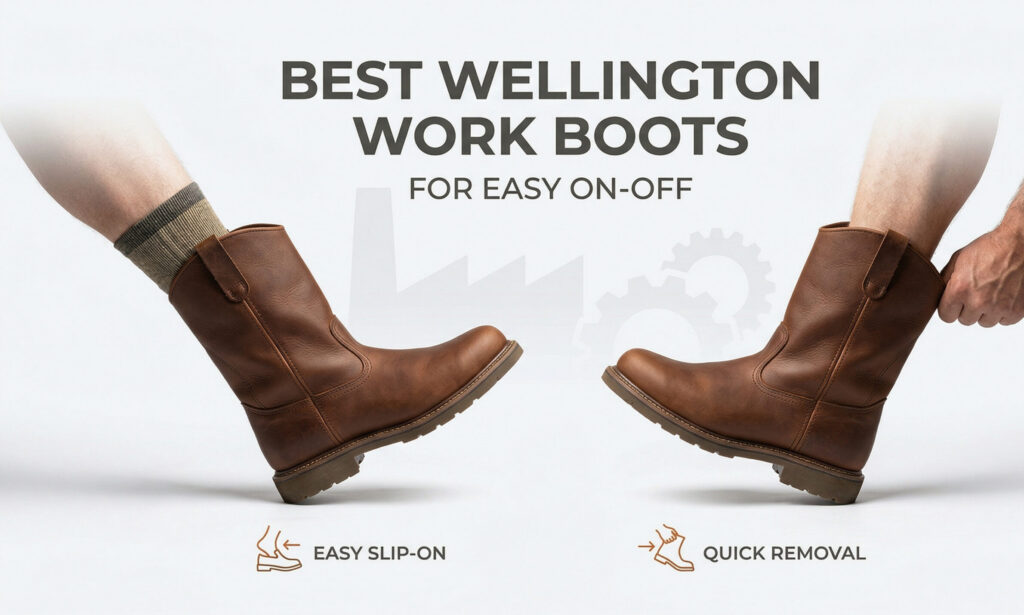
Discover the ultimate in convenience with our Wellington work boots, designed for easy on and off.
Best Wellington Work Boots for Easy On-Off — Decision Table
| Use Case | Boot | If This Is You… | Approx. Price | |
|---|---|---|---|---|
| Best overall | Thorogood American Heritage Wellington 11″ | 👉 You want a USA-made, resoleable Wellington for general industrial use. | $185–$215 | |
| Best waterproof | Wolverine Floorhand 10″ | 👉 You work in wet environments and need EH + steel toe in a pull-on. | $130–$160 | |
| Best for mud / farm | Muck Boot Chore Classic | 👉 You’re in mud, manure, or water daily and need full rubber waterproofing. | $120–$150 | |
| Best for construction | Georgia Boot Men’s Wedge Industrial | 👉 You want a wedge sole Wellington for flat-surface construction or concrete work. | $100–$130 | |
| Best with met guard | Ariat WorkHog XT Met Guard | 👉 Your site requires met guard PPE and you prefer a pull-on western style. | $180–$220 | |
| Best western style | Wolverine Raider DuraShocks Western Wellington | 👉 You want western aesthetics with DuraShocks comfort for ranch or site work. | $150–$180 | |
| Best heavy industrial | Irish Setter Marshall Men’s 11 | 👉 You need a tall shaft, steel toe, and waterproofing for demanding outdoor work. | $160–$200 | |
| Best value | Caterpillar Revolver Pull-On | 👉 You need a reliable pull-on at the lowest price on this list. | $100–$130 |
Always verify current price, safety certifications, and available sizes on the Amazon listing before purchasing.
Wellington Work Boots — Full Feature Comparison
| Boot | Toe | Met Guard | EH Rated | Waterproof | Shaft Height | Construction | Outsole | |
|---|---|---|---|---|---|---|---|---|
| Thorogood American Heritage Wellington 11″ | Steel (separate soft-toe version available) | No | Yes* (verify current listing) | No (water-resistant leather) | 11″ | Goodyear Storm Welt | MAXWear Wedge | |
| Wolverine Floorhand 10″ | Steel | No | Yes* (ASTM F2413 EH, verify) | Yes | 10″ | Cement | Rubber | |
| Muck Boot Chore Classic | None (no safety toe) | No | No | Yes — full rubber | Approx. mid-calf (varies by size) | N/A (one-piece molded) | Rubber | |
| Georgia Boot Men’s Wedge Industrial | Steel | No | Yes* (verify listing) | Yes* (waterproof version; verify) | 10″ | Cement | Wedge rubber | |
| Ariat WorkHog XT Met Guard | Steel | External | Yes* (verify listing for ASTM F2413 + Mt) | No | 11″ | Cement | Rubber lug | |
| Wolverine Raider DuraShocks Western Wellington | Steel | No | Yes* (verify listing) | Yes* (waterproof versions available) | 11″ | Cement | DuraShocks rubber | |
| Irish Setter Marshall Men’s 11″ | Steel | No | Yes* (verify listing) | Yes — UltraDry membrane | 11″ | Cement | Rubber | |
| Caterpillar Revolver Pull-On | Steel | No | No* (EH varies; verify listing) | No | 11″ | Cement | Rubber |
*Certifications can vary between production runs. Always confirm ASTM, EH, and waterproof status on the current product description before ordering.
What Makes a Boot a Wellington?
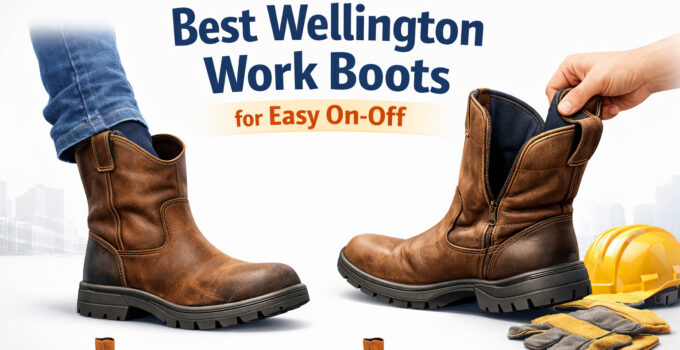
A true Wellington work boot is defined first by its pull-on design. There are no laces and no zippers—just a straight shaft that slides on and off with the help of pull tabs or a notched heel so you can get out the door fast.
Most Wellingtons use a tall shaft, typically around 10–12 inches, to protect your lower leg from mud, debris, chemicals, and splash when you’re working in rough or dirty environments. You’ll find them in both leather versions for industrial and construction work and full-rubber builds for farm and heavy wet conditions.
The style was originally military footwear, then adopted by farmers and ranchers because the no-lace, tall-shaft design is so practical for field work. Compared to cowboy boots, Wellingtons usually have a straighter, lower heel, a rounder toe box for natural foot position, and a shaft that’s cut straight across instead of scalloped and decorative.
Why Pull-On Boots Make Sense for Your Job
Workers choose Wellington pull-on boots for simple, real-world reasons. Speed is the big one: you can pull them on in 10 seconds without a lacing routine, which matters when you’re heading to the barn before sunrise or swapping footwear mid-shift.
They also remove lace snag risk around moving machinery, equipment, and farm gear, where loose laces are a genuine safety hazard. Rubber Wellingtons are especially easy to clean, since you can hose them off in seconds instead of digging mud out of eyelets and grommets.
For mechanics, farmers, and tradespeople who move between clean and dirty spaces several times per day, that easy on-off means less friction and more compliance with site rules. The honest trade-off is fit: pull-on boots don’t give you the same ankle adjustment that a lace-up does, so if you have very narrow or very wide feet, or you live on ladders and scaffolds, a lace-up work boot will lock your foot down more precisely.
How We Chose These Wellington Work Boots
Every boot on this list had to prove that its pull-on design actually works in real conditions. That started with evaluating pull-tab quality, shaft stiffness, and heel clearance—details that determine whether you can slide them on quickly or end up fighting them at the truck tailgate.
We then screened by safety certifications based on manufacturer and retailer listings, focusing on ASTM F2413 toe protection, electrical hazard (EH) ratings, and met guard coverage where applicable. Shaft height and coverage had to match the intended use case, whether that’s ankle-deep mud on a dairy farm or flat-surface concrete in a plant.
Waterproofing type (full rubber, membrane, or treated leather), outsole grip on wet and dry surfaces, and welt or cement construction all factored into durability expectations. Comfort for full-shift standing and walking, break-in profile, price-to-lifespan value, and consistent buyer feedback rounded out the selection criteria. Boots with repeated complaints about difficult pull-on or premature failures were either excluded or clearly flagged in the review.
Best Wellington Work Boots for Easy On-Off: Reviewed
Thorogood American Heritage Wellington 11″ — Best Overall
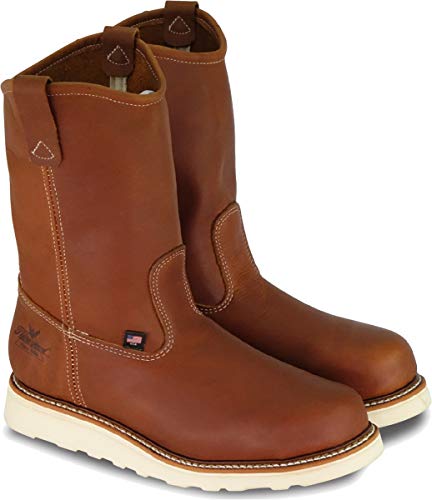
Verdict: A USA-assembled, Goodyear-welted Wellington that trades a longer break-in for multi-year durability and resoleability.
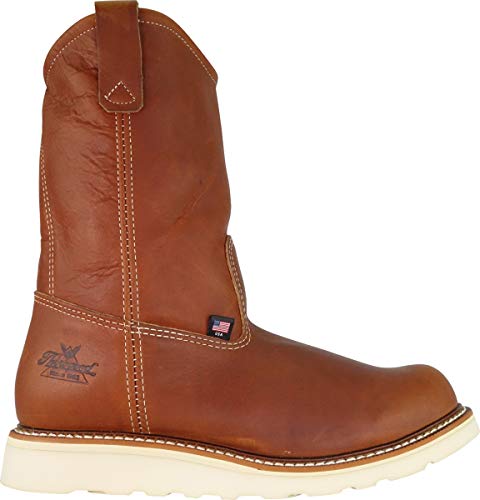
Why This Boot Stands Out: The American Heritage Wellington is the rare pull-on work boot that behaves like a long-term investment rather than a disposable purchase. The Goodyear Storm Welt construction means you can resole the boot when the tread wears down, instead of throwing the entire boot away.
Thorogood pairs that welt with their MAXWear Wedge outsole, which puts more rubber in contact with flat surfaces for soft, slip-resistant comfort on concrete and plant floors. Inside, the Ultimate Shock Absorption footbed on a Poron cushion stack provides serious underfoot comfort for long shifts, not just a thin foam insole.

In real-world use, this is the Wellington that industrial workers and tradespeople reach for when they want something that will go 4–5 years with periodic resoles instead of constantly buying new cemented boots. The oil-tanned American leather is naturally weather-resistant, so it shrugs off light rain and surface moisture even without a full waterproof membrane.
The trade-off is that the leather starts stiff and the fit runs on the snug side, especially for wider feet. Break-in takes a week of regular wear, and the wedge sole is not the best option for heavy ladder use, since it doesn’t lock into rungs the way a defined heel does.

- Key Specs: Steel toe version available; ASTM F2413 I/C and optional EH on specific models (verify listing). Approx. 11″ shaft. Goodyear Storm Welt construction. MAXWear Wedge outsole. Dual pull tabs for easy on-off.
- Pros: Resoleable Goodyear welt for long lifespan; USA-assembled with high-quality leather; wedge sole comfort on concrete; serious underfoot shock absorption.
- Cons: Not fully waterproof for standing water; runs narrow for wide feet; wedge sole not ideal for ladder-focused work.
❌ Skip This Boot If: You need full waterproofing for daily mud or standing water, or you have wide feet and want an easy, out-of-the-box fit.
Wolverine Floorhand 10″ Wellington — Best Waterproof

Verdict: A fully waterproof, steel-toe Wellington that delivers big-ticket safety certifications at a mid-range price.

Why This Boot Stands Out: The Floorhand 10″ is built for workers who live in wet conditions but still need full ASTM-rated protection. Its waterproof full-grain leather upper and sealed construction keep water out not just at the surface, but also along seams and flex zones that cheaper boots often miss.
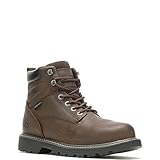
Inside, a moisture-wicking mesh lining helps manage sweat on warm, damp days, while the removable full-cushion footbed provides decent underfoot comfort that you can easily upgrade with an aftermarket insole. This combination of waterproofing, steel toe, and electrical hazard rating is hard to find at this price point.

On real job sites, the Floorhand has earned a reputation as a reliable all-rounder for landscaping crews, outdoor maintenance workers, and anyone who encounters wet grass, puddles, or light standing water throughout the day. Reinforced pull tabs help prevent the all-too-common failure point where cheaper Wellingtons rip out after a few months.
The main limitations come from its cement construction and stock insole. Since you can’t resole the boot, you should plan on a 12–18 month service life under heavy daily use. The factory insole can pack down faster than ideal for heavier workers, so many users drop in an upgraded insert after break-in.
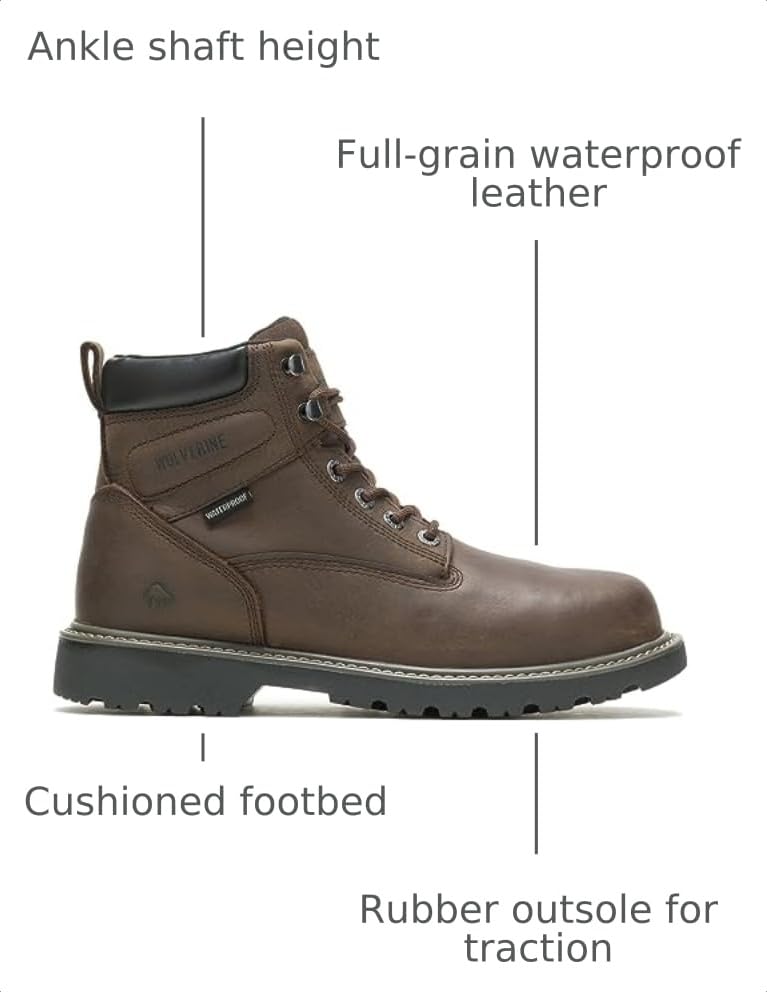
- Key Specs: Steel toe; ASTM F2413-18 M/I/C/EH certified (confirm on listing). Waterproof full-grain leather upper. Approx. 10″ shaft. Cement construction with rubber outsole. Dual pull tabs.
- Pros: Full waterproofing in a leather Wellington; comprehensive safety certifications at a fair price; reinforced pull tabs; good all-weather versatility.
- Cons: Not resoleable; stock insole may need early upgrade; sizing can run slightly large.
❌ Skip This Boot If: You want a boot you can resole for 4–5 years of use—go with the Thorogood Heritage instead.
Muck Boot Chore Classic — Best for Farm / Mud
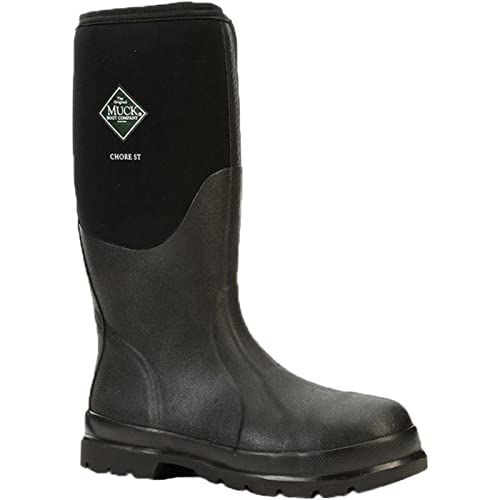
Verdict: The farm-standard full rubber boot for daily mud, manure, and standing water when you don’t need a safety toe.
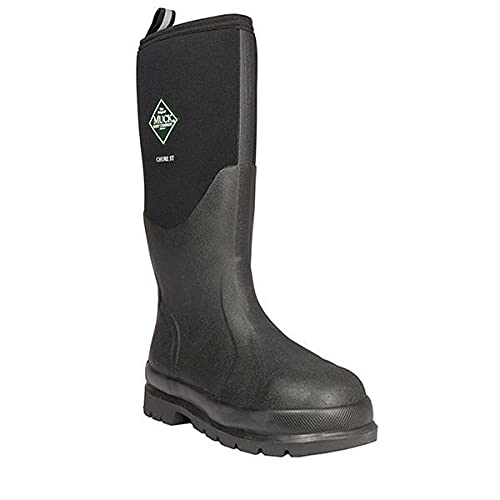
Why This Boot Stands Out: The Chore Classic is built from the ground up for agricultural life. Its full rubber construction and neoprene upper create a 100% waterproof barrier with no leather seams or membranes to fail after repeated flexing in mud and muck.

Because the boot is molded rather than stitched, you get consistent waterproofing up the shaft and around the ankle where leather Wellingtons tend to eventually leak. The neoprene lining adds warmth and flexibility, making the boot easier to pull on and off even when it’s cold out.

On actual farms, dairy operations, and livestock facilities, the Chore Classic has become a go-to because it is quick to rinse off, resists manure and common agricultural chemicals better than leather, and offers enough flex in the shaft to walk comfortably through sticky ground. You don’t fight with eyelets or caked laces—just slip out, spray clean, and you’re done.
The compromise is that there’s no steel toe or ASTM certification, so it won’t meet code on construction sites or industrial plants that require safety toes. The rubber outsole is also less cushioned on bare concrete than a dedicated work boot midsole, so it’s best for mixed ground rather than pure warehouse floors.
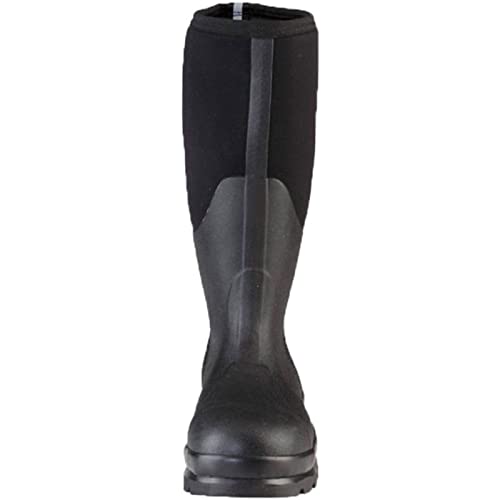
- Key Specs: No safety toe; no ASTM F2413 rating. Full rubber and neoprene construction. Waterproof to shaft height. Rubber outsole optimized for soft ground. Pull-on with no separate tabs needed.
- Pros: 100% waterproof in real farm conditions; extremely easy to clean; flexible shaft for fast on-off; proven track record in mud and manure.
- Cons: No steel toe or EH rating; less comfortable for all-day concrete work; not a leather feel or appearance.
❌ Skip This Boot If: Your job site requires ASTM-certified toe protection or you spend most of your time on hard concrete floors.
Georgia Boot Men’s Wedge Industrial Boot — Best for Construction

Verdict: A value-priced steel-toe Wellington with a wedge sole that’s tailored to concrete, slab, and flat industrial surfaces.

Why This Boot Stands Out: Georgia’s wedge industrial Wellington targets construction workers who want a flat, pressure-distributing sole underfoot instead of a pronounced heel. On concrete and shop floors, that wedge design spreads out impact and reduces hotspots on the ball and heel of your foot.

This model gives you steel toe protection and waterproof construction at a lower price than many big-name competitors in the same category. The toe box is a bit wider than some rivals, which allows your toes to splay more naturally during long shifts when feet swell and arches fatigue.

In practice, it behaves like a no-nonsense workhorse: not the flashiest leather or the plushest cushioning, but a boot that holds up better than most budget options under heavy construction abuse. Many workers add a quality aftermarket insole to turn it into a solid all-day concrete boot.
The downsides are familiar for cement-constructed Wellingtons. You can’t resole them, so you’re realistically looking at 12–18 months of hard use before retirement. The wedge sole also isn’t ideal for ladder-focused jobs, since it doesn’t hook into rungs like a defined heel would.

- Key Specs: Steel toe; ASTM F2413 I/C and likely EH (confirm listing). Waterproof construction options (verify). Approx. 10″ shaft. Cement construction. Wedge rubber outsole.
- Pros: Strong price-to-feature value; wedge sole tailored to concrete; steel toe plus waterproofing in a pull-on package; roomier toe box.
- Cons: Not resoleable; stock insole is basic; wedge sole not the best for ladder work or rough, uneven terrain.
❌ Skip This Boot If: You’re on ladders constantly or working primarily on rocky, uneven ground where a defined heel performs better.
Ariat WorkHog XT Met Guard — Best with Met Guard

Verdict: A heavy-duty, western-style Wellington that brings external met guard protection to workers who still want pull-on convenience.
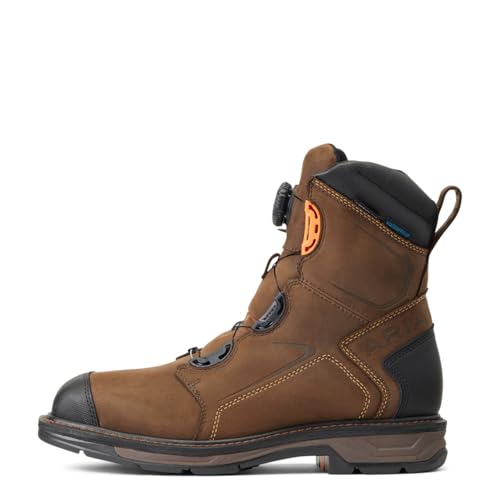
Why This Boot Stands Out: Most met guard boots are lace-ups, which makes the WorkHog XT Met Guard stand out immediately. Ariat manages to integrate an external metatarsal guard into a pull-on design, giving you top-of-foot impact protection without sacrificing the easy on-off that Wellington wearers love.

Underfoot, Ariat’s ATS (Advanced Torque Stability) midsole is tuned for long-shift fatigue resistance, using multiple layers to stabilize your foot and reduce strain in your knees and lower back. The western-influenced last will feel familiar if you’ve worn Ariat’s cowboy or hybrid work boots before.

In heavy industrial settings, especially foundries, steel mills, and pipefitting environments with met guard PPE requirements, this boot fills a rare niche: full safety coverage plus pull-on ease. It’s built with thick leather and a substantial rubber lug outsole for traction on rough, dirty surfaces.
The price for that protection is extra bulk and weight compared to standard Wellingtons, along with slightly more effort required to slide the boot on because the met guard affects the top-of-foot geometry. It’s also not fully waterproof in its standard configuration, so it’s best for dry or only moderately wet sites.
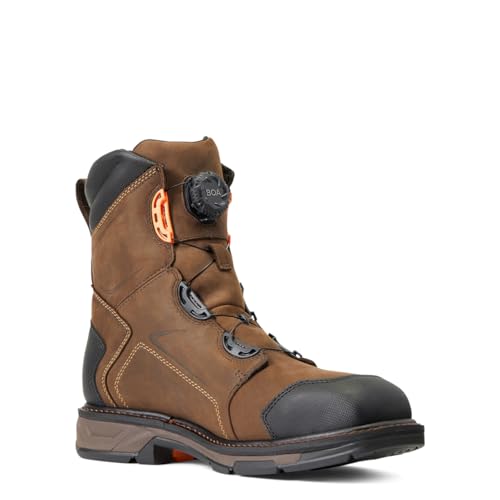
- Key Specs: Steel toe with external met guard; ASTM F2413 I/C/Mt and EH on many models (verify current listing). Approx. 11″ shaft. Cement construction. Rubber lug outsole. Dual pull tabs.
- Pros: Rare pull-on boot with met guard; ATS midsole for serious comfort; western styling many workers already like; built for heavy industrial use.
- Cons: Heavier than non-met-guard Wellingtons; not fully waterproof; pull-on can feel tighter due to met guard shape.
❌ Skip This Boot If: Your site doesn’t require met guard PPE—you’re adding weight and complexity you don’t need.
Wolverine Raider DuraShocks Western Work Wellington — Best Western Style
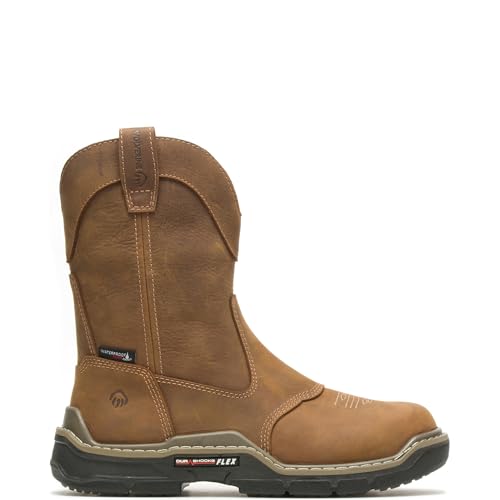
Verdict: A western-styled Wellington with DuraShocks cushioning for ranch and site work where you want cowboy looks but work-boot protection.
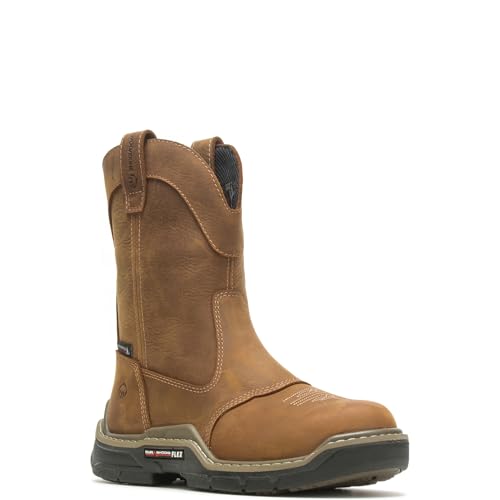
Why This Boot Stands Out: The Raider DuraShocks Western Wellington takes Wolverine’s well-known DuraShocks SR shock-absorbing midsole and wraps it in a western silhouette. You get the squared-off western look with stitching and a defined heel, but underneath it’s a serious work boot.

DuraShocks technology uses multiple layers and special compounds to dampen impact, which you really feel on hard barn floors, concrete cattle facilities, or shop surfaces after several hours. Paired with a steel toe and slip-resistant rubber, it bridges the gap between cowboy boot aesthetics and job-site performance.

For ranch workers and tradespeople in western states, this boot often feels “right at home” visually while still passing safety checks where steel toes and EH ratings are required. Heavy-duty nylon pull loops are another practical touch; they stand up better to daily on-off cycles than thin leather tabs.
The defined western heel does limit ladder performance in some scenarios, and like most cement-constructed Wellingtons, you can’t resole it once the outsole wears down. The style itself may also be a mismatch for very formal or uniformed industrial environments that expect a more standard work boot look.
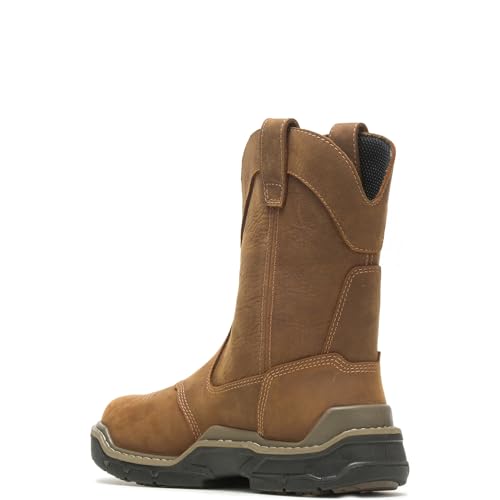
- Key Specs: Steel toe; ASTM F2413 and likely EH-rated (confirm listing). Approx. 11″ shaft. Cement construction. DuraShocks rubber outsole. Western styling with nylon pull loops.
- Pros: Western look with real work-boot protection; DuraShocks significantly improves all-day comfort; durable pull loops; good option for ranch and farm trades.
- Cons: Not resoleable; heel shape not ideal for all ladder work; styling may not fit every workplace.
❌ Skip This Boot If: You need a resoleable, “traditional” work boot look or your workplace frowns on western-style footwear.
Irish Setter Marshall Men’s 11″ — Best for Heavy Industrial

Verdict: A tall, waterproof, steel-toe Wellington tailored to serious outdoor industrial work in wet, muddy, and variable terrain.
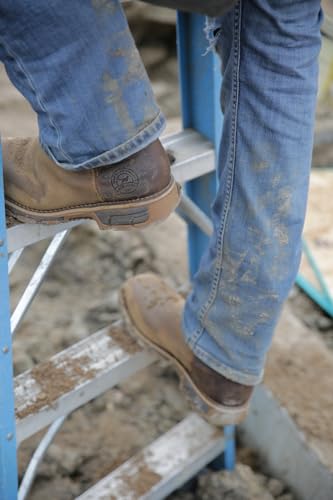
Why This Boot Stands Out: The Marshall’s calling card is coverage. Its 11″ shaft rises higher than many competing Wellingtons at similar price points, shielding more of your lower leg from mud, wet grass, and debris when you’re working outside.
Irish Setter uses its UltraDry waterproofing system—a dedicated membrane layered inside the nubuck leather upper—to keep your feet dry in sustained wet conditions. This approach tends to hold up better over time than simple surface waterproofing, especially around flex points and seams.

For linemen, utility workers, outdoor construction crews, and farm or ranch workers who spend long days in wet fields or sites, that combination of height, waterproofing, and steel toe gives the Marshall a clear edge. The removable PU insole offers solid initial cushioning and can be swapped once it compresses.
On the downside, the extra shaft height and waterproof layers add weight compared to a basic leather Wellington. As a cement-constructed boot, it can’t be resoled, and the nubuck leather needs more regular maintenance to keep water beading and prevent premature drying or cracking.
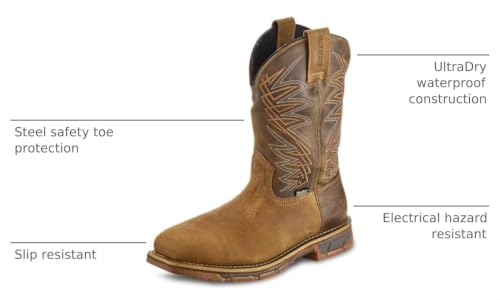
- Key Specs: Steel toe; ASTM F2413 I/C and EH on most variants (verify listing). UltraDry waterproof membrane. Approx. 11″ shaft. Cement construction. Rubber outsole. Pull tabs at the top of the shaft.
- Pros: Taller shaft for better leg coverage; membrane waterproofing for real wet-weather performance; steel toe and safety ratings; comfortable out of the box.
- Cons: Heavier than shorter Wellingtons; needs leather care to maintain waterproofing; not resoleable.
❌ Skip This Boot If: You work mostly indoors on flat concrete and don’t need the extra shaft height or full membrane waterproofing.
Caterpillar Revolver Pull-On — Best Value
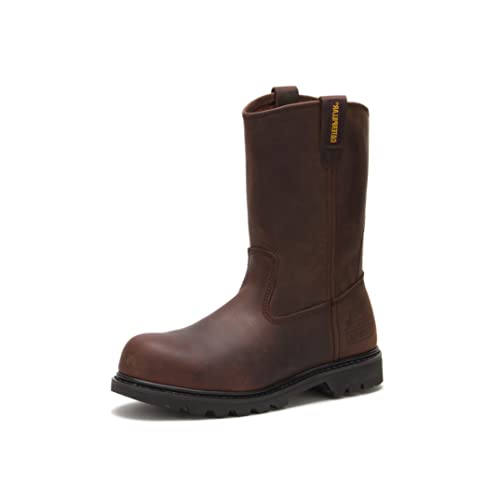
Verdict: A budget-friendly steel-toe pull-on from a major brand that covers the basics without dipping into risky no-name territory.
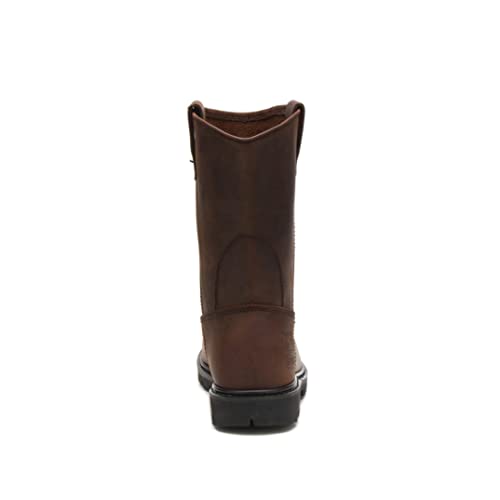
Why This Boot Stands Out: The Revolver hits an attractive price point for anyone on a tight boot allowance or buying their first pair of steel-toe pull-ons. You get CAT branding, which generally means more predictable quality and warranty support than unbranded bargain boots at similar prices.

The design leans western, which helps the boot slide on and off quickly for users who prefer a step-in feel to tugging on tabs. An oil-resistant rubber outsole keeps traction reasonable on greasy shop and industrial surfaces.

In the real world, apprentices, new hires, and budget-conscious workers often choose the Revolver because it lets them meet basic safety requirements without overspending. It’s also a good backup pair for muddy or rough conditions where you don’t want to risk your primary “good” boots.
What you give up at this price are premium comfort and long-term durability. The basic insole almost always benefits from an aftermarket upgrade, and cement construction means you’ll probably retire these after 12–18 months of heavy use. Waterproofing is limited, and EH certification may vary between models and production runs.
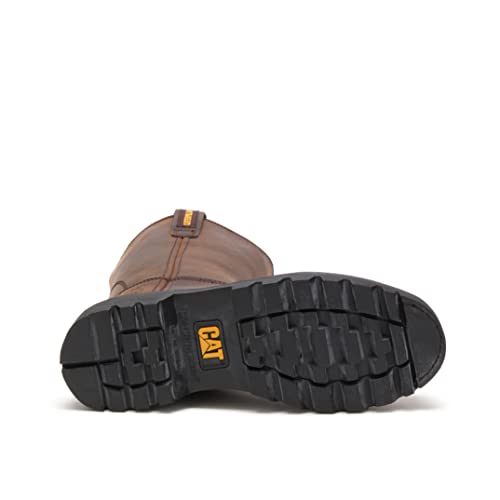
- Key Specs: Steel toe; check current listing for ASTM F2413 and EH status. Approx. 11″ shaft. Cement construction. Oil-resistant rubber outsole. Western-style pull-on design.
- Pros: Lowest price on this list with steel toe; reputable CAT branding; quick on-off western entry; decent starter or backup boot.
- Cons: Limited waterproofing; comfort is basic out of the box; safety certifications can vary; not resoleable.
❌ Skip This Boot If: You need reliable, fully documented waterproofing or rock-solid EH certification—verify the specs carefully before you buy.
Best Wellington Boot by Job and Environment
| Scenario | Best Pick | Why It Fits |
|---|---|---|
| Dairy farm / livestock / mud daily | Muck Boot Chore Classic | Full rubber build is 100% waterproof, wipes clean fast, and handles manure and farm chemicals better than leather. |
| Construction / concrete plant floors | Georgia Boot Wedge Industrial or Thorogood Heritage Wellington | Wedge soles distribute pressure evenly on concrete, reducing fatigue over long shifts. |
| Wet outdoor work / landscaping | Wolverine Floorhand 10″ | Waterproof leather plus steel toe and EH rating for safe work in wet grass, puddles, and light standing water. |
| Refinery / met guard required | Ariat WorkHog XT Met Guard | One of the few pull-ons with a true external met guard that can meet strict PPE rules. |
| Ranch / farm / western trades | Wolverine Raider DuraShocks Western Wellington | Western styling plus DuraShocks cushioning for long ranch days on hard ground. |
| Heavy industrial outdoor | Irish Setter Marshall 11″ | Tall shaft and UltraDry waterproofing protect against mud, wet grass, and rough outdoor terrain. |
| Apprentice / boot allowance | Caterpillar Revolver | Steel toe pull-on from a known brand at the lowest price on this list. |
| Long-term investment (4–5 year boot) | Thorogood American Heritage Wellington | Only resoleable Goodyear-welted Wellington here, often cheaper over time than multiple cemented pairs. |
How to Choose the Right Wellington Work Boot
Leather vs Rubber Wellingtons
When you shop Wellington work boots, you’re really choosing between leather and rubber. Leather Wellingtons use full-grain or nubuck uppers and are ideal for construction, industrial plants, and mixed farm work where you spend a lot of time on hard surfaces and may need ASTM certifications.
Rubber Wellingtons, like the Muck Boot Chore Classic, are 100% waterproof and shine in mud, manure, chemical exposure, and standing water. They’re faster to rinse clean and don’t require leather conditioning, but usually don’t carry safety toe or EH ratings.
The simple rule: if your day is mostly mud, water, or agricultural chemicals, rubber wins. If you’re on concrete, steel grating, or mixed indoor/outdoor industrial surfaces—and especially if your site requires a safety toe—go with leather.
Shaft Height — 10″ vs 11″ vs 12″+
Shaft height matters more than most buyers think. A 10″ shaft is the standard Wellington height and works well for general construction and industrial applications, with enough coverage for splash and moderate mud.
Moving up to an 11″ shaft adds extra leg protection, which is helpful for farm work, outdoor industrial jobs, and deeper mud or wet grass where a shorter boot leaves you exposed. Boots above 12″ become more specialized, offering maximum coverage at the cost of extra weight and slightly more effort to pull on.
For most workers, 10–11 inches is the sweet spot. Only go taller if you’re routinely in conditions where mud, water, or debris regularly rises above your ankle.
Safety Certifications
On regulated job sites, safety ratings are non-negotiable. The core standard is ASTM F2413 for protective footwear, which defines impact and compression resistance for safety toes and other protections.
Look for I/C ratings for impact and compression, EH (electrical hazard) for environments where you might encounter live circuits, and Mt for metatarsal protection when your PPE rules require a met guard. Only the Ariat WorkHog XT on this list brings a met guard to a pull-on design.
“Waterproof” labeling can mean different things: some boots use a full membrane (like UltraDry or similar systems), others rely on treated leather and sealed seams. Membrane-based designs tend to hold up better for all-day wet exposure than simple surface treatments.
Welt Construction vs Cement Construction
Most Wellington work boots use cement construction, where the outsole is glued directly to the upper. This makes the boot lighter and keeps costs down, but usually means the boot can’t be resoled and has a shorter ultimate lifespan.
Goodyear welt construction, as used on the Thorogood American Heritage, stitches the upper to a leather welt and then to the sole. This adds weight and cost upfront but dramatically improves durability and makes resoling straightforward.
If you plan to wear your boots hard for years, a welted boot plus a couple of resoles can actually be cheaper over time than buying multiple cemented pairs that you throw away when the tread is gone.
Pull-On Ease — What Actually Matters
Not every boot labeled “pull-on” is equally easy to get into. Pull tab quality matters; heavy-duty nylon or reinforced leather tabs hold up far better than thin loops that rip out after a few months.
Shaft stiffness is another factor. New leather Wellingtons are often stiff for the first week, so expect a real break-in period before on-off feels truly “easy.” Shaft width and heel clearance also play big roles—narrow shafts and tight heel counters may require a boot jack or shoehorn at first.
If you want the easiest possible experience, consider slightly wider shafts or rubber/neoprene designs for farm work. For leather Wellingtons, using a boot jack protects the heel counter and makes daily on-off much faster during break-in.
Wellington Boots vs Cowboy Boots
Many workers new to pull-on boots confuse Wellingtons with cowboy boots, but they’re built for different jobs. Wellingtons generally use round or square toes, low 1–1.5″ heels, and straight-cut shaft tops, focusing on industrial and farm function.
Cowboy boots tend to have more pointed toes, higher 1.5–2.5″ riding heels, and decorative scalloped or pointed shaft tops designed for ranch work and dress. Safety toes and waterproof membranes are more common in Wellingtons, while cowboy boots often prioritize style and riding performance over industrial specs.
If your primary environment is a job site or industrial setting with PPE rules, you’re usually better off with a Wellington that’s specifically built and certified for work.
Wellington Work Boots — Common Questions
What is the difference between Wellington boots and cowboy boots?
Wellington boots use a round or square toe, a low heel, and a straight-cut shaft top aimed at industrial and farm work. Cowboy boots have a more pointed toe, a higher riding heel, and decorative scalloped shafts designed for ranch and dress use. Both are pull-on, but Wellingtons prioritize work-site practicality while cowboy boots lean into western style.
Are Wellington work boots good for construction?
Yes—leather Wellingtons with steel toes and EH ratings work very well for flat-surface construction, concrete slabs, and plant floors. Wedge-sole models like the Thorogood Heritage and Georgia Boot Wedge Industrial are especially well suited to concrete because they spread pressure across the entire sole. The only trade-off is reduced ankle adjustment compared to lace-ups, which matters if you’re constantly on ladders or scaffolding.
Can Wellington work boots be waterproof?
Wellington boots can absolutely be waterproof. Rubber models such as the Muck Boot Chore Classic are 100% waterproof by design, with no leather seams to fail. Leather Wellingtons achieve waterproofing with either a full membrane system or sealed, treated leather; full membranes typically perform better when you’re in steady rain, slush, or standing water for hours.
How do you break in a leather Wellington work boot?
The best approach is gradual. Wear your new leather Wellingtons for a few hours a day for the first week instead of jumping straight into a 12-hour shift, and use a boot jack to help with removal so you don’t crush the heel counter. After several wears, apply a light leather conditioner to soften the upper and let it mold to your foot over 5–7 working days.
Are pull-on work boots safe for job sites?
Pull-on work boots are as safe as lace-ups when they carry the same certifications. Safety comes from meeting ASTM F2413 standards for impact, compression, and other hazards—not from having laces or not. As long as your Wellington has the required I/C, EH, and met guard ratings for your site, the pull-on design won’t hold you back.
How long do Wellington work boots last?
Lifespan depends on construction and use. Cemented Wellingtons typically give 12–18 months under heavy daily work before the soles are done. Goodyear-welted Wellingtons like the Thorogood Heritage can deliver 4–5 years or more with one or two resoles. Rubber farm boots often last 2–4 seasons depending on exposure to chemicals, sunlight, and how well you clean and store them.
What are the best Wellington boots for wide feet?
Models with naturally roomier lasts or neoprene/rubber shafts tend to work best for wide feet. The Muck Boot Chore Classic and many western-inspired Wellingtons, such as some Wolverine Raiders, often accommodate wide forefeet better than narrow, dressier lasts. Always look for explicit wide-width options (e.g., EE, EEE) and avoid narrow-running designs if you know you need extra room.
Muck boots vs leather Wellington boots — which should I choose?
Choose Muck-style rubber boots if your main hazards are mud, standing water, manure, or farm chemicals and you don’t need a safety toe. Pick leather Wellingtons if you need ASTM-certified toe protection, work on hard surfaces, or need one boot that can handle both indoor and outdoor environments. Many farmers and ranchers end up owning both: rubber for the worst days and leather for mixed-duty work.
Final Verdict: Best Wellington Work Boots for Easy On-Off
| Boot | Best For | Amazon Link |
|---|---|---|
| Thorogood American Heritage Wellington 11″ | Best overall / long-term investment | View on Amazon |
| Wolverine Floorhand 10″ | Best waterproof leather Wellington | View on Amazon |
| Muck Boot Chore Classic | Best for farmers and deep mud | View on Amazon |
| Georgia Boot Men’s Wedge Industrial | Best for construction and concrete | View on Amazon |
| Ariat WorkHog XT Met Guard | Best pull-on with met guard | View on Amazon |
| Wolverine Raider DuraShocks Western Wellington | Best western-style Wellington | View on Amazon |
| Irish Setter Marshall Men’s 11″ | Best for heavy outdoor industrial | View on Amazon |
| Caterpillar Revolver Pull-On | Best value steel-toe pull-on | View on Amazon |
The best pull-on work boot is the one you’ll actually put on every morning without thinking about it. Wellington boots have earned their place in the trades, on farms, and in industrial work for over a century—not for how they look, but for how fast they get you moving.
If you match your boot choice to your environment—mud versus concrete, safety certifications versus flexibility—you’ll end up with a Wellington that saves you time every day and holds up to the way you really work.
Ready to upgrade your pull-on work boots? Use the quick picks and scenario table above to zero in on the right Wellington for your job, then check current pricing and certifications on Amazon before you buy.