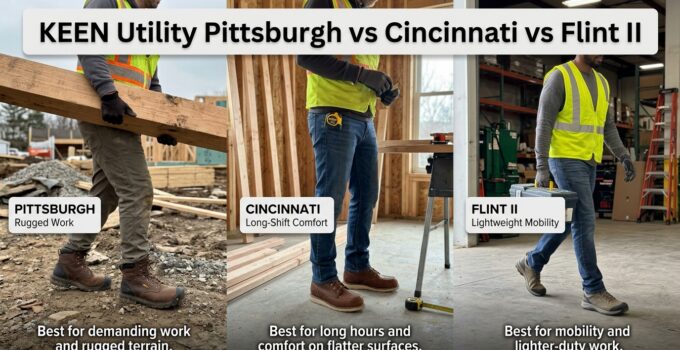
KEEN Utility makes more than 30 work boot models. Three of them account for the majority of repeat purchases, the most Amazon reviews, and most of the “which KEEN should I get?” questions in trades forums. The Pittsburgh, the Cincinnati, and the Flint II are not the same boot aimed at the same buyer with minor variations. They solve different problems on different surfaces for different types of workers.
The Pittsburgh is a traditional heeled lug-sole work boot — built for outdoor terrain, mixed surfaces, and ladder work. The Cincinnati is a wedge-sole boot with Goodyear welt construction and KEEN’s best midsole system — built for concrete, flat surfaces, and high step-count trades. The Flint II (Women’s Low reviewed here) is a lightweight, low-cut work shoe with a hiking-inspired design — built for mobility and lighter-duty industrial environments where ankle coverage is less critical than agility.
This article puts all three side by side: sole type, midsole technology, construction, toe type, and exactly which buyer each one is right for. All three are available on Amazon.
Note on the Flint II: The Women’s Flint II Low is a low-cut work shoe, not a 6-inch boot. The Pittsburgh and Cincinnati are both 6-inch mid-cut boots. This matters — if you need ankle coverage, the Flint II Low is not the right comparison for you. The article covers when this distinction matters and when it doesn’t.
The 30-Second Answer
| Boot | Sole Type | Best Surface | Toe Type | Construction | Best For |
|---|---|---|---|---|---|
| Pittsburgh 6″ | 90° heeled lug | Outdoor, uneven, ladders | Steel (ASTM F2413) | Cement | Mixed terrain, outdoor trades, ladder work |
| Cincinnati 6″ Wedge | Wedge + hybrid lug | Concrete, flat surfaces | Composite/carbon fiber (ASTM F2413) | Goodyear welt | Concrete workers, carpenters, high step-count shifts |
| Flint II Low (Women’s) | Flat siped rubber | Flat indoor, warehouse | Steel (ASTM F2413) | Cement | Women in lighter-duty industrial, mobility-first roles |
KEEN Technology Systems — What Powers Each Boot
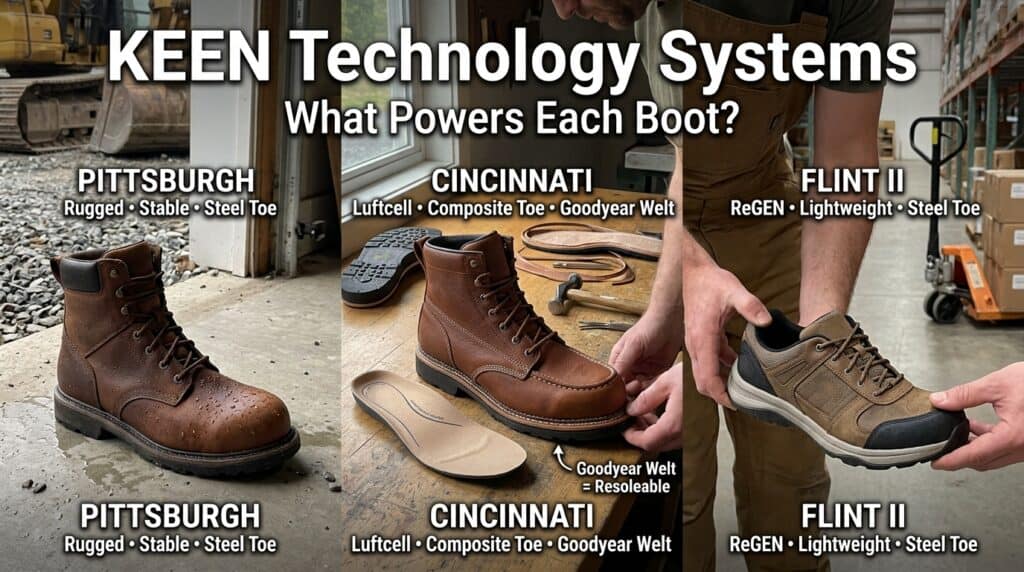
three work boots comparison 202607280918
Every review mentions “KEEN.DRY” and “KEEN.ReGEN” as features. Almost none explain what they actually do or how they differ between models. Here’s what you’re actually buying.
KEEN.DRY Waterproof Membrane
KEEN’s proprietary waterproof breathable membrane — used in all three boots. Blocks liquid water while allowing moisture vapor to escape outward. Not a GORE-TEX membrane — KEEN’s own system. Reliable for rain, morning dew, wet job sites, and floor spills. The membrane seals the interior boot rather than coating the leather, which means waterproofing doesn’t depend on leather condition or treatment.
KEEN.ReGEN Midsole (Flint II)
Compression-resisting midsole that KEEN claims returns 50% more energy per step than standard EVA foam. What that means in practice: the midsole doesn’t flatten as quickly under daily use as a single-density EVA insole, and it pushes back against the foot rather than simply absorbing load. The ReGEN has a lighter, more responsive feel — better suited to workers who cover significant ground in a shift and benefit from energy return over extended standing cushioning.
KEEN Luftcell Midsole (Cincinnati)
An air-infused PU midsole used in the Cincinnati. Denser and more supportive than the ReGEN. The air infusion provides cushioning without the instability of a very soft foam midsole. Designed specifically for sustained heavy-load use on concrete and hard floors. At the end of a long shift on concrete, the Luftcell holds its cushioning profile better than the ReGEN under heavy sustained load — the trade-off is weight. The Cincinnati at approximately 34.6 oz per boot is heavier than the Flint II, which is the Luftcell’s cost.
Luftcell vs. ReGEN — The Practical Difference
ReGEN feels lighter and more energetic — right for workers who walk significant distances and need the midsole to push back. Luftcell feels denser and more cushioned — right for workers who stand for extended periods under load on hard surfaces. Neither is universally better. On a concrete pour or a long warehouse shift where you’re primarily standing and occasionally walking, Luftcell. On a trucking or logistics role where you’re moving almost constantly, ReGEN. Choosing the wrong one for your work pattern shows up by hour 8.
KEEN Asymmetrical Safety Toe Design
All three boots use KEEN’s left-right asymmetrical safety toe. Rather than a symmetric shell, each toe cap is shaped to the anatomy of that specific foot — left cap for left foot, right cap for right foot. This is the primary reason KEEN’s toe box is consistently described as roomier and less pinching than competitors at similar price points. The steel toe in the Pittsburgh and Flint II and the composite carbon fiber toe in the Cincinnati all use this geometry.
KEEN Metatomical Footbed
A PU-based contoured footbed with a defined arch profile built into all three boots. Not just shaped foam — the arch support is structural enough to provide real flat-feet benefit. Removable in all three models, which means you can drop in a custom orthotic or aftermarket insole without fighting the factory footbed out of a tight boot.
Goodyear Welt Construction — Cincinnati Only
The Cincinnati uses Goodyear welt construction. The Pittsburgh and Flint II use cement construction. This is the single most important construction difference between the three boots, and one that almost no current review flags per-model.
A Goodyear-welted boot can be resoled when the outsole wears through. A cobbler stitches a new sole to the welt for $70–$90, and the boot continues. The leather upper, properly conditioned, outlasts multiple outsoles. A cement-construction boot is bonded with adhesive — when the sole goes, the boot goes.
At the Cincinnati’s price, a resole at year 2–3 extends it to 4–5 years of service. Over that period, the cost per month of the Cincinnati is lower than either the Pittsburgh or the Flint II, both of which require full replacement when they wear out. The Goodyear welt is the Cincinnati’s most underrated feature, and most reviews don’t mention it per-model.
Wedge Sole vs. 90° Heeled Lug Sole — The Most Important Decision
The sole choice is the biggest functional difference between the Pittsburgh and the Cincinnati. KEEN themselves describe the distinction clearly, but most buyers don’t find that explanation before purchasing. Here it is, specific to these boots.
What the Pittsburgh’s 90° Heeled Lug Sole Does
The Pittsburgh has a defined rear heel — typically 1 to 1.5 inches — and deep rubber lugs across the outsole. This geometry serves three specific functions that the Cincinnati’s wedge cannot replicate.
First, ladder safety. The defined heel catches ladder rungs in the same way it catches terrain edges — it creates a physical stop that prevents the foot from sliding through. KEEN states directly that 90° heeled boots are better for “extended ladder work.” Workers who climb ladders regularly need a defined heel. A wedge sole does not catch ladder rungs.
Second, uneven terrain grip. The deep lug pattern bites into loose soil, gravel, and uneven outdoor surfaces. The lug walls grip and release mud more effectively than a shallow-profile wedge tread. On a site where you’re moving between the concrete slab and the exterior grade in the same shift, the Pittsburgh handles the transition the Cincinnati can’t.
Third, slope stability. On inclines and descents, the defined heel provides a natural braking point. The wedge sole distributes load evenly — which is the advantage on flat ground — but provides less braking friction on slopes.
What the Cincinnati’s Wedge Sole Does
The Cincinnati’s wedge sole runs flat from heel to toe — full contact with the ground across the entire bottom. KEEN pairs this with a hybrid lug pattern that provides more outdoor traction than a traditional flat wedge while preserving the comfort benefits of even weight distribution.
On concrete, this translates to measurably less foot fatigue over a 10-hour shift. Full contact distributes bodyweight across the entire sole rather than concentrating it at the heel and ball. Pro Tool Reviews, after years of testing both styles, identified the Cincinnati as the best work boot KEEN has made for working on hard surfaces specifically because of this design. On polished concrete, tile, and steel decking, more contact area means more friction and better grip than a lug heel.
The walking efficiency is also meaningfully different. The wedge sole’s heel-to-toe roll on flat ground is more natural than a heeled boot’s defined strike point, which reduces lower-limb fatigue over high step-count shifts.
The ladder caveat: The Cincinnati’s wedge sole does not grip ladder rungs. KEEN states this explicitly. If you use ladders regularly — framing, scaffolding, utility work, roofing — choose the Pittsburgh. This is a safety point, not a preference.
Individual Boot Profiles
KEEN Utility Men’s Pittsburgh 6″ Leather Waterproof Steel Toe
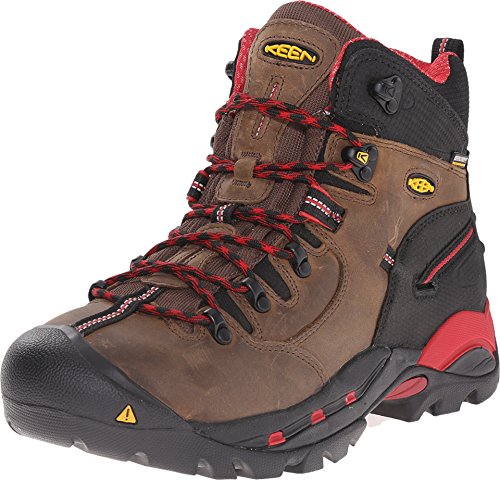
Best for: Outdoor construction, landscaping, general site work involving mixed surfaces and ladders. Workers who move between concrete, gravel, muddy grade, and scaffold in the same shift.
The Pittsburgh is KEEN Utility’s traditional work boot — the model that established KEEN’s reputation in the trades before the Cincinnati arrived. Full-grain leather upper with KEEN.DRY waterproof membrane. Steel toe meeting ASTM F2413. Oil and slip-resistant 90° heeled lug outsole. Where the Cincinnati gets the most press in 2026, the Pittsburgh remains the correct boot for workers whose environment isn’t primarily flat.
The deep lug outsole handles mud, gravel, and uneven outdoor terrain that turns the Cincinnati’s hybrid wedge tread into a traction problem. The defined heel catches ladder rungs and provides braking on slopes. For a site worker transitioning between the concrete slab, the exterior grade, and the scaffold during a single shift, the Pittsburgh handles all three. The Cincinnati handles the concrete portion well and the other two poorly.
The steel toe is slightly heavier than the Cincinnati’s composite — a practical trade-off that many experienced trades workers accept readily, particularly those who’ve never had a composite toe on a demanding site and trust what they know. The asymmetrical steel cap geometry still gives more room than a standard symmetric steel toe from most competing brands.

Key Specs
| Price | $140–$170 |
| Toe Type | Steel — ASTM F2413 I/75 C/75 (verify current listing) |
| EH Rated | Yes — verify current Amazon listing |
| Waterproofing | KEEN.DRY membrane |
| Sole | 90° heeled lug — oil and slip resistant |
| Upper | Full-grain leather, barnyard-resistant |
| Construction | Cement — not resoleable |
| Shaft height | 6 inches |
| Metal detectors | Triggers (steel toe) |
| Ladder grip | Yes — defined heel catches rungs |
Pros
- 90° heeled lug outsole grips ladders, outdoor terrain, and uneven surfaces
- KEEN.DRY waterproofing handles sustained wet conditions
- Asymmetrical steel toe — roomier than most competitor steel toes at this price
- KEEN metatomical footbed provides structured arch support
- EH rated — appropriate for electrical hazard environments
- Full-grain barnyard-resistant leather handles chemical and agricultural environments
Cons
- Cement construction — not resoleable. Replace at 18–24 months of heavy daily use
- Steel toe triggers metal detectors — relevant for oil field, government, and security-adjacent sites
- Heavier than composite-toe alternatives — relevant on high step-count shifts
- Traditional lug sole feels clunky on polished concrete compared to the Cincinnati’s wedge
Skip this if your work is primarily on flat concrete or indoor hard surfaces. The Cincinnati’s wedge sole will be noticeably more comfortable by hour 8 on flat ground. Also skip if you require composite or non-metallic toe for metal detector access.
KEEN Utility Men’s Cincinnati 6″ Composite Toe Waterproof Wedge
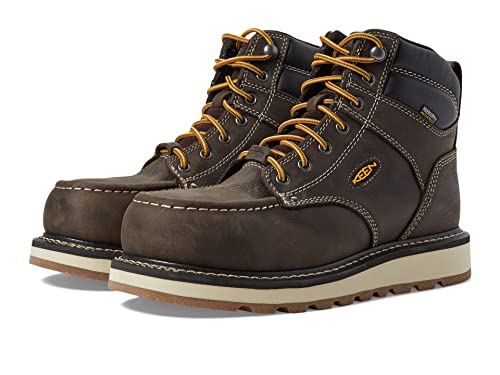
Best for: Carpenters, concrete workers, warehouse workers, flooring trades, and anyone spending 70% or more of their shift on flat hard surfaces with a meaningful daily step count.
The Cincinnati held Pro Tool Reviews’ best work boot overall title for multiple consecutive years. That’s a useful signal — it means real tradespeople tested it against every serious competitor and kept recommending it. The combination that earns that status: Goodyear welt construction, a Luftcell air-infused midsole, a composite carbon fiber toe, and a wedge sole with hybrid lug tread that handles mixed surfaces better than a traditional flat wedge.
The Luftcell midsole is what separates the Cincinnati’s concrete comfort from other wedge boots. Standard EVA midsoles flatten noticeably after 6 months of daily compression. The air-infused PU Luftcell holds its cushioning profile longer — at the end of a long concrete shift, the Cincinnati feels closer to the morning than most boots manage. That’s the feature that earns repeat purchases. The Amazon reviews confirm it: “Comfortable from day one and after a year still in excellent shape” is a common theme, which is rare for a midsole-heavy claim.
The Goodyear welt is the Cincinnati’s other primary advantage. When the outsole wears through, a cobbler resolves it. The leather upper continues. At the Cincinnati’s price point, one resole at year 2–3 makes the total ownership cost competitive with replacing a cheaper cement-construction boot twice. Workers who actually resole their boots — and most experienced tradespeople do — find the Cincinnati becomes the lower-cost option over a 4-year period.
The composite carbon fiber toe is 15% lighter than steel and doesn’t trigger metal detectors. It meets the same ASTM F2413 protection standard. For workers at oil field facilities, government sites, or any location with security screening, the composite toe is a practical advantage the Pittsburgh can’t match.
Key Specs
| Price | $175–$210 |
| Toe Type | Composite/carbon fiber — ASTM F2413 (verify current listing) |
| EH Rated | Yes — verify current Amazon listing |
| Waterproofing | KEEN.DRY membrane |
| Midsole | Luftcell air-infused PU |
| Sole | Wedge + hybrid lug — oil and slip resistant |
| Upper | Full-grain barnyard-resistant leather |
| Construction | Goodyear welt — resoleable |
| Shaft height | 6 inches |
| Weight | ~34.6 oz per boot |
| Metal detectors | Does not trigger (composite toe) |
| Ladder grip | No — wedge sole does not catch rungs |
| Cold conduction | None — composite toe doesn’t conduct temperature |
Pros
- Goodyear welt — the only resoleable boot in this comparison
- Luftcell midsole holds cushioning longer than EVA alternatives under daily compression
- Composite carbon fiber toe — lighter than steel, no metal detector trigger, no cold conduction
- Wedge sole for concrete and flat-surface comfort and grip
- Hybrid lug tread handles mixed terrain better than a pure wedge
- Barnyard-resistant leather handles agricultural chemicals
- Best long-term cost per month of the three boots — if you resole it
Cons
- Heaviest boot in this comparison — ~34.6 oz per boot
- Wedge sole does not grip ladder rungs — Pittsburgh is the correct choice for ladder users
- Highest upfront price of the three
- Break-in period is meaningful — Goodyear welt is stiffer than cement construction initially
Skip this if you use ladders regularly — the wedge sole is a safety issue on rungs, not a preference. Also skip if you need the lightest boot for a high-mobility role. The Flint II is lighter; the Pittsburgh handles mixed terrain better.
KEEN Utility Women’s Flint II Low Steel Toe Work Shoe
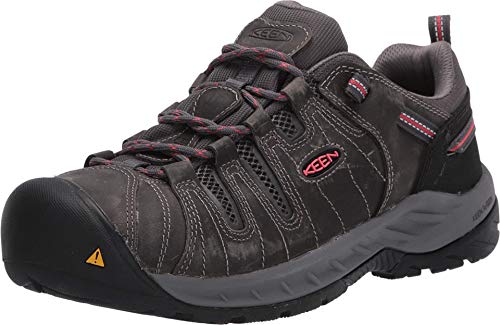
Best for: Women in warehouse, logistics, light industrial, healthcare, and trucking roles where mobility and lighter weight matter more than ankle coverage, and where the work surface is primarily flat and indoor.
Important fit note: The Women’s Flint II Low is a low-cut work shoe — the collar sits below the ankle. This is not a 6-inch boot. If you need ankle coverage, the women’s versions of the Pittsburgh or Cincinnati provide mid-cut shaft protection. The Flint II Low is the right shoe when ankle coverage isn’t the priority and you’re trading boot height for lighter weight and greater agility.
The Flint II fills a real gap in women’s safety footwear. Most safety-toe work shoes available to women are either fashion-adjacent (weak or absent ASTM ratings) or men’s boots scaled down without adjustment for women’s foot geometry. KEEN builds the Flint II on a women’s-specific last with the asymmetrical steel toe geometry — the cap shaped to each foot individually. That means the wider, more anatomical toe box that makes KEEN’s boots consistently more comfortable than competitors at similar price points is present in the women’s version as a design choice, not an afterthought.
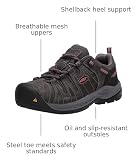
The KEEN.ReGEN midsole returns energy rather than just absorbing it. For workers covering significant ground — warehouse pickers, facility maintenance, healthcare workers doing 8,000-step shifts — the energy return reduces lower-limb fatigue in a way that a static EVA insole doesn’t replicate. The External Stability Shank (ESS) provides midfoot support despite the low cut. The siped outsole is SATRA-certified for oil and slip resistance — a meaningful distinction from slip-resistant claims without certification.
The reflective webbing is a detail that gets mentioned in product specs but matters to healthcare and facility workers on early or late shifts — visibility in low-light conditions without adding bulk or changing the boot’s functional profile.
Key Specs
| Price | $120–$150 |
| Gender | Women’s — women’s-specific last |
| Toe Type | Steel — ASTM F2413 I/75 C/75 (verify current listing) |
| EH Rated | Yes — verify current Amazon listing |
| Waterproofing | KEEN.DRY membrane |
| Midsole | KEEN.ReGEN — 50% more energy return than standard EVA |
| Outsole | Siped oil- and slip-resistant rubber — SATRA certified |
| Midfoot | External Stability Shank (ESS) |
| Shaft height | Low cut — below ankle |
| Construction | Cement — not resoleable |
| Safety extras | Reflective webbing for low-light visibility |
| Metal detectors | Triggers (steel toe) |
Pros
- Women’s-specific last — not a men’s boot in smaller sizes
- Lightest of the three — low cut, lighter construction
- KEEN.ReGEN midsole provides energy return for high step-count roles
- Asymmetrical steel toe — roomier than standard symmetric caps
- SATRA-certified slip resistance — not just a marketing claim
- Reflective webbing for low-light environments
- EH rated — appropriate for electrical hazard environments
- Lowest price of the three
Cons
- Low cut — no ankle support or coverage above the ankle
- Cement construction — not resoleable
- Steel toe triggers metal detectors
- Not appropriate for outdoor, uneven terrain, or environments with ankle hazards
- ReGEN midsole less suited to heavy sustained standing than the Cincinnati’s Luftcell
Skip this if you work outdoors, on uneven terrain, or in environments where ankle protection matters. The women’s Pittsburgh or Cincinnati provides 6-inch mid-cut coverage. Also skip if you need composite toe for metal detector environments.
Full Feature Comparison
| Feature | Pittsburgh 6″ | Cincinnati 6″ Wedge | Flint II Low (Women’s) |
|---|---|---|---|
| Sole type | 90° heeled lug | Wedge + hybrid lug | Flat siped rubber |
| Best surface | Outdoor, uneven, ladders | Concrete, flat indoor | Flat indoor, warehouse |
| Toe type | Steel (ASTM F2413) | Composite/carbon fiber (ASTM F2413) | Steel (ASTM F2413) |
| Toe weight vs. steel | Standard | 15% lighter | Standard |
| Metal detector | Triggers | Does not trigger | Triggers |
| Cold conduction (toe) | Yes — steel conducts | No — composite | Yes — steel conducts |
| Midsole | Standard PU | Luftcell air-infused PU | KEEN.ReGEN |
| Midsole best for | General cushion | Sustained heavy standing | High step-count mobility |
| Construction | Cement | Goodyear welt | Cement |
| Resoleable? | No | Yes — $70–$90 at a cobbler | No |
| Waterproof | KEEN.DRY membrane | KEEN.DRY membrane | KEEN.DRY membrane |
| Shaft height | 6 inches | 6 inches | Low (below ankle) |
| Ankle support | Mid-cut collar | Mid-cut collar | None — low cut |
| Ladder grip | Yes — defined heel | No — wedge sole | No — flat sole |
| Gender | Men’s | Men’s | Women’s |
| Weight | ~30 oz/boot | ~34.6 oz/boot | ~24 oz/boot |
| Price range | $140–$170 | $175–$210 | $120–$150 |
| Expected lifespan | 18–24 months (cement) | 4–5 years (with resole) | 12–18 months (cement) |
| Cost per month (3 yr) | ~$6–7/month | ~$5–6/month (resole at yr 2) | ~$7–9/month |
Which Boot Are You? — Decision Guide
Answer these three questions to find the right boot.
Question 1: Do you use ladders regularly?
If yes, the answer is the Pittsburgh. Full stop. The Cincinnati’s wedge sole and the Flint II’s flat sole do not grip ladder rungs. This is a safety issue, not a comfort preference. The Pittsburgh’s defined heel catches rungs. Choose it.
If no, continue to Question 2.
Question 2: What is your primary work surface?
- Primarily flat (concrete, warehouse floor, tile, steel decking, pavement): Cincinnati for men. Flint II Low for women in lighter-duty mobile roles.
- Mixed (concrete and outdoor terrain in the same shift): Pittsburgh handles both adequately. The Cincinnati handles flat terrain better and outdoor terrain poorly. The Pittsburgh handles both.
- Primarily outdoor or uneven (site grading, landscaping, outdoor construction): Pittsburgh.
Question 3: Do you need the boot to last 3+ years?
If yes, the Cincinnati is the financially correct answer — if you’re willing to resole it. The Goodyear welt means a cobbler adds another 2–3 years of life at $70–$90. The Pittsburgh and Flint II are cement construction — when they wear out, they’re done.
If no (you replace footwear annually or near-annually), the Pittsburgh or Flint II at their lower price points are the sensible choice.
Summary by Role
| Your Role | Right Boot | Reason |
|---|---|---|
| Carpenter / framing / concrete slab | Cincinnati | Wedge sole + Luftcell for flat surfaces, high step count |
| Site worker, outdoor construction, mixed terrain | Pittsburgh | Heeled lug handles outdoor, uneven, and ladder transitions |
| Ladder user (any trade) | Pittsburgh | Defined heel grips ladder rungs — Cincinnati and Flint II don’t |
| Warehouse / logistics / flat industrial (men’s) | Cincinnati | Wedge + Luftcell for concrete fatigue on long shifts |
| Warehouse / logistics / mobile industrial (women’s) | Flint II Low | Lightest, most mobile, ReGEN for step-count energy return |
| Oil field / government / metal detector sites | Cincinnati | Composite toe — no metal detector trigger |
| Long-term investment (resole-minded) | Cincinnati | Only Goodyear-welted boot — only one worth resoling |
| Women in healthcare / trucking / light industrial | Flint II Low | Women’s-specific last, lightest, SATRA slip resistance, reflective |
Sizing — Boot-Specific Notes
Pittsburgh
True to length. Slightly narrow in the toe box relative to the Cincinnati, though the asymmetrical steel toe still provides more room than most competitor steel-toe boots. Workers with wide forefeet should try wide sizing or consider the Cincinnati’s composite toe (which has more interior room for the same external footprint due to thinner carbon fiber walls). Size up half if between sizes or wearing thick work socks on long shifts.
Cincinnati
True to length. The wide asymmetrical toe box is built into the standard width — most buyers don’t need EE sizing unless feet are genuinely extra-wide. At approximately 34.6 oz per boot, the Cincinnati takes a proper break-in period. Plan 8–12 hours of gradual wear before a full demanding shift. The Goodyear welt construction is stiffer initially than cement alternatives. Don’t wear a new pair of Cincinnatis for the first time on a 12-hour concrete pour.
Flint II Low (Women’s)
True to standard women’s shoe size. The low cut means ankle fit is less of a variable — focus on length and forefoot room. The women’s-specific last positions the arch support correctly for women’s foot geometry rather than simply scaling down a men’s last. If between sizes, go up half.
Frequently Asked Questions
What is the difference between the KEEN Pittsburgh and the Cincinnati?
The Pittsburgh uses a traditional 90° heeled lug sole for outdoor terrain and ladder grip. The Cincinnati uses a wedge sole with Luftcell air-infused midsole for concrete and flat surfaces. The Cincinnati is also Goodyear-welted (resoleable) while the Pittsburgh is cement construction. The Cincinnati has a composite carbon fiber toe; the Pittsburgh has a steel toe.
Is the KEEN Cincinnati better than the Pittsburgh for concrete work?
Yes, specifically for concrete and flat hard surfaces. The wedge sole distributes weight more evenly across the full boot bottom, reducing forefoot and heel fatigue compared to a heeled boot on concrete. The Luftcell midsole also holds its cushioning longer than standard EVA under sustained concrete-floor compression. Pro Tool Reviews rated the Cincinnati the best KEEN boot for hard-surface work.
Can I use KEEN Cincinnati boots on ladders?
No. The Cincinnati’s wedge sole does not catch ladder rungs. KEEN explicitly states that 90° heeled boots are the correct choice for workers who use ladders. The Pittsburgh’s defined heel grips ladder rungs. If you use ladders regularly, choose the Pittsburgh regardless of your other surface needs.
What is KEEN Luftcell midsole?
An air-infused PU midsole used in the Cincinnati. The air infusion creates a midsole that provides cushioning without the instability of very soft foam. It holds its cushioning profile longer than standard EVA under sustained daily compression, which is why the Cincinnati remains comfortable on concrete at the end of a long shift in a way that cheaper midsoles don’t.
Is the KEEN Cincinnati Goodyear-welted?
Yes. The Cincinnati uses Goodyear welt construction, making it the only boot in this comparison that can be resoled. When the outsole wears out, a cobbler stitches a new sole to the welt for $70–$90. The Pittsburgh and Flint II both use cement construction and require full replacement when the outsole fails.
What is the KEEN Flint II best for?
The Women’s Flint II Low is best for women in mobile, lighter-duty industrial roles — warehouse, logistics, healthcare, trucking — where lighter weight and agility matter more than ankle coverage. The KEEN.ReGEN midsole provides energy return for high step-count shifts. It is not a 6-inch boot and provides no ankle support above the collar.
Which KEEN Utility boot is the lightest?
The Flint II Low at approximately 24 oz per boot. The Pittsburgh is approximately 30 oz per boot. The Cincinnati is the heaviest at approximately 34.6 oz per boot — the Goodyear welt and Luftcell midsole add weight that the cement-construction alternatives don’t carry.
Are KEEN Pittsburgh boots true to size?
True to length, but slightly narrow in the forefoot compared to the Cincinnati’s composite toe version. The asymmetrical steel toe cap still provides more room than most competing brands’ symmetric steel toes. Workers with wide forefeet should try wide sizing or compare with the Cincinnati, which has more interior room due to the thinner carbon fiber toe cap walls.
Final Verdict
Three boots, three different answers to three different work situations.
Buy the Pittsburgh if you use ladders, work on mixed terrain with significant outdoor exposure, or need a proven traditional work boot at a competitive price. The defined heel is the safety feature no other boot in this comparison provides. Available on Amazon: KEEN Pittsburgh 6″ Steel Toe.
Buy the Cincinnati if your shift is primarily on concrete or flat surfaces, you walk significant daily distance, and you want a boot worth resoling rather than replacing. The Luftcell midsole and Goodyear welt justify the price premium at the 2-year mark. If you work on flat surfaces and are replacing boots annually, the Cincinnati likely costs you less per month. Available on Amazon: KEEN Cincinnati 6″ Composite Wedge.
Buy the Flint II Low if you are a woman in a mobile, lighter-duty role where ankle coverage isn’t required and the lightest possible steel-toe shoe serves you better than a full 6-inch boot. The women’s-specific last and KEEN.ReGEN midsole make it the correct answer for that specific buyer. Available on Amazon: KEEN Women’s Flint II Low Steel Toe.
Still not sure? The decision guide above works through three questions that narrow the answer to one boot for most buyers. If ladder use is anywhere in your answer, stop at Question 1.