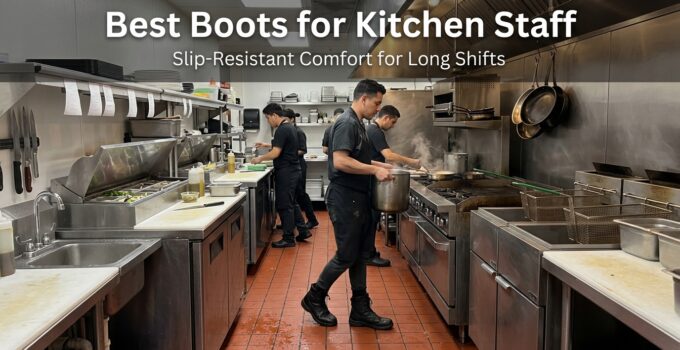
A commercial kitchen floor is one of the most slip-hazardous surfaces a human being stands on for a full shift. Greased tile, wet concrete near the dish pit, and steel grating near the grill all show up in the same 10-hour shift, sometimes in the same five minutes. Get the shoe right and every one of those shifts gets measurably easier. Get it wrong and you’re one greasy corner away from a slip-and-fall that ends your night — or your season.
Here’s what almost every kitchen footwear list gets wrong: it hands every reader the same “best overall” pick as if a dishwasher standing in water all day, a line cook working grease-slicked tile, and a front-of-house server who needs to look presentable have identical footwear needs. They don’t. This guide routes you to the right shoe by your actual role first, then explains the slip-resistance standards that “slip resistant” marketing language usually glosses over, the kitchen environments that call for different materials, the break-in reality nobody warns Dansko and Birkenstock buyers about, and thirteen specific picks — clogs, athletic-style SR shoes, a waterproof boot, and a boot-style option — organized by exactly which kitchen job each one solves.
⚡ Quick Picks — Best Boots and Shoes for Kitchen Staff
| Best For | Shoe | Type | Waterproof | Price |
|---|---|---|---|---|
| Best overall / line cooks | Dansko XP 2.0 Clogs | Clog | Splash | ~$130 |
| Best premium / executive chefs | Dansko Professional Clog | Clog | Splash | ~$150 |
| Best comfort for long shifts | Birkenstock Tokio Super Grip | Clog | Splash | ~$140 |
| Best Birkenstock alternative | Birkenstock Profi-Birki | Clog | ✅ Rubber | ~$100 |
| Best modern design | Snibbs The Clog | Clog | Splash | ~$130 |
| Best budget | Crocs Bistro Clog | Clog | ✅ Rubber | ~$45 |
| Best athletic-style | Hoka Bondi SR | Sneaker | No | ~$155 |
| Best sneaker-style value | New Balance 626v2 | Sneaker | No | ~$85 |
| Best arch support | Skechers Work Arch Fit SR | Sneaker | No | ~$90 |
| Best boot-style option | Dr. Martens 1460 SR | Boot | No | ~$150 |
| Best for women | Reebok Work Sublite Cushion (W) | Sneaker | No | ~$80 |
| Best waterproof / dish pit | Merrell Work Moab 3 Mid WP | Boot | ✅ Full | ~$140 |
| Best toe protection | KEEN Utility Atlanta Cool Low ST | Shoe | No | ~$120 |
Table of Contents
- Closed-Toe Rules: What OSHA and Health Codes Actually Require
- Slip Resistance Decoded: SR vs. SRC vs. ASTM F2913
- Footwear by Kitchen Role: The Routing Matrix
- Kitchen Environment Compatibility Guide
- Clog vs. Sneaker vs. Boot: Which Type Is Right for You
- Arch Support and Plantar Fasciitis in Kitchen Workers
- The Break-In Reality: Dansko and Birkenstock
- Best Overall: Dansko XP 2.0 Clogs
- Best Premium: Dansko Professional Clog
- Best Long-Shift Comfort: Birkenstock Tokio Super Grip
- Best Alternative: Birkenstock Profi-Birki
- Best Modern Design: Snibbs The Clog
- Best Budget: Crocs Bistro Clog
- Best Athletic-Style: Hoka Bondi SR
- Best Sneaker-Style Value: New Balance 626v2
- Best Arch Support: Skechers Work Arch Fit SR
- Best Boot-Style: Dr. Martens 1460 SR
- Best for Women: Reebok Work Sublite Cushion
- Best Waterproof: Merrell Work Moab 3 Mid WP
- Best Toe Protection: KEEN Utility Atlanta Cool Low ST
- Cleaning and Care by Material Type
- When to Replace Your Kitchen Shoes
- Pre-Purchase Checklist
- FAQ — 10 Questions Answered
- Final Verdict by Kitchen Role
Closed-Toe Rules: What OSHA and Health Codes Actually Require
chef wearing closed toe boots 202607050916
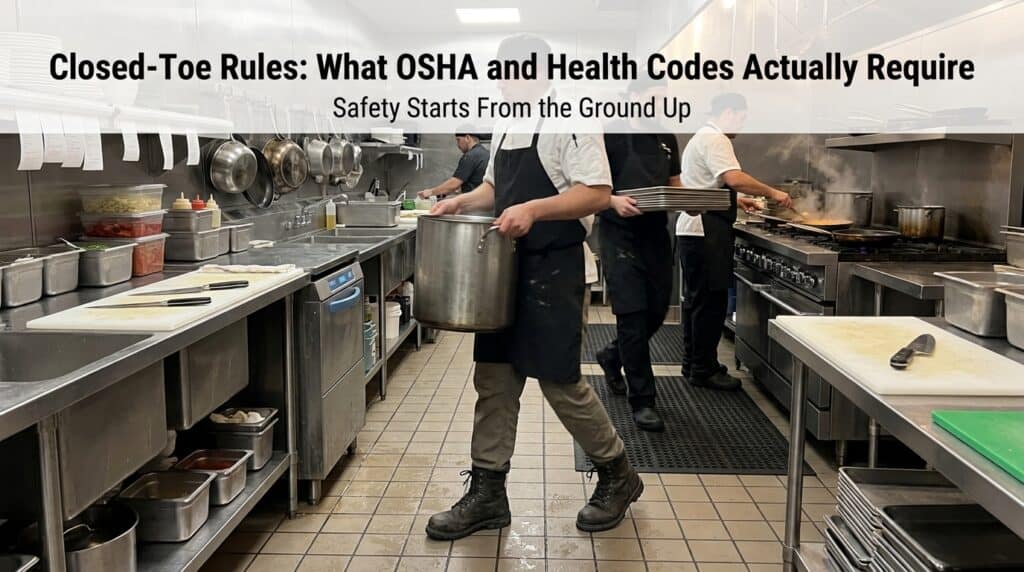
Workers frequently search “do I have to wear closed-toe shoes in a kitchen” without a straight answer available anywhere. Here’s the honest breakdown. OSHA 29 CFR 1910.136 requires employers to ensure employees use protective footwear when there is a danger of foot injury from falling or rolling objects, or from exposure to corrosive or hot substances — a standard commercial kitchen environment (dropped knives, hot oil, heavy stockpots) typically qualifies, which is why closed-toe footwear is treated as a baseline safety requirement rather than optional guidance.
Separately, NSF International standards and local health department codes for food service establishments typically require closed-toe, slip-resistant footwear as part of food safety and workplace safety compliance — though the specific wording and enforcement varies by state and county. On top of both of those, employers are generally within their rights to require closed-toe, slip-resistant footwear as internal workplace policy regardless of whether a specific regulation mandates it for your exact role.
What is not typically required: steel-toe or composite-toe footwear. Commercial kitchens don’t usually carry the heavy-falling-object risk that construction or warehouse environments do, so toe-cap protection beyond standard closed-toe is a role-specific choice (relevant for staff also handling loading dock deliveries or heavy equipment) rather than a universal kitchen requirement.
Slip Resistance Decoded: What SR, SRC, and ASTM F2913 Actually Mean
slip resistance decoded work boots 202607050917
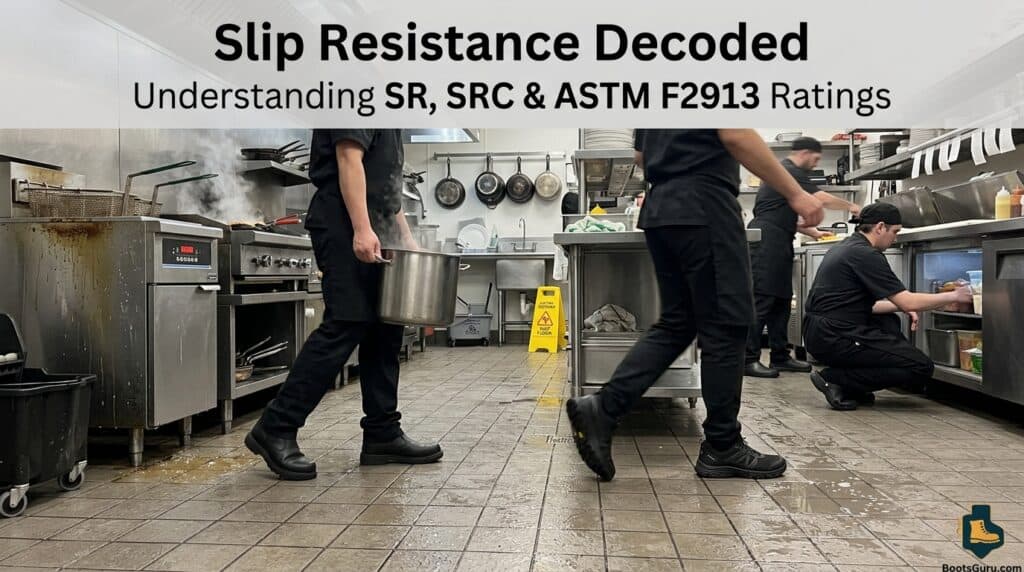
“Slip resistant” is printed on nearly every kitchen shoe listing, and it means at least three genuinely different things depending on which testing standard backs it up — information that determines whether a shoe was actually tested on anything resembling your kitchen floor.
| Standard | Test Method | Threshold | What It Means for You |
|---|---|---|---|
| ASTM F2913 | U.S. standard — dynamic coefficient of friction (DCOF) measured on wet ceramic tile and steel | DCOF ≥ 0.40 on wet tile | The primary U.S. food-service standard. Look for this specific reference, not generic “slip resistant” wording. |
| SR (ISO 13287) | European standard — wet ceramic tile with detergent, and steel with glycerol | Minimum COF, varies by surface | A legitimate but different test than ASTM. Not directly comparable number-for-number. |
| SRC | Must pass both SR surfaces (ceramic tile + steel/glycerol) | Passes both conditions | The most rigorous common European rating — generally equal to or stronger than ASTM F2913 for kitchen use. |
| Brand “SR” claim | Internal manufacturer testing, method often unpublished | No standardized threshold | Common on athletic and casual shoes marketed toward kitchen use. Not equivalent to third-party certification — verify published data where the brand provides it. |
Every product review below states explicitly which slip-resistance basis applies to that shoe, rather than repeating generic “slip resistant” language from the listing.
Footwear by Kitchen Role: The Routing Matrix
| Kitchen Role | Top Priority | Footwear Type | Best Picks |
|---|---|---|---|
| Line cook / sauté | Max slip resistance on grease-slicked tile, all-day comfort | Professional clog | Dansko XP 2.0, Birkenstock Tokio, Snibbs |
| Dishwasher / potwasher | Waterproof upper, standing in water | Rubber clog / waterproof boot | Crocs Bistro, Merrell Moab WP |
| Prep cook | Closed toe (knife safety), waterproof, easy clean | Waterproof clog | Crocs Bistro, Birkenstock Profi-Birki |
| Executive chef / sous chef | Premium ergonomic support, multi-season durability | Premium professional clog | Dansko Professional, Birkenstock Tokio |
| FOH server / floor staff | Professional appearance, slip resistance on polished floors | SR athletic shoe | Hoka Bondi SR, NB 626v2, Dr. Martens SR |
| Pastry chef / baker | Comfort on concrete bakery floor, closed toe | Clog or cushioned SR shoe | Dansko XP 2.0, Skechers Arch Fit SR |
| Kitchen/restaurant manager | Professional appearance across FOH and BOH | SR work shoe or dress boot | Dr. Martens SR, KEEN Atlanta Low |
Kitchen Environment Compatibility Guide
| Environment | Primary Hazard | Required Feature | Avoid |
|---|---|---|---|
| Hot dry line kitchen | Grease-contaminated tile slip | ASTM F2913/SRC outsole, heat-resistant toe material | Mesh at the toe box (hot liquid drop risk), open sandals |
| Wet dish pit | Standing water, wet concrete slip | Fully waterproof upper, quick-dry footbed | Leather uppers (absorb water), laced shoes (laces soak) |
| Walk-in freezer (frequent access) | Cold-stiffened outsole losing grip | Rubber outsole (stays flexible cold) | Foam-only midsoles that compress and harden below 40°F |
| Grill / wood-fire station | Radiant heat, ember contact | Full-grain leather or rated synthetic, no mesh panels | Open mesh athletic uppers, low-melt synthetics |
| FOH / polished tile or hardwood | Slip on smooth or waxed flooring | SR certification for smooth-surface testing, dress-appropriate design | Heavy clog soles that mark polished floors |
Clog vs. Sneaker vs. Boot: Which Type Is Right for You
clogs vs sneakers vs boots 202607050918
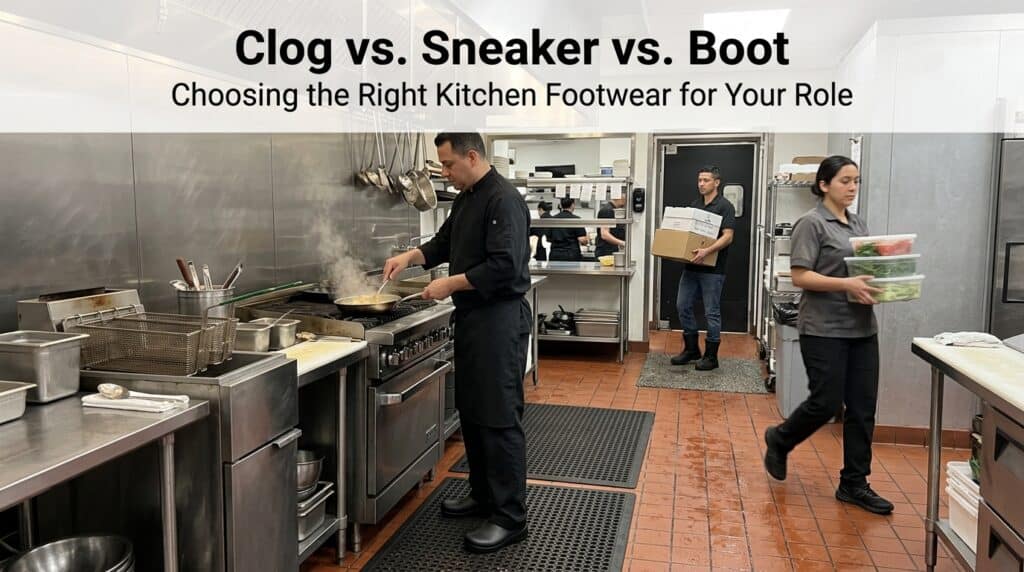
Clog vs. athletic shoe vs. boot isn’t primarily a style preference — it’s a function of your role, shift length, floor type, and dress code. Clogs dominate professional kitchens for real reasons: easy on/off for sanitation breaks, no laces to catch near flames or equipment, and a fully wipeable exterior. Their limitation is minimal ankle support, which matters if you have a history of ankle instability. Athletic SR shoes serve FOH and floor staff better, since appearance matters there, and they suit anyone needing higher arch support than most flat-footbed clogs provide. Boots aren’t standard kitchen footwear except for outdoor catering, food trucks, or cold-climate back-door access — Dr. Martens aside, most kitchen workers won’t need one.
Arch Support and Plantar Fasciitis: The Kitchen Worker’s Most Common Foot Problem
Standing on hard tile for 10+ hours with inadequate arch support is a leading contributor to plantar fasciitis among kitchen staff — one of the most searched foot-health concerns in this occupation. The footwear factors that matter: genuine arch support (Birkenstock’s cork footbed and the Dansko Professional both perform well here; Crocs Bistro is notably weak on arch support), a moderate heel-to-toe drop of roughly 10–20mm (a flat, zero-drop shoe can actually worsen plantar fasciitis symptoms in a standing-all-day kitchen context), and a cushioned midfoot that doesn’t bottom out by mid-shift.
Practical guidance by severity: for mild discomfort, add a quality insole (OrthoLite or Superfeet Work) to whatever kitchen shoe you already wear. For moderate to chronic plantar fasciitis, the Dansko Professional or Birkenstock Tokio are the two most frequently recommended kitchen-specific options. For severe or persistent cases, see a podiatrist before buying anything — custom orthotics may be the right call, and no shoe substitutes for that assessment.
The Break-In Reality: Dansko and Birkenstock Are Worth It, But Plan for 3–6 Weeks
Dansko Professional and Birkenstock’s cork-footbed clogs are the two most recommended professional kitchen shoes in the industry — and both have break-in periods long enough to genuinely surprise first-time buyers who assume any new shoe should feel fine within a day or two.
| Model | Break-In Period | What to Expect | How to Manage It |
|---|---|---|---|
| Dansko Professional | 3–6 weeks (15–25 shifts) | Stiff leather toe box and heel counter; possible heel/toe blistering | Thick socks first 2 weeks; start on shorter shifts; condition the leather from day one |
| Dansko XP 2.0 | 1–2 weeks (5–10 shifts) | Softer synthetic upper breaks in noticeably faster than Professional | Minimal management needed |
| Birkenstock Tokio | 2–4 weeks (10–20 shifts) | Cork footbed hardens initially; arch support feels intrusive until molded | Short sessions first; body heat accelerates molding — do not soak in water |
| Crocs Bistro / Hoka Bondi SR / NB 626v2 | None to minimal | Immediate to near-immediate comfort | No special management needed |
Best Overall / Line Cooks: Dansko XP 2.0 Clogs
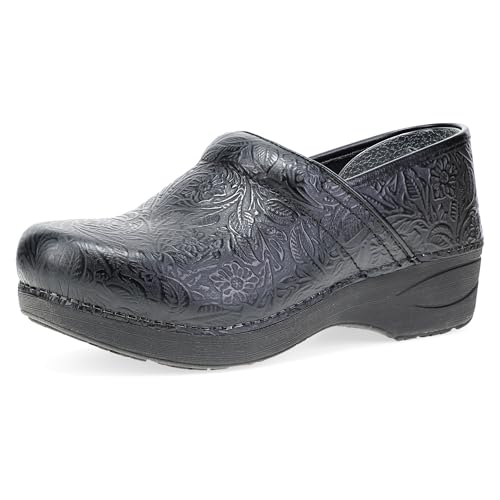
The XP 2.0 is the professional kitchen clog most line cooks reach for by default, and for good reason: it carries Dansko’s slip-resistant rated outsole in a lighter, more flexible synthetic-upper construction than the leather Professional model, which means a dramatically shorter break-in period — most wearers report full comfort within 5–10 shifts rather than several weeks. For anyone starting a new kitchen job who can’t afford to hobble through their first two weeks, this is the practical entry point into the Dansko line.

The rocker-bottom sole design promotes a natural walking gait across long shifts, and the roomy toe box accommodates the swelling that happens after standing for 8+ hours. The slip-resistant outsole is Dansko’s kitchen-specific compound — appropriate for the greasy tile environment that defines most line cook stations. Water-resistant (splash-level, not fully submersion-proof) construction handles typical kitchen spills without requiring the full waterproofing a dish-pit role demands.

Best for: line cooks, sauté stations, pastry work — any role with heavy standing time on greasy or wet-splashed tile. Not ideal for: full dish-pit submersion work (choose a fully waterproof clog or boot instead) or FOH roles requiring a dressier appearance.

Kitchen Specs
Slip standard: Dansko slip-resistant outsole | Upper: Synthetic (fast break-in) | Water resistance: Splash-level
Break-in: 1–2 weeks | Best role: Line cook, sauté, pastry
Pros: Much faster break-in than leather Dansko Professional; roomy toe box for afternoon swelling; rocker sole reduces gait fatigue; genuine kitchen-rated outsole.
Cons: Splash-resistant, not fully waterproof — wrong choice for standing dish pit work; premium price relative to Crocs.
Best Premium / Executive Chefs: Dansko Professional Clog
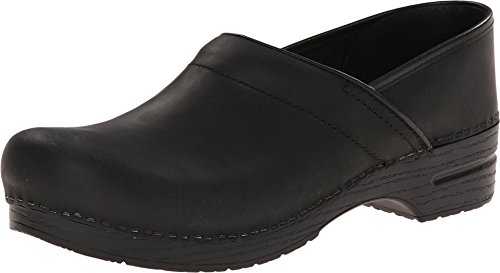
This is the original — the clog that built Dansko’s reputation across decades of professional kitchens and culinary schools. Full-grain leather upper, a roomier and more contoured footbed than the XP 2.0, and the kind of long-term durability that makes it the standard recommendation for executive chefs and sous chefs who wear the same pair for multiple seasons rather than replacing footwear annually.

The trade-off for that durability and premium leather feel is a genuinely longer break-in — plan for 3–6 weeks of regular wear before the toe box and heel counter fully soften, as covered in the break-in table above. Once broken in, the arch support and rocker-bottom gait mechanics are widely considered among the best available in any kitchen clog, which is exactly why chefs who’ve worn through several pairs over a career tend to stick with this specific model rather than experimenting elsewhere.

Best for: executive chefs, sous chefs, and any kitchen professional planning to wear one pair across multiple seasons. Not ideal for: new hires who need immediate first-shift comfort — choose the XP 2.0 instead and consider the Professional for your second pair once you know the fit works for your feet.

Kitchen Specs
Slip standard: Dansko slip-resistant outsole | Upper: Full-grain leather | Water resistance: Splash-level
Break-in: 3–6 weeks | Best role: Executive chef, sous chef, multi-season wear
Pros: Industry-standard durability across multiple seasons; excellent arch support once broken in; premium leather resists kitchen wear better than synthetic alternatives.
Cons: Longest break-in period in this guide — plan accordingly; not ideal as a first-week purchase.
Best Comfort for Long Shifts: Birkenstock Tokio Super Grip

The Tokio is Birkenstock’s food-service-specific clog, built around the brand’s contoured cork-latex footbed rather than a flat insole — arguably the single best arch support system available in any kitchen clog in this guide. The Super Grip outsole is specifically compounded and rated for wet, greasy commercial kitchen floors, distinct from Birkenstock’s standard casual outsole.

The cork footbed molds to the individual foot’s shape over 2–4 weeks of wear (see the break-in table above), and once molded, provides a genuinely custom-fit arch and heel cradle that most kitchen workers with plantar fasciitis or general foot fatigue find hard to match with any other brand. Adjustable buckle strap allows fine-tuning fit across the swelling that happens over a long shift, which flat-slip clogs can’t replicate.

Best for: executive chefs, line cooks with plantar fasciitis history, and anyone prioritizing arch support above all else. Not ideal for: workers who want zero break-in — the cork molding period is real and should be planned around, similar to Dansko Professional.

Kitchen Specs
Slip standard: Super Grip food-service rated outsole | Footbed: Cork-latex, contoured | Water resistance: Splash-level
Break-in: 2–4 weeks | Best role: Arch support priority, executive chef, long-shift line work
Pros: Best-in-guide arch support once molded; adjustable buckle strap for fit fine-tuning; Super Grip outsole specifically rated for commercial kitchen floors.
Cons: Cork break-in period requires patience; premium price.
Best Birkenstock Alternative: Birkenstock Profi-Birki
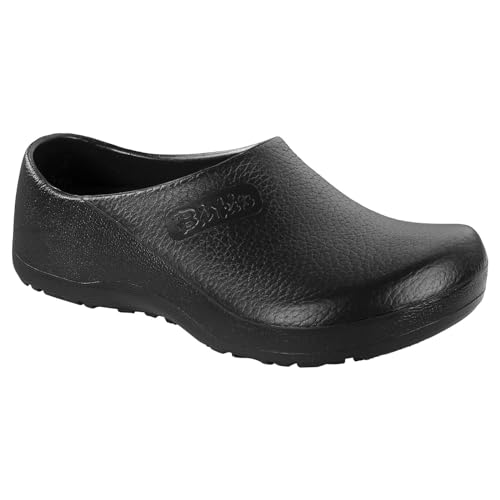
The Profi-Birki takes a fundamentally different construction approach than the Tokio: rather than a leather upper over a cork footbed, it’s a single-piece, fully rubber/polyurethane clog that’s genuinely waterproof rather than just splash-resistant. This makes it the correct Birkenstock pick specifically for prep cooks and any role with sustained wet contact — raw protein handling, frequent hose-down cleaning, or standing near active water sources — where the Tokio’s leather upper would be the wrong material choice.

Because it’s a single molded piece rather than leather-over-cork, the break-in period is essentially nonexistent — the flexible polyurethane conforms to foot pressure from the first wear, unlike the multi-week cork molding process the Tokio requires. It sacrifices some of the Tokio’s premium contoured arch support in exchange for that immediate comfort and full wet-environment durability.

Best for: prep cooks, wet-station workers, anyone needing genuine Birkenstock brand construction with full waterproofing rather than splash resistance. Not ideal for: workers specifically seeking the Tokio’s premium cork arch support experience.

Kitchen Specs
Construction: Single-piece PU/rubber, fully waterproof | Break-in: None to minimal
Best role: Prep cooks, wet stations, sustained water/chemical contact roles
Pros: Fully waterproof (not just splash-resistant); essentially zero break-in; genuine Birkenstock construction quality.
Cons: Less contoured arch support than the Tokio’s cork footbed; simpler aesthetic than the leather models.
Best Modern Design: Snibbs The Clog

Snibbs was founded by a former chef specifically to modernize the professional kitchen clog category, and The Clog is the result: a memory-foam footbed instead of a traditional cork or EVA insole, a slip-resistant outsole built for commercial kitchen floors, and a noticeably more contemporary silhouette than the traditional Dansko or Birkenstock shape. For kitchen workers who want genuine functional performance without looking like they’re wearing their grandfather’s orthopedic clogs, this is the pick.

The memory foam footbed provides immediate cushioning without a break-in period, closer to the Crocs experience than the Dansko/Birkenstock molding process, while still delivering genuine all-day support that a basic rubber clog can’t match. This is a newer entrant to the category compared to the century-plus histories of Dansko and Birkenstock, so long-term multi-year durability data is less established — but the fundamentals (kitchen-rated slip resistance, memory foam comfort, easy-clean exterior) are all in place.

Best for: style-conscious kitchen workers, younger staff entering the profession, anyone who wants Dansko-level function without the traditional clog look. Not ideal for: workers prioritizing decades-proven brand durability over design — Dansko Professional has the longer track record.

Kitchen Specs
Slip standard: Kitchen-rated slip-resistant outsole | Footbed: Memory foam | Water resistance: Splash-level
Break-in: Minimal | Best role: Style-conscious line cooks and kitchen staff of any role
Pros: Contemporary design distinct from traditional clog aesthetic; memory foam comfort with near-zero break-in; founded by a chef with direct kitchen-use design input.
Cons: Shorter brand track record than Dansko or Birkenstock; premium price for a newer entrant.
Best Budget: Crocs Bistro Clog

The Bistro isn’t a standard Crocs casual clog — it’s Crocs’ dedicated food-service line, built with a raised heel and a smooth, non-perforated footbed specifically designed to keep out kitchen debris and standing liquid, unlike the ventilated holes on their recreational clogs. At roughly $45, it’s the lowest-cost genuinely food-service-rated shoe in this entire guide, and it requires zero break-in — the Croslite foam material conforms to foot shape with body heat within the first hour of wear.

Fully waterproof by construction (single-piece molded foam, not fabric or leather), and dishwasher-safe on the top rack — a genuinely practical cleaning advantage no other product in this guide can match. This is the correct starting point for first-time kitchen workers, culinary students on a budget, or anyone who wants to test whether the clog format works for their feet before investing in a premium Dansko or Birkenstock purchase.

Best for: dishwashers, prep cooks, budget-conscious first-time kitchen workers, culinary students. Not ideal for: workers with plantar fasciitis or significant arch support needs — the flat footbed is the weakest arch support in this entire guide.

Kitchen Specs
Slip standard: Food-service rated outsole | Construction: Single-piece Croslite foam | Water resistance: Fully waterproof
Break-in: None | Cleaning: Dishwasher-safe (top rack) | Best role: Dishwasher, prep, budget/student pick
Pros: Lowest price of any genuinely food-service-rated shoe in this guide; fully waterproof; dishwasher-safe cleaning; zero break-in.
Cons: Weakest arch support in this guide — not ideal for plantar fasciitis or long-term standing needs without an added insole.
Best Athletic-Style: Hoka Bondi SR
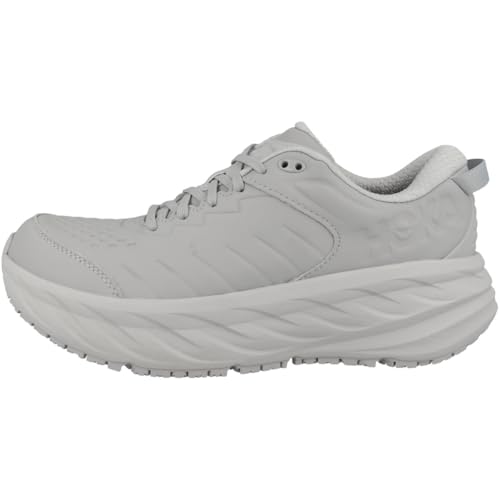
This is the SR (Slip Resistant) version of Hoka’s famously maximalist Bondi running shoe — not the standard consumer Bondi, which is not rated for kitchen use. Hoka built this variant specifically for food-service and healthcare workers who spend long shifts on hard floors and want the brand’s signature thick, cushioned midsole with a slip-rated outsole added on top. For FOH staff or anyone whose kitchen role involves significant walking distance rather than sustained standing in one spot, the Bondi SR’s cushioning is genuinely a step above the traditional clog category.

Sneaker-style lacing provides a more secure, adjustable fit than any slip-on clog, which matters for staff who move quickly between stations or cover significant floor distance during a shift. It’s a genuinely premium price point relative to the rest of this guide, reflecting Hoka’s positioning, but the maximalist cushioning is difficult to match with any clog-format shoe.

Best for: FOH servers, expo staff, and anyone covering significant walking distance during a shift rather than standing in one station. Not ideal for: roles requiring frequent quick shoe removal (clogs are faster) or full waterproofing (this is not a waterproof shoe).

Kitchen Specs
Slip standard: Hoka SR-rated outsole (specific food-service variant) | Type: Maximalist cushioned sneaker
Water resistance: None | Break-in: Minimal | Best role: FOH, expo, high-movement roles
Pros: Best-in-class cushioning for high-mileage shifts; secure lace-up fit; genuine SR-rated variant distinct from standard Bondi.
Cons: Not waterproof; premium price; slower on/off than a clog for frequent sanitation breaks.
Best Sneaker-Style Value: New Balance 626v2
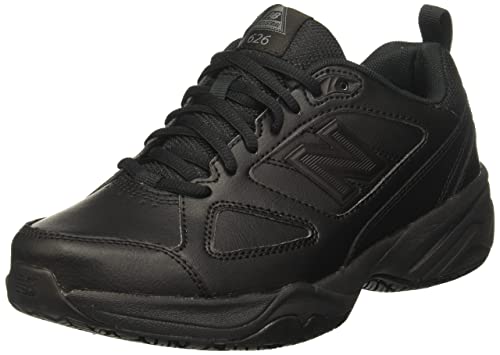
New Balance’s dedicated work-shoe line brings the brand’s athletic-shoe comfort reputation to a genuinely slip-resistant outsole at a price well below the Hoka Bondi SR. This is the sneaker-format pick for kitchen and FOH staff who want an athletic silhouette and a proven, reasonably priced brand rather than the premium price of the Hoka line, without sacrificing certified slip resistance.

Available in wide-width variants, which matters directly for the arch-support and foot-swelling considerations covered earlier in this guide — a standard-width shoe that compresses the forefoot by mid-shift undermines both comfort and circulation. Lace-up closure allows fine-tuning fit as feet swell across a long shift, similar to the Hoka.

Best for: FOH staff, kitchen managers, and anyone wanting an athletic-shoe format at a mid-range price with wide-width availability. Not ideal for: roles needing maximalist cushioning (Bondi SR is stronger there) or full waterproofing.

Kitchen Specs
Slip standard: SR-rated work outsole | Type: Athletic sneaker | Width options: ✅ Wide available
Water resistance: None | Break-in: Minimal | Best role: FOH, management, mid-budget athletic pick
Pros: Mid-range price for a genuine SR-rated athletic shoe; wide-width availability; proven New Balance construction; lace-up fit adjustment.
Cons: Not waterproof; less cushioning depth than the Bondi SR.
Best Arch Support (Athletic): Skechers Work Arch Fit SR
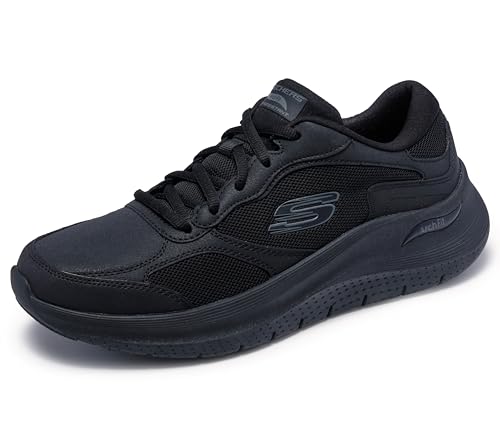
Skechers’ Arch Fit insole system is podiatrist-certified and built specifically to address the plantar fasciitis and arch fatigue concerns covered earlier in this guide — a direct answer for kitchen workers whose feet ache by mid-shift despite an otherwise decent shoe. Paired with a genuine slip-resistant outsole, this is the strongest orthotic-level arch support available in a sneaker format at a mid-range price point in this guide.

Lightweight athletic construction with essentially no break-in period, and the certified Arch Fit contour genuinely reduces the need for a separate aftermarket insole purchase — for workers who’ve been adding OrthoLite or Superfeet insoles to other shoes to manage arch pain, this shoe is built to make that extra step unnecessary from day one.

Best for: kitchen workers managing plantar fasciitis or chronic arch fatigue who want built-in orthotic-level support without buying separate insoles. Not ideal for: wet-station roles needing waterproofing, or workers who specifically prefer clog-style quick on/off.

Kitchen Specs
Slip standard: SR-rated outsole | Footbed: Podiatrist-certified Arch Fit | Water resistance: None
Break-in: None | Best role: Plantar fasciitis / chronic arch pain, any standing role
Pros: Podiatrist-certified Arch Fit support built in; genuine SR rating; zero break-in; reduces need for separate insole purchase.
Cons: Not waterproof; sneaker format slower for quick removal than a clog.
Best Boot-Style Option: Dr. Martens 1460 Slip Resistant
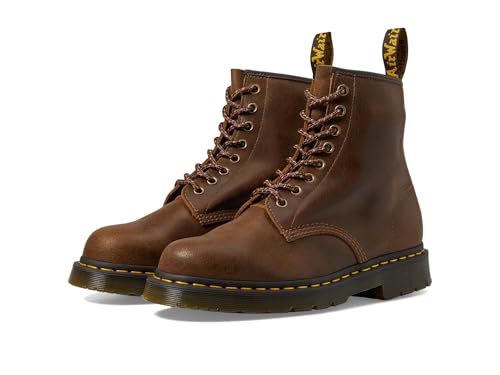
Honest framing up front: this is more a style preference than a strict functional requirement for most kitchen environments, but it’s genuinely popular among kitchen and hospitality staff who want the iconic Dr. Martens look with real slip-resistant certification added underneath. The 1460 SR keeps the brand’s recognizable silhouette and all-day comfort reputation while swapping in a certified slip-resistant outsole for the standard model’s non-rated sole.

The full-leather upper and lace-up ankle-boot height make this a strong choice for outdoor catering, food truck service, cold-climate back-door access, or kitchen managers who move between BOH and FOH and want one shoe that reads as professional in both contexts rather than a visibly “work” clog.

Best for: kitchen/restaurant managers, outdoor catering staff, food truck workers, and style-conscious kitchen staff who want boot-height coverage. Not ideal for: anyone needing fast on/off for frequent sanitation breaks, or full waterproofing for wet-station work.

Kitchen Specs
Slip standard: SR-rated outsole (verify listing) | Type: Leather ankle boot | Water resistance: None
Best role: Managers, outdoor catering, food trucks, style-conscious staff
Pros: Genuine SR-rated outsole in an iconic silhouette; professional appearance across FOH and BOH; boot height suits outdoor and cold-access roles.
Cons: Slower on/off than any clog; not waterproof; more a style choice than functional necessity for most standard kitchen roles.
Best for Women: Reebok Work Sublite Cushion (Women’s)

Built on a women’s-specific last rather than a men’s shoe scaled down, the Sublite Cushion addresses the narrower heel and different forefoot proportions that generic unisex kitchen shoes often get wrong for women — a fit issue that shows up as heel slippage and blisters in shoes that weren’t designed around women’s foot geometry in the first place. Lightweight construction with a genuine slip-resistant rated outsole.

The sneaker format and lighter overall weight suit FOH and fast-paced kitchen roles well, and the price point is genuinely accessible relative to the Hoka and premium clog options in this guide. Sublite Cushion midsole technology provides real all-day comfort without the bulk of a maximalist shoe.

Best for: women in FOH, line cook, or any kitchen role wanting a genuine women’s-last athletic shoe rather than a unisex or men’s-scaled option. Not ideal for: workers needing full waterproofing or maximum cushioned support (Hoka Bondi SR provides more depth there).

Kitchen Specs
Slip standard: SR-rated outsole | Last: ✅ Genuine women’s-specific | Water resistance: None
Break-in: Minimal | Best role: Women in FOH, line cook, or any fast-paced kitchen role
Pros: Genuine women’s-specific last addresses real fit differences; lightweight for fast-paced roles; accessible price; SR-rated outsole.
Cons: Not waterproof; less cushioning depth than premium maximalist options.
Best Waterproof / Dish Pit: Merrell Work Moab 3 Mid Waterproof

For kitchen roles that extend beyond the standard indoor floor — dishwashers dealing with sustained standing water, staff working loading docks in wet weather, or anyone whose kitchen access includes an unprotected outdoor walkway to a walk-in — the Moab 3 Mid brings genuine full waterproofing and mid-height ankle coverage that no clog in this guide provides. Merrell’s Vibram-style outsole delivers durable grip that holds up on both wet kitchen tile and outdoor wet concrete.
The cushioned midsole and mid-cut boot height give more support and coverage than any low-cut sneaker or clog option, useful for staff who are also occasionally exposed to outdoor or dock conditions rather than working exclusively on an indoor kitchen floor. Verify the specific listing’s slip-resistance rating for indoor kitchen tile before purchasing, since this shoe’s outsole heritage comes from hiking rather than food-service design.

Best for: dishwashers, dock-adjacent staff, and any kitchen role with outdoor or sustained-water exposure beyond a standard indoor floor. Not ideal for: FOH roles needing a dressier low-cut appearance, or fast on/off between stations.

Kitchen Specs
Water resistance: ✅ Full waterproof, mid-height | Outsole: Durable Vibram-style tread
Slip standard: Verify listing for indoor kitchen SR rating | Best role: Dishwasher, dock access, outdoor-exposed kitchen roles
Pros: Genuine full waterproofing with mid-height ankle coverage; durable outsole handles indoor and outdoor conditions; cushioned support for long shifts.
Cons: Bulkier than clogs or low-cut sneakers; verify indoor kitchen SR rating specifically before purchase; not designed as a dedicated food-service shoe.
Best Toe Protection: KEEN Utility Atlanta Cool Low Steel Toe
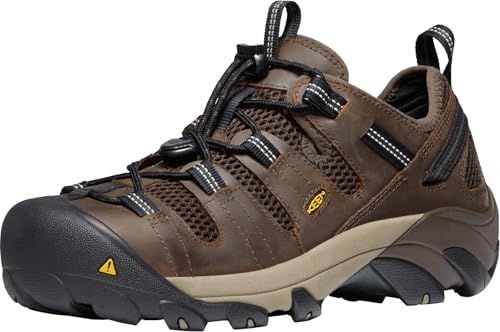
Most kitchen roles don’t require steel-toe protection, as covered in the OSHA section above — but some do, particularly staff who also handle loading dock deliveries, work in industrial-scale commercial kitchens with heavy rolling equipment, or split time between the kitchen and a warehouse-adjacent supply area. The Atlanta Cool Low delivers genuine steel-toe impact protection in a low-cut, breathable format that doesn’t feel like a construction boot.

Slip-resistant rated outsole appropriate for kitchen and industrial floors alike, with KEEN’s asymmetric toe box design providing genuinely more forefoot room than a standard steel-toe cap — useful given the afternoon foot-swelling issue that affects long kitchen shifts regardless of toe protection needs. The low-cut, breathable upper keeps this from feeling like overkill for staff who need the toe protection but still want kitchen-appropriate mobility.

Best for: kitchen staff who also handle heavy deliveries, rolling equipment, or loading dock work where OSHA’s falling-object standard genuinely applies. Not ideal for: standard line cook, FOH, or dishwasher roles where steel toe is unnecessary overkill — choose a lighter option elsewhere in this guide.

Kitchen Specs
Toe: Steel — ASTM certified | Slip standard: SR-rated outsole | Water resistance: None
Best role: Kitchen staff also handling deliveries, heavy equipment, or dock-adjacent work
Pros: Genuine steel-toe impact protection in a low-cut kitchen-appropriate format; asymmetric wide toe box; SR-rated outsole for kitchen floors.
Cons: Overkill for standard kitchen roles without falling-object risk; heavier than any clog or low-cut sneaker in this guide.
Cleaning and Care by Material Type
| Material | After Each Shift | Weekly Deep Clean | Never Do |
|---|---|---|---|
| Rubber (Crocs Bistro, Profi-Birki) | Wipe with damp cloth, rinse under cold water | Dishwasher-safe top rack (remove insole first) or mild degreaser | Bleach (degrades rubber), hot dryer |
| Full-grain leather (Dansko Professional, Birkenstock Tokio) | Wipe with damp cloth, remove insole to air dry overnight | Mild saddle soap or leather cleaner, dry away from heat | Machine wash, submerge, heat-dry, bleach |
| Synthetic (Dansko XP 2.0, Snibbs) | Damp wipe exterior, remove and air insole | Mild soap and water, soft brush on outsole | Machine wash, solvents, heat-dry |
| Athletic upper (Hoka, NB, Skechers, Reebok) | Knock out debris, air overnight with insole removed | Remove insoles, gentle machine cycle, air dry only | Tumble dryer (destroys foam midsole), bleach on colored uppers |
When to Replace Your Kitchen Work Shoes
Slip-resistant outsoles lose their effectiveness well before a shoe looks visibly worn out. Once outsole tread depth wears below roughly 1.5–2mm, the slip-resistance rating is no longer reliable, even if the shoe still looks presentable. In daily-wear commercial kitchen environments, most SR-rated shoes reach that point in 3–6 months — significantly faster than the one-year replacement cycle many workers assume applies.
Signs it’s time to replace: visible tread smoothing at the heel and forefoot contact zones, any slip incident on a surface the shoe previously handled without issue, or midsole compression (press your thumb into the footbed — if it doesn’t spring back, the cushioning is gone). Rule of thumb: inspect tread depth quarterly if you wear the shoe daily, and replace at least every 6 months in high-grease environments regardless of how the shoe looks from the outside.
Pre-Purchase Checklist
☐ Primary kitchen role identified (line cook, dishwasher, FOH, executive chef, manager)
☐ Environment type confirmed — wet dish pit, hot dry tile, walk-in freezer access, or grill-adjacent heat
☐ Slip-resistance standard appropriate to your floor type verified (ASTM F2913, SR, or SRC — not just generic “slip resistant” marketing text)
☐ Footwear type matched to role and employer dress code (clog, sneaker, or boot)
☐ Width and arch support needs assessed — especially if you have plantar fasciitis history
☐ Break-in time planned for if choosing Dansko Professional or Birkenstock Tokio — do not wear for the first time on a double shift
☐ Employer’s specific closed-toe and slip-resistance policy confirmed before purchase
FAQ — 10 Kitchen Footwear Questions Answered
What are the best shoes for working in a kitchen?
It depends heavily on your specific role. Line cooks and sous chefs generally do best in professional clogs (Dansko, Birkenstock) for maximum slip resistance on greasy tile. Dishwashers need fully waterproof rubber clogs (Crocs Bistro) or waterproof boots. FOH staff typically prefer SR-rated athletic shoes (Hoka Bondi SR, New Balance 626v2) for a more presentable appearance. There is no single universal “best” — match the shoe to your actual daily environment.
Do kitchen workers have to wear closed-toe shoes?
Generally yes. OSHA 29 CFR 1910.136 requires protective footwear where there’s danger of foot injury, which commercial kitchens typically meet given knife, hot oil, and heavy-equipment risks. NSF and local health codes frequently mandate closed-toe, slip-resistant footwear as well, and employers can additionally set closed-toe policy as internal workplace safety requirements regardless of specific regulatory mandates.
What does SR mean on kitchen shoes?
SR stands for Slip Resistant, but the certification behind it varies. In the U.S., ASTM F2913 measures coefficient of friction on wet tile and steel. The European SR standard (ISO 13287) uses a different test method on similar surfaces. SRC is the highest common European rating, requiring a pass on both test surfaces. Generic manufacturer “SR” claims without a cited standard may reflect internal, non-certified testing — look for the specific standard named in the listing.
Are Dansko clogs good for kitchen work?
Yes — Dansko is widely regarded as the professional kitchen clog standard, particularly the Professional model for chefs planning multi-season wear and the XP 2.0 for faster break-in. Be aware both require a real break-in period (1–2 weeks for XP 2.0, 3–6 weeks for the Professional) before reaching full comfort.
Are Crocs Bistro Clogs slip resistant?
Yes — the Bistro is Crocs’ dedicated food-service line, built with a raised heel and a smooth, non-perforated footbed specifically for kitchen environments, distinct from their recreational ventilated clogs. It carries a genuine food-service-rated slip-resistant outsole, though its arch support is notably weaker than Dansko or Birkenstock.
What shoes do professional chefs wear?
Dansko and Birkenstock dominate professional kitchens for line cooks and chefs — clogs are preferred over laced shoes because they’re faster to remove for sanitation breaks and have no laces to catch near flames or moving equipment. FOH staff more commonly wear SR-rated athletic shoes for a dressier appearance.
How long do kitchen work shoes last?
The slip-resistant outsole typically wears out well before the rest of the shoe looks worn — most SR-rated shoes lose reliable slip resistance within 3–6 months of daily commercial kitchen use. Inspect tread depth quarterly and replace at least every 6 months in high-grease environments regardless of visible condition.
What are the best shoes for dishwashers?
Fully waterproof rubber clogs like the Crocs Bistro Clog or Birkenstock Profi-Birki are the correct choice, since dishwashers spend extended time standing in and around water. Waterproof boots like the Merrell Work Moab 3 Mid WP are appropriate if the role also involves outdoor or dock-adjacent exposure. Athletic sneakers and leather clogs generally aren’t suited to sustained wet-station work.
Are Hoka shoes good for kitchen work?
Specifically the Hoka Bondi SR — yes. This is a dedicated food-service variant with a certified slip-resistant outsole, distinct from the standard consumer Bondi running shoe, which is not rated for kitchen use. The Bondi SR suits FOH and high-mileage roles well due to its maximalist cushioning.
How do I clean kitchen clogs?
It depends on material. Rubber clogs (Crocs, Profi-Birki) can go in the dishwasher’s top rack with the insole removed, or be wiped and rinsed after each shift. Leather clogs (Dansko Professional, Birkenstock Tokio) should only be wiped with a damp cloth and treated with leather conditioner monthly — never machine washed or submerged. Athletic SR shoes should have insoles removed and air-dried, with gentle machine washing if needed, never a heated dryer.
Final Verdict: Best Kitchen Shoe by Role
Kitchen Role → Best Shoe
Line cook / sauté (first pair, fast break-in): Dansko XP 2.0 Clogs
Executive chef / multi-season investment: Dansko Professional Clog
Arch support priority / plantar fasciitis (clog): Birkenstock Tokio Super Grip
Prep cook / sustained wet contact: Birkenstock Profi-Birki
Style-conscious line cook: Snibbs The Clog
Dishwasher / budget / student: Crocs Bistro Clog
FOH / high-mileage cushioning: Hoka Bondi SR
FOH / mid-budget athletic: New Balance 626v2
Arch support priority (sneaker): Skechers Work Arch Fit SR
Manager / outdoor catering / style boot: Dr. Martens 1460 SR
Women’s-specific fit: Reebok Work Sublite Cushion
Dish pit / dock-adjacent waterproof: Merrell Work Moab 3 Mid WP
Toe protection for delivery/equipment handling: KEEN Utility Atlanta Cool Low ST
Match the shoe to your actual role and floor conditions first — the specific brand comes second. A dishwasher in a premium leather clog and a line cook in a waterproof rubber shoe are both wearing the wrong footwear for their job, no matter how good either shoe is on paper. Get the role match right and everything else in this guide falls into place.