Here is the problem with almost every “work boots for sore feet” guide on the internet: they recommend the same boots to everyone, regardless of where or why the feet hurt. Heel pain from plantar fasciitis requires a completely different boot than ball-of-foot pain from metatarsalgia. Arch pain from flat feet needs the opposite midsole from general shift fatigue. And in many cases, the softest boot you can find will actually make your plantar fasciitis worse — a counterintuitive truth that no competing guide ever mentions.
This guide does three things differently. First, it opens with a pain-type diagnostic so you know exactly which boot features you need before reading a single review. Second, it explains the midsole science — specifically the EVA vs. PU comparison and the “dead boot” problem — that underlies most chronic work boot foot pain. Third, every product recommendation is matched to a specific pain condition, not just labelled “comfortable.”
Every boot below is available on Amazon with a verified affiliate link from our product database. All 10 picks are lightweight, ASTM-compliant where safety toe is included, and selected specifically for workers who spend 8–12 hours on their feet.
What Type of Sore Feet Do You Have? Find Your Boot Before Reading Reviews
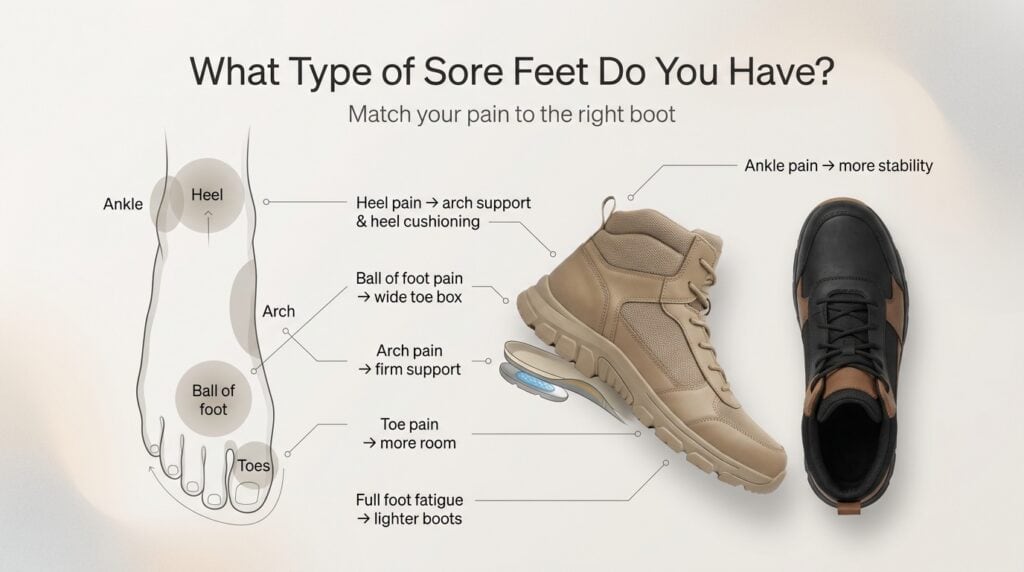
Find the perfect boots for your sore feet! Match your pain type to the right footwear for comfort and support.
Before looking at a single boot, identify where your pain is. The location and timing of soreness maps directly to the boot feature that will fix it — and getting this wrong means buying an expensive boot that doesn’t help.
Heel pain, worst in the morning or after sitting: This is almost certainly plantar fasciitis. You need a deep heel cup, firm medial arch posting, and shock-absorbing heel cushion. You do NOT need maximum softness — see the “too cushioned” trap later in this article. Best pick: Timberland PRO Titan EV (Pick 2).
Burning or aching under the ball of your foot, behind the toes: This is metatarsalgia, or potentially Morton’s neuroma. You need a wide forefoot and toe box to relieve pressure at the metatarsal heads. No amount of heel cushioning fixes forefoot compression. Best pick: KEEN Utility San Jose (Pick 3).
Arch pain along the inside of the foot, worse after standing: This is typically flat feet or overpronation. You need medial arch posting and a firm, non-collapsible midsole. Soft boots make this worse. Best pick: OrthoFeet Granite (Pick 4).
Toe pain, cramping, or numbness: Your toe box is too narrow. No insole or cushioning solves this — you need a wider, deeper toe box. Best pick: KEEN Flint II Wide (Pick 7).
Everything hurts by the end of the shift, generalised fatigue: Check for dead boots first (see the midsole section). If your boots are over 12 months old, this is likely midsole collapse. If under 12 months, your pain is probably boot weight or lack of energy return. Best pick: Merrell Work Moab 3 (Pick 1) or Timberland PRO Reaxion (Pick 5).
Ankle soreness or lateral foot instability: Your boot’s heel counter is too soft or your shaft is too low. You need a firmer heel counter and a 6-inch shaft minimum. Any of the 6-inch picks in this guide addresses this.
Quick Comparison: Best Lightweight Work Boots for Sore Feet
| Boot | Best For | Midsole | Weight (per boot) | Removable Insole | Safety Toe | Price |
|---|---|---|---|---|---|---|
| Merrell Work Moab 3 Mid WP | Best overall / general fatigue | Air cushion + EVA | ~14 oz | Yes | Verify listing | ~$130–$155 |
| Timberland PRO Titan EV 6″ | Plantar fasciitis / heel pain | PU anti-fatigue geometry | ~18 oz | Yes | Composite | ~$160–$190 |
| KEEN Utility San Jose 6″ | Metatarsalgia / forefoot pain | LuftCell PU | ~15 oz | Yes | Alloy | ~$150–$175 |
| OrthoFeet Granite Work Boot | Flat feet / arch pain / overpronation | Ortho-Cushion System | ~14 oz | Yes — orthotic insole | Safety toe (verify) | ~$130–$160 |
| Timberland PRO Reaxion CT | Ultra-lightweight / high step count | EVA anti-fatigue | ~13 oz | Yes | Composite | ~$130–$165 |
| Ariat Treadfast 6″ ST | Concrete / hard floor standing | ATS dual-density EVA | ~18 oz | Yes | Steel | ~$120–$145 |
| KEEN Utility Flint II ST | Wide toe box / bunions / swelling | EVA midsole | ~16 oz | Yes | Steel | ~$120–$150 |
| BRUNT Marin Welted CT | Long-term value / resoleable | Athletic flex PU | ~20 oz | Yes | Composite | ~$140–$165 |
| Carhartt Rugged Flex 6″ Women’s | Best women’s lightweight | EVA + PU combination | ~16 oz | Yes | Steel | ~$110–$145 |
| Wolverine Overpass 6″ CT WP | Best budget pain relief | Contour PU | ~18 oz | Yes | Composite | ~$110–$140 |
1. Merrell Work Moab 3 Mid WP — Best Overall for Sore Feet

Best for: Workers with general shift fatigue, heel soreness from long-distance walking, and anyone transitioning from a heavy traditional work boot who wants immediate, noticeable pain relief.
| ASIN | B0D97392TQ |
| Midsole | Air cushion heel + EVA foam — specifically absorbs heel strike impact |
| Weight | ~14 oz per boot — among the lightest work boots in this guide |
| Outsole | Vibram TC5+ — reliable grip on mixed surfaces including wet concrete |
| Waterproof | Yes — Merrell DRY breathable membrane |
| Removable insole | Yes — Kinetic Fit Base, orthotic-compatible |
| Safety toe | Verify on current Amazon listing — safety toe version available |
| Women’s version | Yes |
| Pain conditions addressed | General fatigue, heel impact soreness, high step-count fatigue |
| Price range | ~$130–$155 |
The Merrell Work Moab 3 sits at the top of this guide because it solves the most common form of work boot foot pain: cumulative shift fatigue in workers who have been living with heavy, rigid traditional boots. The transition from a 28-ounce full-leather steel-toe boot to a 14-ounce athletic-construction Moab 3 is often immediately and dramatically felt. The air cushion heel is not marketing language — it is a genuine air pocket integrated into the rear of the midsole that absorbs the compressive spike of each heel strike before it travels into the calcaneus and up the kinetic chain. Workers whose heel pain worsens progressively across a shift rather than being worst in the morning are experiencing this type of cumulative impact loading, and the Moab 3 directly addresses it.

The Vibram TC5+ outsole has a tight lug pattern that performs particularly well on polished warehouse floors, wet concrete, and smooth indoor surfaces — better than aggressive deep-lug outsoles that reduce contact area on smooth floors. The Kinetic Fit Base insole is removable and leaves sufficient depth for a Superfeet Green or OrthoLite upgrade if you need more structured arch support than the stock insole provides. The Merrell DRY membrane keeps the boot weatherproof without the full bootie construction that reduces interior volume and warmth in Gore-Tex equivalents. For workers coming to this guide with generalised sore feet who are not sure of their specific pain type, the Moab 3 is the right starting point.
Pain conditions addressed: General shift fatigue, heel impact soreness, high step-count fatigue.
Pros: Lightest boot in guide at ~14 oz, air cushion heel absorbs impact directly, Vibram TC5+ outsole for smooth and mixed surfaces, orthotic-ready removable insole, women’s version on genuine women’s last.
Cons: EVA midsole (not PU) — will compress after 10–14 months of daily hard use; plan for replacement at that interval. Verify safety toe spec on current listing if ASTM certification is required for your site.
2. Timberland PRO Titan EV 6″ — Best for Plantar Fasciitis and Heel Pain
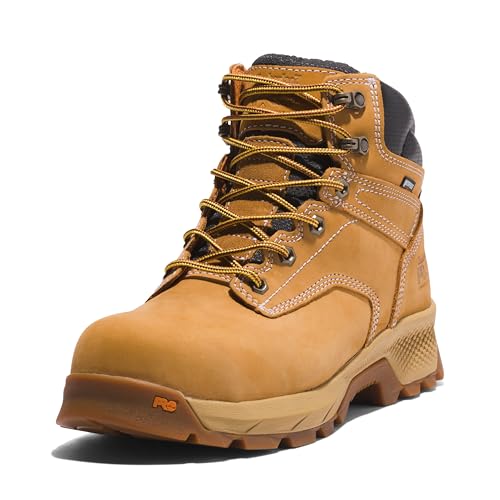
Best for: Workers with diagnosed or suspected plantar fasciitis, morning heel pain, or chronic heel soreness from prolonged standing on hard concrete and industrial floors.
| ASIN | B0CPN9XC1R |
| Midsole | Timberland PRO Anti-Fatigue Technology — geometric wave insert, PU-based energy return |
| Weight | ~18 oz per boot |
| Outsole | Slip-resistant rubber — suited for polished concrete and industrial floors |
| Waterproof | Verify on current listing |
| Safety toe | Composite — ASTM F2413 rated |
| EH rated | Yes |
| Removable insole | Yes — orthotic-ready |
| Pain conditions addressed | Plantar fasciitis, morning heel pain, hard-floor standing fatigue, heel strike soreness |
| Price range | ~$160–$190 |

Timberland PRO’s Anti-Fatigue Technology is a specifically engineered geometric wave pattern built into the midsole — not just a foam layer. The geometry is designed to mimic the energy return of a sprung heel, absorbing compressive force on heel strike and returning a portion of that energy at toe-off. For workers with plantar fasciitis, the heel strike phase is where the plantar fascia experiences its highest tensile load. A midsole that absorbs and partially returns that energy reduces the peak tensile force on the ligament with every step. This is the mechanism that makes the Titan EV particularly effective for plantar fasciitis, rather than simply providing general cushioning.

The PU-based composition of the Anti-Fatigue insert is important: it maintains its energy-return properties significantly longer than standard EVA foam. Workers who have experienced the “the new boots feel great and then start hurting at six months” cycle are experiencing EVA midsole compression — the Titan EV’s PU-based system resists this compression for 18–24 months under daily hard use. The composite safety toe reduces boot weight compared to steel equivalents, which matters for plantar fasciitis sufferers whose pain worsens with fatigue-related gait changes late in a shift. Available in black for uniform-compliant environments.
Pain conditions addressed: Plantar fasciitis, heel pain, hard-floor standing fatigue, heel strike impact soreness.
Pros: Anti-Fatigue geometric insert specifically addresses heel strike energy; PU-based system resists compression longer than EVA; composite toe saves weight; EH rated; removable insole accepts orthotics.
Cons: Heavier than the Merrell Moab 3 at ~18 oz — not the best choice if boot weight is the primary pain driver. Not the widest toe box if forefoot pain is also present.
3. KEEN Utility San Jose 6″ — Best for Metatarsalgia and Forefoot Pain
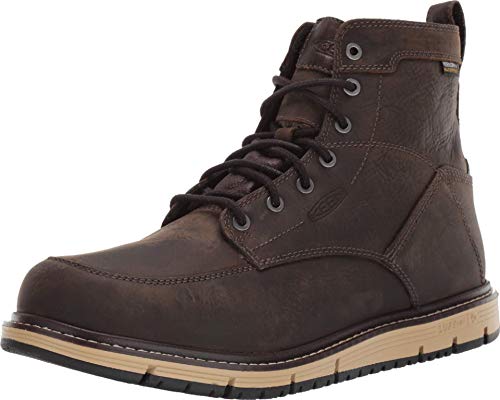
Best for: Workers with burning or aching pain under the ball of the foot, between or behind the toes — metatarsalgia, Morton’s neuroma, or forefoot pressure from narrow toe boxes in previous boots.
| ASIN | B07RV2GZ21 |
| Midsole | LuftCell PU — lightweight and long-lasting, better compression resistance than EVA |
| Toe box | Asymmetric wide — 106mm+ at widest point; no structural element at MTP joint |
| Weight | ~15 oz per boot — one of the lightest safety boots available |
| Safety toe | Alloy — ASTM F2413 I/75 C/75 EH rated; note: alloy is metallic |
| Waterproof | Yes — KEEN.DRY breathable membrane |
| Removable insole | Yes — metatomical footbed, orthotic-compatible |
| Pain conditions addressed | Metatarsalgia, Morton’s neuroma, forefoot compression pain, general forefoot soreness |
| Price range | ~$150–$175 |

Metatarsalgia — pain at the ball of the foot — is the direct result of excessive pressure concentrated on the metatarsal heads. Every standard narrow-toe-box boot that forces the forefoot into a compressed, tapered shape increases this pressure with every step. KEEN’s asymmetric wide toe box is the correct solution: it widens toward the big toe, following the natural shape of the forefoot, and specifically avoids any structural element (seam, overlay, lacing hardware) directly at the first metatarsophalangeal joint where bunion pressure and metatarsal head compression are most common. At 106mm at its widest measured point, the KEEN toe box is one of the largest in any safety-rated work boot, and the relief workers with metatarsalgia report is consistently tied to this single design decision.

The LuftCell PU midsole is an important specification for this pick: it provides lightweight cushioning that maintains performance significantly longer than EVA foam, meaning the forefoot pressure relief the boot provides on day one is still present at month fourteen of daily use. The KEEN.ReGEN energy return compound further reduces the energy cost of each step. At approximately 15 ounces per boot, the San Jose is one of the lightest ASTM-rated safety boots available. One important note: the safety toe is alloy (aluminum alloy), which is metallic and may trigger metal detectors. For workers in environments without metal detector crossings this is not relevant, but airport workers or security-cleared sites should consider this. Women’s version available on genuine women’s last.
Pain conditions addressed: Metatarsalgia, Morton’s neuroma, forefoot compression, bunion pressure, toe cramping.
Pros: Widest toe box in guide (106mm+), LuftCell PU midsole lasts longer than EVA, lightest safety boot at ~15 oz, KEEN.DRY waterproof, genuine women’s last available.
Cons: Alloy toe is metallic — may trigger metal detectors. Mesh hybrid upper less durable than full leather in high-abrasion environments; brush mesh panels regularly to maintain airflow.
4. OrthoFeet Granite Work Boot — Best for Flat Feet, Arch Pain, and Overpronation

Best for: Workers with diagnosed flat feet, overpronation, arch collapse, or plantar fasciitis driven by structural foot mechanics rather than simple impact loading — especially those who have been told by a podiatrist they need arch support.
| ASIN | B0B71FTLBR |
| Insole system | Ortho-Cushion System — premium orthotic insole with deep heel cup and medial arch posting |
| Key feature | Extra-depth design accommodates custom orthotics without removing volume |
| Toe box | Wide, non-restrictive — suitable for bunions and swelling |
| Safety toe | Verify on current Amazon listing |
| EH rated | Yes — slip resistant |
| Removable insole | Yes — designed for orthotic replacement |
| Pain conditions addressed | Flat feet, overpronation, arch collapse, structural plantar fasciitis, heel spurs |
| Price range | ~$130–$160 |
OrthoFeet occupies a unique position in this guide: it is the only pick purpose-built for structural foot conditions rather than general comfort. The Ortho-Cushion System includes a premium orthotic insole with genuine medial arch posting — a firm, shaped wedge under the arch that physically prevents the foot from collapsing inward during the stance phase of each step. This is the mechanism that addresses overpronation at its source rather than simply cushioning the symptoms. For workers whose arch pain or plantar fasciitis has a structural overpronation component — feet that roll inward, creating excessive tension on the plantar fascia from the inside — no amount of heel cushioning in a standard boot will provide lasting relief. The OrthoFeet does what standard cushioned boots cannot: it controls the motion.

The extra-depth design is the second critical feature: it adds interior volume specifically to accommodate custom orthotics. Workers who use podiatrist-prescribed custom devices have often been frustrated by work boots that don’t have sufficient depth to accommodate the orthotic without crushing the foot against the toe cap. OrthoFeet designs around this problem from the start. The wide toe box prevents forefoot compression on the wide, flat feet that often accompany overpronation, and the slip-resistant outsole handles warehouse and light construction surfaces reliably. This is not the lightest boot in the guide, but for workers with genuine structural foot conditions, the support it provides typically eliminates the foot pain that lighter boots fail to address.
Pain conditions addressed: Flat feet, overpronation, arch collapse, structural plantar fasciitis, heel spurs.
Pros: Only purpose-built orthopedic work boot in guide, genuine medial arch posting controls overpronation, extra-depth for custom orthotics, wide toe box, EH slip-resistant.
Cons: Not designed for rugged outdoor construction — best for indoor, light-duty, and warehouse environments. Verify current ASTM safety toe specification on Amazon listing before ordering for safety-critical sites.
5. Timberland PRO Reaxion Composite Toe — Best Ultra-Lightweight

Best for: Workers whose primary pain driver is boot weight — warehouse pickers, delivery workers, retail staff, site supervisors, and anyone walking 8,000–15,000 steps per shift who needs the absolute minimum foot-carry weight with ASTM safety compliance.
| ASIN | B0CLT1R54L |
| Midsole | Anti-fatigue EVA footbed — lightweight energy return |
| Upper | Synthetic and mesh — athletic construction, maximum breathability |
| Weight | ~13 oz per boot — lightest ASTM-rated boot in this guide |
| Safety toe | Composite — ASTM F2413 rated, non-metallic |
| EH rated | Yes |
| Removable insole | Yes |
| Pain conditions addressed | Weight-driven fatigue, high-mileage shift soreness, general end-of-day foot and leg ache |
| Price range | ~$130–$165 |

Research consistently shows that each 100 grams of additional footwear weight increases the oxygen cost of walking by approximately 1 percent. For a worker walking 8 miles across a 10-hour shift, the difference between a 13-ounce Reaxion and a 25-ounce traditional leather work boot — roughly 340 grams per boot, 680 grams per pair — represents approximately 6–7 percent more energy expended on locomotion every single day. Over a 50-hour work week, that compounds into measurable end-of-week fatigue accumulation and elevated compressive joint load. Workers who have been in heavy steel-toe leather boots for years and switch to the Reaxion consistently describe the relief as “like taking a weight off my feet” — which is precisely what it is.

The synthetic and mesh upper provides dramatically better breathability than full-grain leather, reducing the internal heat and sweat accumulation that contributes to late-shift foot swelling and pressure. The composite safety toe carries full ASTM F2413 protection without the weight of steel, and is non-metallic for environments with metal detectors. The anti-fatigue footbed provides energy return at toe-off, reducing the energy cost of each step further. Available in black for professional environments. The main trade-off: EVA midsole will compress faster than PU-based alternatives under heavy daily use — this boot performs best for workers who walk a lot rather than stand stationary all day, and should be replaced at 12–14 months under daily use.
Pain conditions addressed: Weight-driven fatigue, high-mileage shift soreness, generalised foot and leg ache from carrying heavy boots.
Pros: Lightest boot in guide (~13 oz), composite toe for metal-detector environments, maximum breathability, anti-fatigue footbed, EH rated, black available.
Cons: EVA midsole — not the most durable for heavy standing; best for high-step-count walking roles. Less ankle debris exclusion than full-leather 6-inch alternatives for rough outdoor construction.
6. Ariat Treadfast 6″ Steel Toe — Best for Concrete and Hard Floor Standing

Best for: Workers who stand more than they walk — concrete finishers, assembly line workers, retail, security guards, restaurant kitchen — where the pain comes from prolonged static loading on unforgiving surfaces rather than walking fatigue.
| ASIN | B08ZRVL1R1 |
| Midsole | ATS (Advanced Torque Stability) — fiberglass shank + dual-density EVA, engineered for hard surface standing |
| Outsole | Duratread — abrasion and chemical resistant (concrete, sealant, grout) |
| Upper | Full-grain leather — durable, moulds to foot over break-in |
| Safety toe | Steel — ASTM F2413 I/75 C/75 EH |
| EH rated | Yes |
| Removable insole | Yes |
| Pain conditions addressed | Heel and arch pain from prolonged static standing, metatarsalgia from hard floor pressure, lower back pain from ground-up impact |
| Price range | ~$120–$145 |

Static standing on concrete is biomechanically distinct from walking: instead of the rolling heel-to-toe load of each step, you are sustaining continuous compressive force on the same points of the foot — the heel bone, the metatarsal heads, and the arch — without the blood-pumping benefit of the muscle contractions in each step cycle. This is why assembly line workers and concrete finishers often describe a different, duller type of foot pain than construction workers who walk all day. Ariat’s ATS (Advanced Torque Stability) system was originally developed for ranch and agricultural workers who stand for extended periods, and it translates directly to industrial standing applications. The fiberglass shank distributes the point load of a standing foot across the entire longitudinal arch, preventing the arch collapse that occurs when soft foam compresses under prolonged static weight.

The Duratread outsole compound deserves specific attention for workers on concrete: it provides significantly better abrasion resistance than standard rubber, extending outsole life by 30–50% on concrete floors where outsole wear is the primary maintenance concern. The chemical resistance handles concrete curing compounds, sealants, grout, and tile adhesive that degrade standard rubber outsoles. The full-grain leather upper moulds to the foot over a 1–2 week break-in period, which is worth mentioning: the Treadfast is not a comfortable-out-of-the-box boot. The first week requires brief break-in wear. After that, the leather’s custom-formed shape provides a fit that no synthetic upper can replicate for long-term standing comfort.
Pain conditions addressed: Prolonged static standing on hard surfaces, heel impact from hard floors, arch fatigue from standing load, metatarsalgia from floor pressure.
Pros: ATS system specifically engineered for hard-surface standing, Duratread chemical-resistant outsole, full-grain leather moulds to foot, EH rated, proven Ariat durability.
Cons: 1–2 week leather break-in period. Steel toe is slightly heavier than composite alternatives — if boot weight is also a concern, consider the Timberland PRO Titan EV (Pick 2) which addresses both plantar fasciitis and weight.
7. KEEN Utility Flint II Steel Toe — Best Wide Toe Box for Bunions and Foot Swelling

Best for: Workers whose foot pain comes from forefoot compression — bunions, hammer toes, Morton’s neuroma, feet that swell significantly over a shift, or anyone who has returned three pairs of “comfortable” boots because they cramp the toes by mid-afternoon.
| ASIN | B07VCLW7B4 |
| Toe box | KEEN asymmetric wide — no structural element at MTP joint, widens toward big toe |
| Midsole | EVA cushion midsole |
| Waterproof | Yes — KEEN.DRY membrane |
| Safety toe | Steel — ASTM F2413 I/75 C/75 EH |
| EH rated | Yes |
| Outsole | Oil/slip-resistant rubber — non-marking |
| Wide sizing | Yes — wide version available |
| Removable insole | Yes |
| Pain conditions addressed | Bunion pressure, forefoot cramping, toe soreness from narrow boots, foot swelling, metatarsalgia |
| Price range | ~$120–$150 |

There is a fundamental rule about toe box pain that no insole, cushioning system, or midsole technology can override: if the toe box is too narrow, your toes are being compressed, and that compression causes pain. Period. No upgrade fixes a box that doesn’t fit. The KEEN Flint II’s asymmetric wide toe box solves this problem at the source — the box widens toward the big toe following the natural geometry of the forefoot, and KEEN specifically designs the cap to avoid any structural contact at the first metatarsophalangeal joint. This is the joint where bunion pressure concentrates, where metatarsal head compression peaks, and where tight shoes cause the most damage over repeated shifts. Workers who have been losing toenails, developing blisters at the MTP joint, or experiencing progressive forefoot pain across a shift are experiencing toe box failure, and the Flint II addresses it directly.

Foot swelling is the second reason this boot earns its place in the guide. Feet swell meaningfully during long shifts — often half a width-size by mid-afternoon as blood volume accumulates in the lower extremities. A boot that fits comfortably in the morning can create painful forefoot compression by 2 PM if the toe box has no room for this expansion. The KEEN wide asymmetric box accommodates swelling that standard-width boots cannot. The non-marking outsole is a practical benefit for workers on finished floors and client-facing environments, and the KEEN.DRY membrane handles wet conditions without the full-volume reduction of a Gore-Tex bootie. Wide sizing is available for workers who need even more room throughout the foot, not just at the toe.
Pain conditions addressed: Bunion pressure, forefoot cramping, toe soreness from narrow boots, afternoon foot swelling, metatarsalgia.
Pros: KEEN asymmetric wide toe box at under $150, wide sizing available, KEEN.DRY waterproof, non-marking outsole, EH rated, removable insole for orthotic upgrades.
Cons: EVA midsole — plan replacement at 12–14 months of daily hard use. Steel toe is metallic; not for metal-detector environments. Not the best option if arch support is also needed — combine with a Superfeet Green insole for that.
8. BRUNT Marin Welted Composite Toe — Best Long-Term Value and Dead-Boot Solution
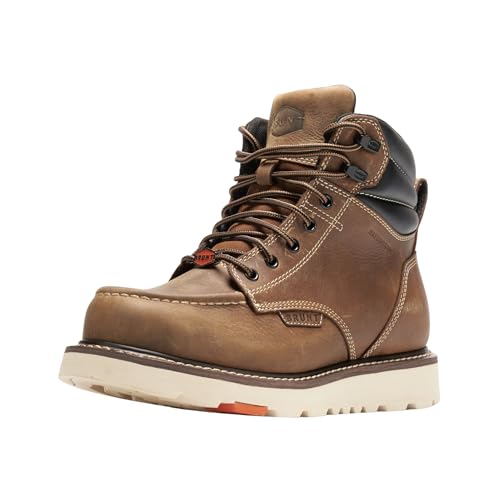
Best for: Workers who have been through multiple pairs of boots and found that foot pain always returns after 8–12 months — the Goodyear welt construction allows the boot to be resoled before midsole collapse occurs, breaking the cycle of repeated boot replacement.
| ASIN | B0D4RKKZZ1 |
| Sole construction | Goodyear welt — resoleable, extends service life indefinitely with maintenance |
| Midsole | Athletic flex construction with PU cushion |
| Safety toe | Composite — ASTM F2413 I/75 C/75 EH |
| Waterproof | Yes — full waterproof construction |
| Upper | Full-grain leather — durable, abrasion-resistant |
| EH rated | Yes |
| Removable insole | Yes |
| Pain conditions addressed | Recurring fatigue from midsole collapse, general soreness from worn-out boots, any condition worsened by dead boot syndrome |
| Price range | ~$140–$165 |

Every boot in this guide will eventually have its midsole compress. EVA boots typically reach that point at 10–14 months under daily construction use. PU boots at 18–24 months. Once the midsole has compressed, the boot looks fine on the outside but provides zero meaningful shock absorption — and foot pain returns regardless of how good the boot was when new. For workers stuck in this cycle, the BRUNT Marin’s Goodyear welt construction offers a permanent solution: when the midsole and outsole have worn, the boot can be resoled by a cobbler for $75–$90, renewing the cushioning system and tread while retaining the broken-in leather upper. A $155 boot resoled twice over three years costs $305 total — less than the $360 cost of three $120 cemented boots over the same period, and without three painful break-in cycles.

BRUNT’s direct-to-consumer model allows them to deliver Goodyear welt construction — traditionally found only on boots costing $250+ — at under $165. The composite toe is genuinely non-metallic, adding the metal-detector safety benefit for workers who cross checkpoints. The athletic flex construction built into the Goodyear welt framework provides more flexibility than traditional rigid welted boots, reducing the gait compensation that causes calf and arch soreness in stiff work boots. Full-grain leather provides durability against construction abrasion. Available in black for professional environments. Break-in period of 1–2 weeks is expected with Goodyear welt leather construction — plan accordingly before first full shift.
Pain conditions addressed: Recurring fatigue from midsole collapse, generalised soreness from worn-out boot syndrome, any foot pain that returns after 8–12 months in the same boots.
Pros: Goodyear welt resoleable — the only long-term solution to the dead-boot problem; composite non-metallic toe; waterproof; EH rated; athletic flex in welted construction; black available.
Cons: 1–2 week break-in for Goodyear welt leather. Heavier than athletic-construction picks at ~20 oz — not ideal if boot weight is the primary pain driver.
9. Carhartt Rugged Flex 6″ Women’s — Best Women’s Lightweight Work Boot for Sore Feet

Best for: Women in construction, trades, and industrial roles with foot pain — the only pick in this guide specifically on a genuine women’s last, addressing the anatomical fit issues that cause much of women’s work boot foot pain.
| ASIN | B00T4ZR1BI |
| Last | Genuine women’s last — narrower heel cup, forward arch position, correct forefoot proportions |
| Key feature | Rugged Flex articulated sole — bends naturally with foot, reducing compensatory gait soreness |
| Lining | FastDry moisture-wicking — manages sweat that contributes to swelling and blister pain |
| Safety toe | Steel — ASTM F2413 I/75 C/75 EH |
| EH rated | Yes |
| Upper | Full-grain leather |
| Removable insole | Yes |
| Pain conditions addressed | Arch pain from wrong-last boots, heel slippage-induced blisters, gait-compensation soreness, calf tightness from rigid gait |
| Price range | ~$110–$145 |

A significant portion of women’s work boot foot pain has nothing to do with cushioning — it comes from wearing boots built on men’s lasts that have been scaled down without modifying the heel cup width, arch position, or forefoot geometry. Women’s feet have a narrower heel relative to forefoot width, a more forward arch position, and different overall proportions than men’s feet of the same length. A boot that sits the arch in the wrong place, allows the heel to slip, or compresses the wider female forefoot into a man’s narrower proportional toe box will cause persistent soreness that no insole will fix, because the underlying fit geometry is wrong. The Carhartt Women’s Rugged Flex is built on a genuine women’s last that addresses all three of these anatomical differences, making it the right starting point for women whose work boot pain has not responded to cushioning upgrades.

The Rugged Flex articulated sole is the second key feature: it builds flex zones into the sole that allow the boot to bend naturally at the ball of the foot during the push-off phase of each step. Rigid, unbending soles force the foot into a compensatory gait pattern — shortened stride, altered toe-off, increased calf recruitment — that causes soreness throughout the lower leg and arch by mid-shift. The Rugged Flex removes this mechanical resistance, allowing the foot to move naturally and reducing the compensatory muscle load that causes secondary soreness. The FastDry lining manages the sweat that contributes to afternoon foot swelling and blister formation. At under $145, this is also the most affordable pick in the guide for workers who need a full 6-inch safety boot.
Pain conditions addressed: Wrong-last arch pain, heel slip blisters, compensatory gait soreness, calf and arch tightness from rigid soles.
Pros: Genuine women’s last (not a resized men’s boot), Rugged Flex reduces gait compensation soreness, FastDry moisture management, EH rated, most affordable 6-inch pick in guide.
Cons: Steel toe is metallic. Full-grain leather needs 1-week break-in. Not the best choice if toe box width is the primary issue — consider KEEN Flint II Wide (Pick 7) for wide feet.
10. Wolverine Overpass 6″ Composite Toe WP — Best Budget Pain Relief

Best for: Workers currently in a heavy, rigid steel-toe leather boot who want meaningful foot pain relief without spending over $140 — the ContourWelt flexible construction often provides more relief than any insole upgrade to a rigid boot.
| ASIN | B01MU1VO3P |
| Key feature | ContourWelt flexible construction — bends naturally, reduces compensatory gait soreness |
| Safety toe | Composite — non-metallic, ASTM F2413 I/75 C/75 EH |
| Waterproof | Yes — full waterproof membrane |
| EH rated | Yes |
| Outsole | Multi-directional lug — mixed surfaces and terrain |
| Removable insole | Yes — orthotic-compatible |
| Midsole | Contour PU cushion |
| Pain conditions addressed | Gait compensation pain, calf and arch soreness from rigid boots, general fatigue |
| Price range | ~$110–$140 |

Workers who have been wearing heavy, rigid steel-toe leather boots for years often develop a compensatory gait pattern without realising it — they shorten their stride, reduce their natural heel-to-toe roll, and recruit extra calf and arch muscles to push off against a sole that won’t flex. This gait compensation is one of the most common undiagnosed causes of calf soreness, arch fatigue, and Achilles tightness in tradespeople. Switching from a rigid boot to the Wolverine Overpass — with its ContourWelt construction that flexes naturally at the ball of the foot — often provides more immediate relief from this type of soreness than any amount of insole upgrading in the old rigid boot. The flex point alignment is the key: the boot bends where the foot bends, eliminating the mechanical resistance that was causing the compensatory movement.

The composite toe is a meaningful upgrade over steel for soreness sufferers: lighter weight reduces the total daily foot-carry burden, and the non-metallic construction eliminates the heat conduction that steel adds in warm environments. The PU contour cushion midsole provides solid shock absorption that maintains performance longer than EVA alternatives at this price point — a meaningful advantage for workers who have experienced the 8-month midsole-collapse problem with cheaper EVA boots. The full waterproof membrane handles outdoor and wet-site conditions, and the multi-directional lug outsole grips reliably on mixed construction surfaces. The removable insole accepts Superfeet, OrthoLite, or custom orthotics for workers who need arch support in addition to flex relief.
Pain conditions addressed: Rigid-boot gait compensation soreness, calf and Achilles tightness, generalised fatigue from heavy steel-toe boots.
Pros: ContourWelt flex addresses the rigid-boot gait compensation pattern, composite toe (lighter + non-metallic), PU midsole more durable than EVA at this price, waterproof, EH rated, removable insole for orthotic upgrades.
Cons: Not the lightest option at ~18 oz — if weight is the primary driver of pain, Timberland PRO Reaxion (Pick 5) is lighter. Wolverine runs slightly large — size down half a step from your normal size.
EVA vs. PU Midsoles: The Decision That Determines How Long Your Feet Stay Pain-Free
This is the single most important technical concept in this guide for workers who have experienced recurring foot pain that improves with new boots and then returns after 6–12 months. The midsole material determines how long the boot actually works — and it is almost never discussed in boot reviews.
EVA (ethylene-vinyl acetate) is the dominant midsole material in budget-to-mid-range work boots. It is lightweight and provides a soft, responsive feel from day one. The problem: EVA is a closed-cell foam that permanently compresses under repeated load. Most EVA midsoles lose 20–40% of their shock-absorbing capacity within 300–500 miles of hard walking — roughly 6–12 months of daily construction or warehouse use. The boot looks fine from the outside. The upper leather is intact, the tread still has depth. But the midsole has collapsed, and every heel strike is now transmitting near-full force directly into your foot, ankle, knee, and lower back. This is the “dead boot” problem, and it is the most common undiagnosed source of recurring work boot foot pain.
PU (polyurethane) midsoles are denser and slightly heavier than EVA but resist compression significantly longer — typically maintaining 80 percent or more of their shock-absorbing performance for 18–24 months under daily hard use. Workers who have found that their foot pain returns reliably at the 6-to-8-month mark should specifically seek PU-midsole boots for their next purchase. Boots in this guide with PU-based midsoles: KEEN San Jose (LuftCell PU), Timberland PRO Titan EV (PU-based anti-fatigue insert), Wolverine Overpass (contour PU), BRUNT Marin (PU cushion).
Dual-density EVA/PU combinations offer a middle ground: a softer EVA layer at the top for immediate feel, backed by a firmer PU base that maintains its structure. This is the best-performing option for workers who want both initial softness and long-term durability. Several premium work boots use this system.
The “Too Cushioned” Trap: Why the Softest Boot Can Make Your Feet Worse
This is the most counterintuitive concept in this entire article, and it is one that podiatrists consistently identify as the reason well-intentioned workers end up more pain than before: for plantar fasciitis, flat feet, and overpronation, very soft midsoles — memory foam, ultra-plush EVA — make the pain worse, not better.
The mechanism is arch collapse. When you stand or walk on a soft, compliant midsole, your body weight sinks into the foam and the arch drops inward with every step. For a foot with normal arch mechanics, this is tolerable. For a foot with plantar fasciitis or flat feet, this inward collapse (overpronation) increases the tensile load on the plantar fascia with every step — the exact opposite of what you need. The plantar fascia is a ligament running from the heel to the toes; when the arch drops, this ligament is stretched further. A soft midsole that allows more arch drop means more plantar fascia stretch means more heel pain.
The correct midsole for plantar fasciitis and flat feet is firm with structured arch support. The heel zone needs cushioning for impact absorption. The midfoot arch zone needs to be firm and non-collapsible — it should resist the inward roll of the foot, not accommodate it. Boots that explicitly have medial arch posting (OrthoFeet Granite) or geometric energy-return structures (Timberland PRO Anti-Fatigue) address this correctly. Boots sold purely on softness do not.
The correct recommendation for metatarsalgia is different: moderate forefoot cushioning combined with a wide toe box. Here, some softness under the metatarsal heads helps. But again, the arch zone should remain structured to prevent the mid-foot collapse that shifts more load onto the forefoot.
New Boots vs. Better Insoles: The Honest $40 vs. $180 Decision
Many workers with sore feet do not need new boots. They need a better insole in the boot they already own. Conversely, some workers are wasting money on insoles when the underlying problem is a boot that fundamentally doesn’t fit their foot. Here is how to decide.
Buy better insoles if: Your current boots are under 12 months old and the upper fits correctly — no heel slippage, no toe cramping, no width pressure. Your pain is primarily arch or heel pain that an insole with appropriate support directly addresses. Your stock insole has become flat and thin (replace it regardless of boot age). Cost: $35–$50 for Superfeet Green (best for flat feet and plantar fasciitis), OrthoLite Flex (moderate arch, balanced), or Tread Labs Pace (adjustable arch height for finding the right level of support).
Buy new boots if: Your current boots are over 12–18 months old and foot pain has returned despite insole upgrades — midsole has likely collapsed and no insole fixes it. The toe box is too narrow causing forefoot pressure — no insole widens a boot. Your heel slips inside the boot because the heel cup is wrong for your anatomy — no insole fixes this fit geometry problem. You have tried multiple insoles and the pain persists in a boot under 6 months old — the boot itself is wrong for your foot type.
The insole upgrade protocol: Remove the stock insole first — never stack an aftermarket insole on top of the factory one. Stacking reduces toe box volume, pushes the foot upward, and creates new pressure points. Insert the replacement insole into the empty boot. The arch should contact your arch without pressure when standing. If you feel the arch pushing uncomfortably, try a lower-profile insole rather than forcing through the discomfort — the arch support should feel stabilising, not intrusive.
Dead Boots: The Signs Your Midsole Has Collapsed and Is Causing Your Pain
The “dead boot” problem is the most underdiagnosed source of chronic work boot foot pain. A boot whose midsole has fully compressed looks nearly identical on the outside to a functional boot — the leather is intact, the tread pattern may show moderate wear, the stitching is clean. But the shock-absorbing capacity is gone, and every step is transmitting near-full impact force directly through your foot.
The thumb test: Press firmly on the midsole of your boot with your thumb. On a functional midsole, the foam will compress under pressure and spring back when you release. On a dead midsole, it leaves a permanent indent that does not recover. If your midsole fails the thumb test, the boot is dead regardless of its other condition.
The thickness test: Compare the sole thickness of your current boots to a new pair of the same model in a store. Dead boots are measurably thinner — the foam has physically compressed and lost volume. Some workers find they can fit two fingers under the arch of a new boot of the same model but only one under their worn pair.
The pain timeline test: If your foot pain appeared gradually over 6–18 months of wearing the same boots, and progressively worsened rather than appearing suddenly, midsole collapse is the most likely cause. Pain from a bad-fitting boot appears quickly. Pain from dead boots builds slowly as the protection erodes.
Replacement schedule by use pattern: Light duty daily wear (retail, office, warehouse): EVA boots at 14–18 months. Daily construction or heavy industrial use: EVA boots at 8–12 months, PU boots at 18–24 months. Goodyear welt boots (BRUNT, Thorogood, Danner): resole at 14–18 months to renew the cushion system without replacing the upper.
Boot Weight and the Fatigue Equation
The research on footwear weight and fatigue is consistent: each additional 100 grams of footwear weight increases the oxygen consumption of walking by approximately 1 percent. This seems small until you calculate it across a full work shift.
A worker walking 8 miles across a 10-hour shift in a 700-gram boot (25 oz, a typical traditional leather steel-toe) versus a 370-gram boot (13 oz, like the Timberland PRO Reaxion) carries 330 grams less per boot — 660 grams less per pair. That weight reduction corresponds to roughly 6–7 percent less energy expended on walking alone. For a worker already at the edge of their physical tolerance after 8 hours, that 6–7 percent represents real end-of-shift fatigue, real late-shift foot pain, and real cumulative weekly exhaustion.
The practical implication: if you are a high-step-count worker (warehouse picker, delivery driver, site supervisor, patrol officer) and your foot pain is generalised fatigue rather than a specific condition like plantar fasciitis, boot weight reduction may be the single highest-return intervention available. Switching from a 25-ounce traditional boot to a 13–15-ounce athletic-construction composite-toe boot often provides more relief than any insole upgrade to the heavy boot.
Surface Matching: Why Your Work Floor Matters for Boot Choice
Different surfaces cause different pain patterns and require different boot features. Buying the same boot for polished hospital floors and outdoor construction sites is a common mistake that leads to boots that partially address the problem but never fully solve it.
Polished concrete, terrazzo, and sealed hospital floors provide zero energy absorption. Every heel strike transmits full compressive force upward. These surfaces benefit most from maximum midsole cushioning and energy return. Aggressive deep-lug outsoles perform worse on smooth floors than tight or flat-tread rubber — the raised lugs reduce the contact patch on a smooth surface, which actually reduces grip and traction. Best boots for this surface: Merrell Work Moab 3 (Vibram TC5+ tight tread) or Timberland PRO Titan EV (anti-fatigue system).
Construction concrete, asphalt, and packed dirt provide slightly more compliance than finished floors, but the cumulative impact across a shift is still significant. These surfaces benefit from both heel cushioning and arch support, with aggressive lugs appropriate for debris navigation. Best boots: Ariat Treadfast or KEEN San Jose.
Warehouse tile, epoxy, and polished industrial floors present a slip hazard as a primary concern alongside fatigue. Oil-resistant and chemical-resistant outsole compounds are important, as is fine lug pattern for grip on smooth surfaces. Best boots: Wolverine Overpass or Merrell Work Moab 3.
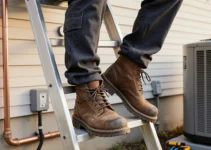
Standing on ladder rungs and scaffolding creates a localised pressure point under the arch from the ladder rung itself. Boots with a defined heel (not a flat wedge sole) and a rigid fiberglass shank distribute this load better. Wedge-sole boots perform poorly on ladder rungs — the flat profile doesn’t lock onto the rung. For workers who climb frequently: any 6-inch boot with a defined heel and fiberglass shank.
Break-In vs. Bad Fit: What Your Pain Timeline Tells You
Pain timing is a diagnostic tool. Different pain patterns point to different causes, and knowing which you have tells you whether to wait it out, return the boots, or buy an insole.
Pain in the first week only, disappearing by week 2–3: Normal leather break-in. Full-grain leather and Goodyear welt boots stiff from the factory, moulding to the foot over the first 15–20 hours of wear. If pain is only from stiffness and gradually improves, continue wear. Accelerate with leather conditioner on the upper and a boot stretcher on tight spots.
Pain that persists after 3 weeks of regular wear: This is a fit problem, not a break-in problem. The boot is wrong for your foot shape. Identify the specific location — heel slip means the heel cup is too wide; toe pain means the box is too narrow; arch pain in a new boot means the arch support doesn’t match your anatomy. Return and find a different boot.
Pain that begins at hour 4–6 into a shift but not at the start: This is midsole fatigue under sustained load — the boot performs adequately for the first hours but its cushion system compresses under the accumulated weight and impact of a long shift. This pattern suggests an EVA midsole that needs replacing, or a boot that needs a PU-midsole upgrade. Upgrade to a PU-based boot at next replacement.
Pain that steadily worsens over 6–18 months in the same boots: This is midsole collapse (dead boot syndrome). The boots need replacement, not insoles. Read the dead boot section above and check your midsole with the thumb test before buying another pair of insoles.
Insole Upgrade Guide: The Best Drop-In Insoles for Work Boots by Pain Type
When the right insole is the right solution — and the boot itself fits correctly — here are the specific insoles matched to the pain conditions in this guide.
Plantar fasciitis and heel pain: Superfeet Green. Firm medial arch post, deep heel cup, semi-rigid base. The most recommended OTC insole for plantar fasciitis by sports podiatrists. Works best in boots with sufficient depth to accommodate its thickness — remove the stock insole first.
Flat feet and overpronation: Superfeet Green (same recommendation) or Powerstep Pinnacle. The medial arch post is the key feature — it prevents the inward arch collapse that drives overpronation pain. Avoid soft, unstructured insoles for this condition regardless of how cushioned they feel.
Metatarsalgia and ball-of-foot pain: Spenco Total Support or an insole with an integrated metatarsal pad. The metatarsal pad sits just behind the metatarsal heads and redistributes forefoot pressure away from the most loaded points. Combine with a wide toe box boot (KEEN Flint II or KEEN San Jose) for best results.
General fatigue and midsole upgrade: OrthoLite Flex or Tread Labs Pace. These are designed to replace the factory insole with a longer-lasting, more supportive system while maintaining appropriate arch height. Good for any boot where the stock insole has flattened but the midsole is still functional.
Custom orthotics: If you have been prescribed custom orthotics by a podiatrist, the boots in this guide with sufficient depth to accommodate them are: OrthoFeet Granite (designed for this), KEEN San Jose, Merrell Work Moab 3, Wolverine Overpass, and KEEN Flint II. Remove the stock insole before inserting the custom device and verify the fit allows the heel to seat correctly in the heel cup.
Frequently Asked Questions
Why do my feet hurt in work boots even with cushioned insoles?
The most common cause is a collapsed midsole — the foam in the boot itself has compressed and is no longer absorbing impact, regardless of what insole you add on top. Do the thumb test on your boot midsole: if it leaves a permanent indent, the boot is dead and needs replacing. The second most common cause is a toe box that is too narrow causing forefoot compression — no insole resolves this. And the third cause is that soft, cushioned insoles worsen plantar fasciitis and flat-foot pain by allowing arch collapse. Make sure your insole has structured arch support, not just cushioning.
How heavy should work boots be to avoid foot fatigue?
Under 18 ounces per boot is the general target for workers whose primary concern is fatigue. Under 15 ounces is ideal for high-step-count roles (8,000+ steps per shift). The lightest ASTM-rated safety boots are in the 13–15 ounce range — the Timberland PRO Reaxion (13 oz) and KEEN San Jose (15 oz) represent the current lightweight ceiling for safety-toe work boots. Each 100g above these weights adds approximately 1% more oxygen consumption per mile of walking.
Are EVA or PU midsoles better for sore feet in work boots?
PU midsoles are better for workers with chronic, recurring foot pain because they maintain their cushioning performance significantly longer — 18–24 months vs. 6–12 months for EVA under daily hard use. EVA is lighter and feels softer initially, making it better for workers prioritising immediate comfort and weight over longevity. If your foot pain reliably returns after 6–8 months of wearing the same boots, switch to a PU-midsole boot at your next replacement.
How do I know if my work boots are causing my plantar fasciitis?
Two signs: first, pain that is worst in the morning after your feet have rested and improves slightly with activity but worsens again after prolonged standing is the classic plantar fasciitis pattern. Second, if your boot’s midsole has collapsed (fails the thumb test) or your boot lacks a deep heel cup and medial arch support, it is likely contributing. Switch to a boot with structured arch support (not maximum softness), deep heel cup, and firm medial posting — the OrthoFeet Granite or Timberland PRO Titan EV specifically address this.
Should I buy work boots or better insoles for foot pain?
Buy insoles if: your boots are under 12 months old and the upper fits correctly, and your pain is arch or heel pain an insole directly addresses. Buy new boots if: your boots are over 12–18 months old, the toe box is too narrow, the heel cup causes slippage, or you have tried insoles and the pain persists in boots under 6 months old. Never stack an aftermarket insole on top of the factory one — always remove the stock insole first.
How long before work boot midsoles compress and cause foot pain?
EVA midsoles: 8–12 months under daily heavy construction use; 12–14 months under daily light construction or warehouse use. PU midsoles: 18–24 months. Goodyear welt boots can be resoled at 14–18 months to renew the midsole without replacing the boot. The thumb-press test reveals collapse before pain becomes severe — do it monthly on boots over 8 months old.
Can work boots cause knee or back pain as well as foot pain?
Yes — this is the kinetic chain effect. Worn-out midsoles transmit unabsorbed impact upward through the ankle, knee, and hip. Soft heel counters allow the calcaneus to evert (roll inward) which transmits rotational force into the knee. Heavy boots increase overall muscular load and fatigue throughout the lower body. Workers with knee pain, hip tightness, or lower back soreness that worsens progressively over months or years in the same occupation should evaluate their boot condition and weight before pursuing other interventions.
What’s the best work boot for someone who stands on concrete all day?
The Ariat Treadfast for pure standing roles, or the Timberland PRO Titan EV for roles with both standing and walking. Standing on concrete is biomechanically different from walking — it creates sustained static compressive loading rather than the rolling impact of each step. The Ariat ATS system was specifically engineered for this pattern. If you also have plantar fasciitis or need an anti-fatigue midsole for long standing shifts, the Timberland PRO Titan EV addresses both concerns simultaneously.
Final Verdict: Match Your Boot to Your Pain Type
The most important thing to take from this guide is the diagnostic framework at the top: your specific pain location and timing determine which boot feature you need, and getting that match right matters more than price, brand, or any other consideration.
For most workers with generalised fatigue from heavy, stiff boots: Merrell Work Moab 3 — lightest in guide, air cushion heel, immediate relief from weight reduction alone.
For plantar fasciitis and heel pain: Timberland PRO Titan EV — anti-fatigue geometry specifically addresses heel strike load; PU midsole lasts longer than EVA alternatives.
For metatarsalgia and forefoot pain: KEEN San Jose — widest toe box in guide, LuftCell PU midsole, lightest safety boot available.
For flat feet and overpronation: OrthoFeet Granite — the only purpose-built orthopedic work boot in this guide; medial arch posting controls the root cause, not just the symptoms.
For the lightest possible boot for high step-count roles: Timberland PRO Reaxion — 13 oz per boot, composite toe, the weight reduction is often the complete solution for weight-driven fatigue.
For workers who cycle through boots every 8–12 months: BRUNT Marin Welted — Goodyear welt resoleable construction breaks the midsole-collapse cycle permanently.
For bunions, wide feet, and toe swelling: KEEN Flint II Wide — widest toe box under $150, KEEN asymmetric design avoids all MTP joint pressure.
For concrete and hard floor standing: Ariat Treadfast — ATS system engineered for static standing load, Duratread outsole for concrete chemistry resistance.
For women: Carhartt Rugged Flex Women’s — genuine women’s last addresses the anatomical fit issues that cause much of women’s work boot pain regardless of cushioning.
For the best budget relief: Wolverine Overpass CT — ContourWelt flex removes the rigid-boot gait compensation that causes calf and arch soreness; often more effective than any insole upgrade to a rigid boot.