
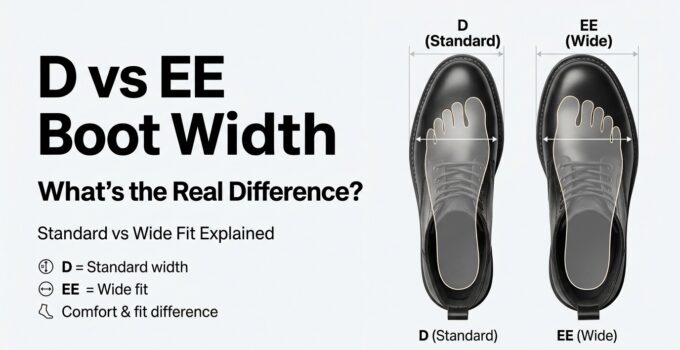
D vs EE Boot Width: The Short Answer
D is standard/medium width for men. EE (also written 2E) is wide. That’s the most common comparison people search for, and the answer is simple: EE is approximately 1/4 inch wider than D at the ball of the foot — enough to make a significant difference in comfort if your foot is broader than average.
For women, the standard width is B — so a men’s D already counts as wide for women’s feet.
The Full Boot Width Chart — Every Letter Explained
US boots and shoes use a letter system to indicate width. Here’s the complete scale from narrowest to widest:
| Width Code | Width Name | Who It’s For |
|---|---|---|
| AAA (AAAA) | Extra Narrow | Very narrow feet — rare in work boots |
| AA (2A) | Narrow | Narrow feet — some women’s styles |
| B | Standard (Women’s) | Average women’s foot |
| D | Standard (Men’s) | Average men’s foot — most common work boot width |
| E (2E / EE) | Wide | Wider than average — most brands offer this |
| EEE (3E) | Extra Wide | Significantly wider — fewer brands offer this |
| EEEE (4E) | Extra Extra Wide | Very wide feet — limited availability |
| F / G / H | UK Wide Fittings | UK/European sizing — H is the widest |
The physical difference: Each width step adds approximately 1/4 inch at the ball of the foot. So EE (wide) is 1/4″ wider than D (standard), and 4E (extra wide) is 1/2″ wider than D.
Is EE the Same as W (Wide)?
Yes — EE and W are the same thing. Brands just use different labeling conventions:
- Thorogood, Red Wing, Wolverine → use letter codes (D, EE, EEE)
- Timberland PRO, CAT → often use W (wide) or XW (extra wide)
- KEEN Utility → uses W for wide
- New Balance → uses 2E, 4E
When you see “W” on a men’s work boot, it almost always means EE. When you see “XW” or “WW,” that’s 4E territory.
Is EE or H Wider?
This only applies if you’re comparing US sizing (EE) to UK/European sizing (H). In UK sizing, H is extra wide — roughly equivalent to a US 4E or EEEE. So H is wider than EE.
UK width letters run: B (narrow) → C → D → E → EE → F → G → H (widest). Most UK-made boots like Grenson or Tricker’s use this system. Most American work boot brands use the US letter/number system.
How to Tell If You Have Wide Feet
Don’t guess — measure. Here’s the 2-minute method:
- Stand on a piece of paper with your full weight on the foot (sitting changes your foot width)
- Trace the outline of your foot
- Measure the widest point across the ball of the foot in inches
- Compare to the chart below
| Shoe Size (Men’s) | D (Medium) Width | EE (Wide) Width | 4E (X-Wide) Width |
|---|---|---|---|
| Size 8 | 3 11/16″ | 3 15/16″ | 4 3/16″ |
| Size 9 | 3 13/16″ | 4 1/16″ | 4 5/16″ |
| Size 10 | 3 15/16″ | 4 3/16″ | 4 7/16″ |
| Size 11 | 4 1/16″ | 4 5/16″ | 4 9/16″ |
| Size 12 | 4 3/16″ | 4 7/16″ | 4 11/16″ |
| Size 13 | 4 5/16″ | 4 9/16″ | 4 13/16″ |
If your measurement lands at or above the EE column for your size — you need wide boots. If you’re measuring above the 4E column, you need extra wide.
5 Signs You Need Wide Work Boots
- Your boots feel tight across the ball of the foot within the first hour — this is the most reliable sign
- You develop blisters on the sides of your feet, not just the heel or toes
- Your toenails go black after long shifts — often blamed on length, but can be caused by the foot being pushed forward by lateral compression
- You have flat feet — flat arches spread the foot wider under load
- You’re developing bunions — a narrow toe box accelerates bunion formation significantly
Should You Size Up Instead of Going Wide?
No — and this is a critical mistake many people make. Sizing up in length to get more width doesn’t work because boot construction doesn’t scale that way. A size 12D is not meaningfully wider than an 11D at the ball of the foot — it’s just longer. The result is heel slippage, blisters at the back, and a boot that feels loose in the wrong places while still being tight where it matters.
The right move is always to find the correct length in a wide width. Brands like Thorogood, Wolverine, Red Wing, and Chippewa offer genuine wide and extra-wide sizing. Thorogood in particular is known for running true to width — their EE is a real EE, not a stretched D.
How Much Room Should You Have in Work Boots?
- Length: About 3/8″ to 1/2″ between your longest toe and the end of the boot — roughly the width of your thumb
- Width: Your foot should sit flush with the footbed edges — not spilling over, not swimming in space
- Toe box: You should be able to wiggle all five toes independently without them touching the sides
- Heel: Maximum 1/4″ of lift when you walk — anything more causes blisters
If you’re buying online without trying on first, err toward the wider size rather than the narrower. A slightly wide boot can be managed with thicker socks or an insole. A boot that’s too narrow will cause problems no amount of breaking-in will fix.
Best Work Boot Brands for Wide Feet
Not all brands offer genuine wide sizing. These are the ones Ethan recommends based on years of fitting real workers:
- Thorogood — best true-to-width sizing in the business; available in D, EE, and EEE
- Red Wing — offers D, EE, and EEE in most styles; measures consistently
- Wolverine — wide sizing available in most core lines; slightly generous in D
- Chippewa — wide and extra-wide options; good for high-volume feet
- KEEN Utility — roomy toe box even in standard D; W width is genuinely wide
- New Balance (work line) — offers 2E and 4E consistently across the range
→ See our full guide: Best Work Boots for Wide Feet (2026)

Written by Ethan Walker
Ethan spent 8+ years in a Midwest construction supply store fitting contractors, roofers, and electricians with work boots. He’s personally fitted hundreds of people with wide-width boots and knows exactly where brands get it wrong. More about Ethan →
