
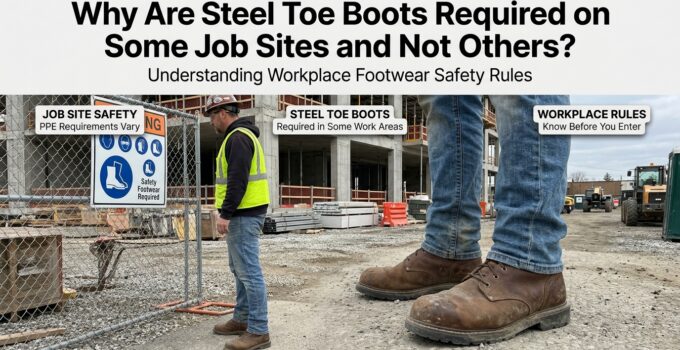
Here’s the part most people get wrong: OSHA does not require steel toe boots. Not on construction sites, not in warehouses, not anywhere. What OSHA actually requires is protective footwear that meets a performance standard, and steel is just one of several materials that can meet it. Whether your job site lands on “steel toe required,” “steel toe prohibited,” or “no safety toe needed at all” comes down to two separate decisions stacked on top of each other, and almost nobody explains both halves in one place.
This article walks through both. First, whether your job needs a safety toe at all. Second, if it does, which material actually fits the hazard, because steel is sometimes the right call, sometimes the wrong one, and sometimes actively dangerous.
What OSHA Actually Requires
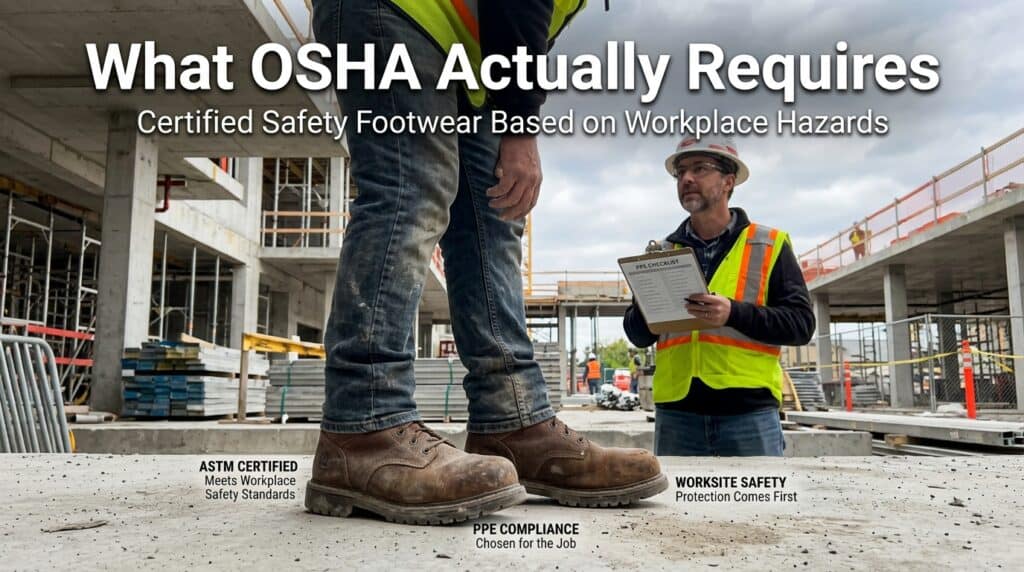
The relevant regulation is 29 CFR 1910.136, and it’s written around performance, not material. Employers must provide protective footwear where there’s a danger of foot injury from falling or rolling objects, objects piercing the sole, or electrical hazards. The footwear has to meet ASTM F2413 testing standards for impact and compression resistance, commonly shown on a boot’s rating as I/75 and C/75.
worker safety boots inspection o… 202608061525
Nothing in that standard says the toe cap has to be steel. Steel, composite, aluminum alloy, and carbon fiber can all pass ASTM F2413 testing and satisfy OSHA, as long as the boot carries the certification. The choice of material is left entirely to the employer’s judgment, based on what the actual hazard is. That’s the piece most job site rules and most online explanations skip past.
Why Some Job Sites Require Steel Toes Specifically
Steel earns its reputation honestly. It offers strong impact and compression resistance in a relatively thin profile, which means more room inside the boot for your actual toes compared to some alternatives, and it typically costs less than composite or alloy options with equivalent protection.
That combination makes steel the default on job sites where the primary hazard is blunt force: crushing, falling objects, or rolling equipment. Common examples:
- Construction sites: falling tools, dropped materials, heavy equipment moving across uneven ground
- Warehouses and distribution centers: forklifts, pallet jacks, and stacked inventory that can shift or fall
- Manufacturing floors: machinery, heavy parts handling, and equipment with genuine crush potential
- Logging and heavy outdoor labor: falling timber and heavy tool use where impact force is the dominant risk
On these sites, there’s no electrical or temperature complication working against steel, so it’s simply the most cost-effective way to meet the impact and compression requirement.
Why Some Job Sites Prohibit Steel Toes
electrician wearing safety boots… 202608061529
This is the half of the story that gets skipped most often. Steel isn’t just “unnecessary” on some sites, it’s genuinely the wrong material, and in some cases explicitly barred.
Electrical Hazard Work
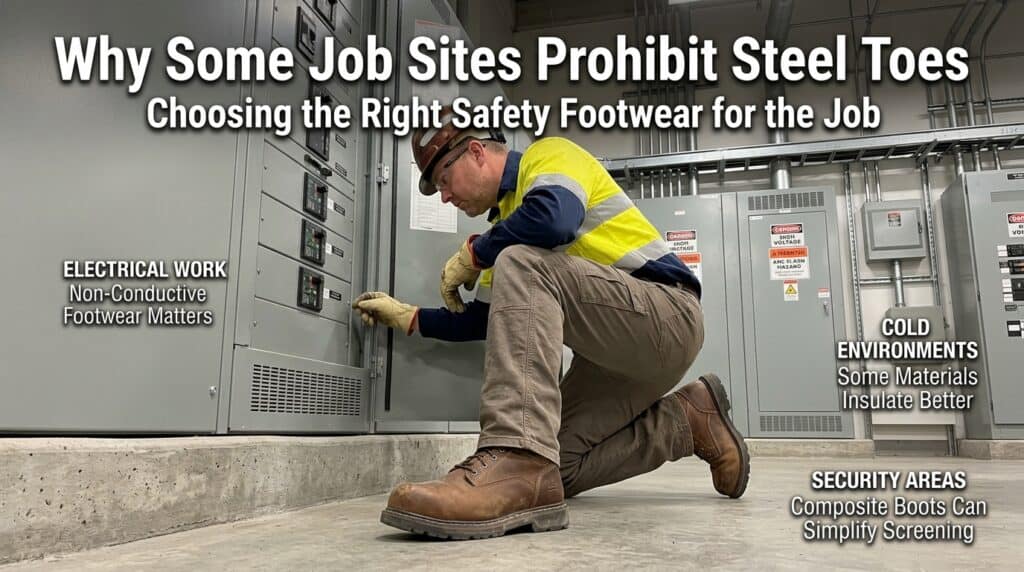
Steel conducts electricity. On any job site with exposure to live electrical circuits, electricians, linemen, anyone working near energized equipment, a steel toe cap turns into a conductive path directly at the foot. This isn’t a minor preference. Electrical hazard (EH) rated composite toe boots are built specifically to be non-conductive, and they’re the standard for this category of work for a real safety reason, not just habit.
Extreme Cold Environments
Steel transfers temperature efficiently, which is exactly what you don’t want wrapped around your toes in a walk-in freezer, an outdoor winter job, or any cold-storage environment. Composite and alloy toe caps insulate better, which is why you’ll see composite toes far more often in refrigerated warehouses and cold-climate outdoor work than steel.
Metal Detector Environments
Airports, some manufacturing plants with security screening, and certain government or industrial facilities run staff through metal detectors regularly. Steel toe boots trigger them every time. Composite toe boots don’t, which makes them the practical choice anywhere staff move through screening multiple times a shift.
Why Some Job Sites Require No Safety Toe At All
This is the other half of “not others” in the question. Plenty of jobs simply don’t carry a foot-crush or impact hazard significant enough to trigger the OSHA requirement in the first place. Office work, most retail environments, and many light warehouse or service roles fall into this category. The employer’s hazard assessment doesn’t turn up a falling or rolling object risk, so there’s no basis for requiring a safety toe.
Food service is a useful middle example. Kitchens often require slip-resistant, puncture-resistant footwear, since dropped knives and wet floors are real hazards, but many kitchens don’t require a certified impact-rated safety toe, because crushing and falling-object risk isn’t the dominant concern the way it is on a construction site.
Who Actually Decides, and How
There’s no single government list matching job titles to footwear requirements. Each employer is responsible for conducting a hazard assessment of their specific workplace and determining what PPE, including footwear, that assessment calls for. That’s why two people with the same job title, warehouse worker, for example, can have completely different footwear requirements at two different companies. One warehouse might have forklift traffic and heavy pallet handling that clearly calls for a safety toe. Another might be a lighter-duty fulfillment operation where that hazard doesn’t exist in the same way.
If you’re unsure what your job requires, the hazard assessment and the answer both sit with your employer or safety officer, not with a general industry rule of thumb.
Does Your Employer Have to Pay for Your Boots?
When an employer requires specialty protective footwear for a job, including steel toe or EH-rated boots, OSHA’s PPE payment rule generally requires the employer to provide that footwear at no cost to the employee. This applies specifically to specialty safety footwear required to comply with a hazard the employer has identified, not to ordinary footwear an employee might choose to wear regardless.
There’s a common exception worth knowing: if an employer allows a required safety boot to be worn off the job for personal use, that doesn’t change the payment obligation. The employer still has to cover it if it’s required for the work. On the other hand, non-specialty footwear that isn’t tied to a specific identified hazard generally isn’t something OSHA requires the employer to pay for.
Steel Toe vs Composite vs Alloy: Quick Decision Guide
| Hazard Type | Recommended Toe Material | Why |
|---|---|---|
| Falling or rolling heavy objects | Steel | Best impact/compression resistance for the cost, thin profile |
| Electrical hazard exposure | Composite (EH rated) | Non-conductive, steel is a genuine shock risk here |
| Extreme cold or cold storage | Composite or alloy | Doesn’t transfer temperature the way steel does |
| Frequent metal detector screening | Composite | Won’t trigger detectors |
| General impact risk, weight-conscious | Alloy | Similar protection to steel at lower weight, higher cost |
| Slip/puncture risk only, no crush hazard | No safety toe required | Hazard assessment doesn’t call for impact protection |
This table reflects general hazard-to-material matching used across most trades. Always confirm your specific job’s requirement with your employer’s hazard assessment or safety officer rather than choosing based on this table alone.
Common Myths About Steel Toe Boots
Myth: OSHA Requires Steel Toe Boots
Covered above, but worth repeating since it’s the most common misconception in this entire topic. OSHA requires certified protective footwear meeting performance standards. It does not specify steel as the material.
Myth: A Steel Toe Cap Can Crush Your Toes Worse on Impact
This is a long-running myth, that a heavy impact can bend the steel cap inward and cause worse injury than no protection at all. It’s been repeatedly shown to be false. Certified steel toe caps are tested to ASTM impact and compression standards specifically to prevent that failure mode.
Frequently Asked Questions
Is it illegal to work without steel toe boots if my job requires them?
If your employer has identified a foot injury hazard and set a safety footwear requirement based on that assessment, working without the required footwear is a workplace safety violation on your employer’s part if they don’t enforce it, and a real injury risk for you regardless. It’s not a matter of general law outside that workplace-specific requirement.
Can I wear steel toe boots on an electrical job?
Generally, no. Steel conducts electricity, and jobs with electrical hazard exposure typically require EH-rated composite toe boots specifically because they’re non-conductive. Check your job’s specific PPE requirement rather than assuming steel is acceptable.
Does OSHA require my employer to provide steel toe boots for free?
When specialty safety footwear is required to comply with an identified job hazard, OSHA’s PPE payment rule generally requires the employer to cover that cost. This applies to steel toe and EH-rated boots specifically required for the job, not to general footwear preferences.
What’s the difference between a safety toe and a steel toe?
“Safety toe” is the general category, any certified protective toe cap meeting ASTM F2413 standards. “Steel toe” is one specific material option within that category. Composite, alloy, and carbon fiber toes are also safety toes, just built from different materials with different trade-offs.
Bottom Line
Steel toe boots aren’t a blanket OSHA requirement, and they’re not always the right call even when a safety toe is genuinely needed. The real answer to “why are they required on some sites and not others” comes down to your employer’s hazard assessment: whether a foot-crush risk exists at all, and if it does, whether steel, composite, or alloy actually fits that specific hazard. If you’re shopping for a certified pair, match the material to your actual job conditions first, electrical work calls for composite, cold storage calls for composite or alloy, straightforward impact risk on a dry, temperature-normal site is exactly where steel does its job well.