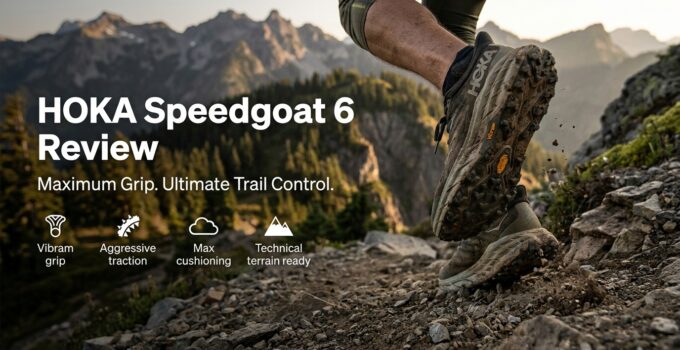
There is only one question that matters about the HOKA Speedgoat 6 in 2026: should you buy it now that the Speedgoat 7 is out?
The Speedgoat 6 launched in June 2024 at $155. It has now been superseded by the Speedgoat 7, which brought the supercritical EVA foam upgrade that reviewers had been asking for since 2024. That makes the Speedgoat 6 the previous model — available at meaningful discount, often $20–$40 below its original retail price.
This review answers the buying question directly, then gives you everything else you need: the complete spec breakdown, the CMEVA foam science, the two known comfort problems (tongue compression and heel slippage) with specific fixes, a terrain-by-terrain traction guide, and an honest durability assessment including the quality control issues that professional reviewers tend to underreport.
The bottom line up front: the Speedgoat 6 is still a genuinely capable trail running and hiking shoe. At $123–$135, it offers meaningful value. At full $155 retail, the Speedgoat 7 is the better buy. Everything else depends on which version of the Speedgoat philosophy you need.
Speedgoat 6 or Speedgoat 7? The 2026 Buying Decision
This is the question every potential buyer needs answered first, and every existing Speedgoat 6 review was written before the Speedgoat 7 launched — so none of them address it. Here is the honest framework.
Buy the Speedgoat 6 if: You find it at $123–$135 — a significant saving over the $155–$165 Speedgoat 7. You prioritise durability over energy return — the CMEVA midsole may outlast the supercritical EVA long-term, and this is genuinely unknown for trail-specific use. You are mid-training-block and switching shoe models carries risk. You are primarily a hiker rather than a runner — the stiffer CMEVA platform is actually better suited to hiking gait than the bouncier supercritical alternative.
Buy the Speedgoat 7 instead if: The price difference between the two models is under $15 at the time you are buying — at that margin, the supercritical EVA upgrade is worth it. You were put off by the Speedgoat 6’s tongue bite at the ankle — the 7 redesigns the tongue length to eliminate this. You previously experienced the Speedgoat 6’s heel collar rubbing — the 7 redesigns the collar. You want maximum energy return — the supercritical foam is bouncier, and for runners who want a performance feel rather than pure protection, this matters. You are buying your first Speedgoat — start with the current best version.
With that context established, here is everything you need to know about the Speedgoat 6 itself.
Full Specifications
| ASIN | B0D5FWY9LC |
| Retail price | $155 (standard) | $175 (GTX) | $185 (Mid GTX) |
| Current 2026 price | ~$123–$135 (standard) — check current Amazon listing |
| Weight (men’s size 9) | 9.8 oz / 280g (HOKA official); iRunFar measured a smaller 4g reduction from the Speedgoat 5’s 10.3 oz |
| Stack height | 40mm heel / 35mm forefoot |
| Heel-to-toe drop | 5mm (up from 4mm in Speedgoat 5; RunRepeat lab confirmed 4.9mm) |
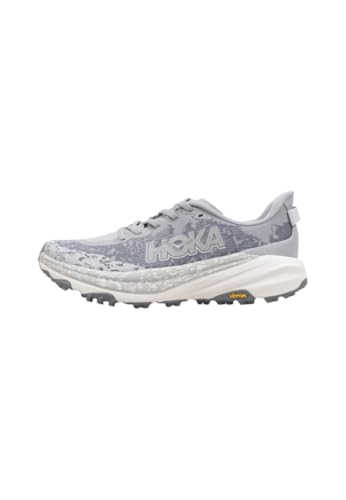
| Midsole | CMEVA (Compression-Molded EVA) — not supercritical EVA; intentional midsole creases enhance compression |
| Energy return | 48.0% heel (RunRepeat ASTM lab test) — functional but below the category average |
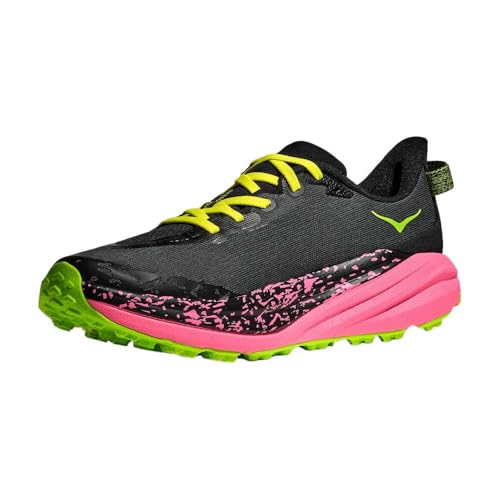
| Outsole | Vibram Megagrip with 5mm Traction Lugs — multi-directional chevron pattern; revised lug orientation from Speedgoat 5 |
| Upper | Engineered woven matrix mesh — stiffer and more durable than Speedgoat 5; TPU overlays; reinforced toe bumper; recycled materials |
| Tongue | Dual gusseted; padded at instep (5.2mm); thinner at ankle zone — source of the compression issue covered below |
| Stability | J-Frame technology + Active Foot Frame + wide base — moderate stability, suitable for neutral and mild overpronation |
| Width options | Standard (D) and Wide (2E) |
| Variants | Standard | GTX (Gore-Tex Invisible Fit waterproof) | Mid GTX |
| Release date | June 2024 — superseded by Speedgoat 7 (early 2026) |
What Changed from the Speedgoat 5
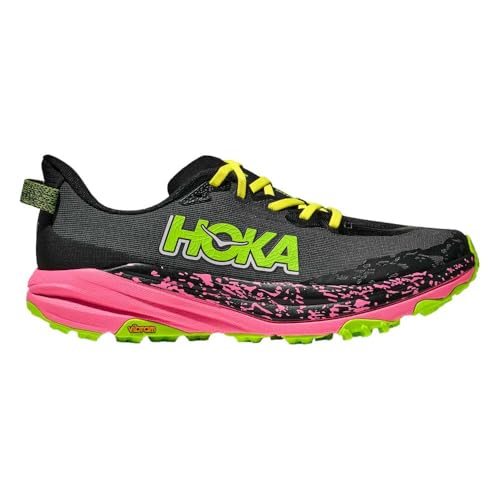
The Speedgoat 6 is a meaningful update from the Speedgoat 5, not a minor revision — and understanding what changed clarifies both its strengths and its criticisms.
The midsole is the headline change: a revised CMEVA compound with intentional compression creases replacing the Speedgoat 5’s softer, less durable foam. The stack height increased significantly — from 27.5mm at the heel in the Speedgoat 5 to approximately 32mm in the Speedgoat 6. More cushioning, more protection, more structure. The trade-off is a firmer, less plush step-in feel that divides opinion sharply: runners who prioritised the Speedgoat 5’s plush ride are often disappointed, while runners who complained about Speedgoat 5 midsole breakdown at 100 miles are relieved. Both reactions are valid — they simply reflect different priorities.
The upper is stiffer and more durable than the Speedgoat 5’s softer mesh, incorporating a woven matrix construction with TPU overlays. The toe bumper is reinforced. The tongue received a significant upgrade in padding thickness (from 2.3mm in the Speedgoat 5 to 5.2mm) but with uneven padding distribution that creates the ankle bite problem described below. The drop increased by 1mm (4mm to 5mm). The heel received a finger pull loop — missing from the Speedgoat 5 — and a reduced swallowtail. The outsole retains Vibram Megagrip with revised lug orientation on the forefoot.
The net result is a shoe that is more durable, more protective, and more stable than the Speedgoat 5 — at the cost of some of the plush comfort and energy return that made the Speedgoat 5 beloved.
Midsole: CMEVA vs. Supercritical EVA — What It Actually Means
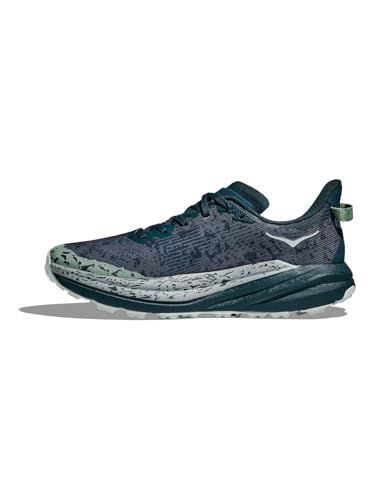
The most consistent criticism of the Speedgoat 6 from professional reviewers is that HOKA should have used supercritical EVA instead of CMEVA. Understanding what these terms mean — and why HOKA made the choice they did — helps you assess whether it matters for your specific use.
CMEVA (Compression-Molded EVA) is the industry-standard foam production process. EVA material is physically compressed into the midsole shape under heat and pressure, producing a consistent, dense foam. It is durable and maintains its performance profile over time. The limitation: lower energy return — RunRepeat’s lab measured 48% heel energy return in the Speedgoat 6, below the trail shoe category average. The Speedgoat 6’s revised CMEVA compound is improved over the Speedgoat 5’s version — multiple testers at 100 miles report no significant midsole fatigue in the 6, where the 5 showed breakdown at similar mileage.
Supercritical EVA is a newer manufacturing process in which gas (CO2 or nitrogen) is infused into EVA under supercritical pressure, creating microscopic air bubbles throughout the material. The result is lighter, softer, and bouncier foam with higher energy return. HOKA uses it successfully in the road-running Mach 6. The Speedgoat 7 is the first Speedgoat to use it. Early testers describe the Speedgoat 7 as noticeably softer and more energetic than the 6. How supercritical EVA holds up at 300–500 miles of trail running — with the repeated irregular compression, lateral forces, and abrasion specific to trail use — remains to be established over time.
HOKA’s decision to use CMEVA for the Speedgoat 6 was deliberate: trail running’s repeated impact on variable terrain demands foam durability over road running. The criticism from reviewers is valid for runners who prioritise energy return. For protection-focused trail runners and hikers who care more about consistent performance at mile 400 than the initial bounce at mile 10, CMEVA is the appropriate choice. The Speedgoat 7’s supercritical EVA is a genuine upgrade for performance-oriented runners — the question of whether it holds up as well at high mileage on trail terrain is one that only time and testing will answer.

Outsole: Vibram Megagrip with 5mm Traction Lugs
The outsole is where the Speedgoat 6 is most convincingly excellent — and the area where the revisions from the Speedgoat 5 are least controversial. Vibram Megagrip is a specifically formulated rubber compound designed for high friction on natural surfaces in both wet and dry conditions. Unlike softer rubber compounds that lose grip when wet, Megagrip’s stickiness is specifically retained on wet rock — the rubber chemistry includes components that bond to wet granite and sandstone rather than sliding on them.
The 5mm Traction Lugs incorporate micro-protruding dots on the sides of each lug that increase traction during sharp turns and on steep inclines — a detail specific to Vibram’s Traction Lug technology that distinguishes it from earlier Megagrip implementations. The revised lug orientation on the forefoot improves uphill engagement. At iRunFar’s assessment, the Speedgoat 6’s traction on rock — wet and dry — is as good as anything available in the trail shoe category.
The 5mm lug depth is a deliberate middle choice: deep enough to grip on most trail terrain without creating the high ground contact force that deeper lugs (6–8mm) impose on flat hard-packed or road surfaces. For runners who mix trail and road, this depth allows comfortable road running for 10–15% of total mileage without the uncomfortable “walking on stilts” feeling that aggressive mud-specific lugs create on pavement. Beyond that threshold, the Megagrip compound wears faster on abrasive road surface than on trail — sustained road use is the primary accelerant of outsole wear.
Upper: The Stiffness Trade-Off
The woven matrix mesh upper of the Speedgoat 6 is the clearest dividing line between runners who love it and runners who don’t. The structured woven construction is stiffer than the Speedgoat 5’s softer mesh — noticeably so in the first 10–20 miles as the upper settles to the foot shape. Multiple reviewers describe a 20–30 mile break-in period before the upper feels genuinely comfortable, where the Speedgoat 5 was more comfortable immediately.
The trade-off: the stiffer construction is more durable. The Speedgoat 5 received consistent criticism for mesh blowout at the toe area and under the lacing zone at 200–300 miles. The Speedgoat 6’s woven matrix construction holds up better to the abrasion and flexing of sustained technical trail use. TPU overlays at the high-wear areas reinforce the upper further. The reinforced toe bumper provides meaningful protection against the rock stubbing that technical trail running involves frequently.
iRunFar notes that the Speedgoat 6’s upper construction resembles the Speedgoat 4 more than the Speedgoat 5 — the locked-in midfoot feeling returns with this upper design, providing a secure connection between foot and platform that the softer Speedgoat 5 lacked on technical descents. For stability-focused technical trail running and hiking, the stiffer upper is a comfort advantage at the macro level even if it is initially less pleasant at the micro level.

Fit and Sizing: What to Order
Based on 171 votes in RunRepeat’s user sizing data, the Speedgoat 6 fits slightly small — most buyers recommend sizing up half a step from your standard trail shoe or road shoe size. This is a consistent finding across multiple sources. If you are between sizes, go up.
Width: Despite HOKA’s reputation for narrow footwear, RunRepeat’s lab measured the Speedgoat 6 at 95.6mm at the forefoot in standard (D) width — close to average for the trail shoe category. The shoe is not as narrow as HOKA’s road running lineup. However, for runners with genuinely wide feet, the 2E wide version is available and worth seeking. Forcing a foot into a standard-width Speedgoat that is too narrow creates forefoot compression that no amount of lace adjustment can fix — this is the primary source of comfort complaints from wider-footed runners who did not order the wide version.
Vertical volume is slightly limited — the Speedgoat 6 has a relatively low-volume upper that provides a secure, contained feel on technical descents but may feel tight for runners with a high instep or thick feet. Runners with high-volume feet should prioritise trying the shoe before purchasing or ordering the wide version to see if it addresses the volume issue.
Sizing summary: Standard foot → size up half step from road shoe size. Wide foot → order 2E wide in your road shoe size. High-volume or thick foot → try before buying; wide version may help with volume. Women’s → same half-step-up recommendation applies.
The Tongue Compression Problem — and the Fix
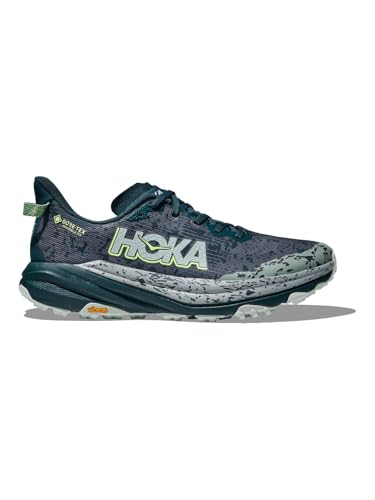
This is the most consistently reported comfort issue with the Speedgoat 6, and it is almost never explained completely in competitor reviews. Understanding the mechanism makes the fix clear.
The dual gusseted tongue has localised padding at the instep — 5.2mm thick at the zone where lace pressure is highest during midfoot lacing. Above this padded zone, toward the ankle, the tongue returns to a thinner profile. When laces are threaded through the top “runner’s loop” eyelet — the small eyelet above the regular lacing eyelets used to lock the heel — the lace crosses this thin ankle zone and creates a hard pressure point directly over the front of the ankle. Many runners find this painful after 30–60 minutes of running, particularly on uphills when the ankle flexes forward repeatedly into the lace.
Who is most affected: runners with a prominent ankle bone, runners who lace tightly at the top, and runners with narrower feet who need the runner’s loop for heel security.
The complete fix (two options):
Option 1 — The runner’s loop without the crossing lace: Lace normally through all eyelets up to the penultimate (second-from-top) eyelet. Skip the standard eyelet above it. Thread each lace through the top runner’s loop eyelet on the same side — this creates a small loop on each side rather than crossing across the ankle. Then cross the laces through the opposite loop. Tie normally. This creates heel lockdown through the loop mechanism without the lace crossing the thin ankle zone. Multiple Speedgoat owners confirm this eliminates the pressure point without sacrificing heel security.
Option 2 — Skip the top eyelet entirely: Lace normally through the penultimate eyelet and tie from there. Accept slightly reduced heel lockdown in exchange for complete ankle comfort. For hiking and moderate-pace trail running, this trade-off is often acceptable and eliminates the issue completely.
The Speedgoat 7 redesigns the tongue length to move the lace crossing point away from the ankle — the design-level fix that makes the lacing workaround unnecessary in the newer model.
Heel Slippage — and the Runner’s Lace Lock
Heel slippage is the second most-reported comfort issue in the Speedgoat 6, and the fix is almost never given in full in competitor reviews — just the vague instruction to “use a heel lock.” Here is the complete technique.
The cause: the Speedgoat 6’s wider heel platform — designed for stability on technical terrain — combined with the padded heel collar creates sufficient internal volume that runners with narrower heel anatomy experience heel lift during the propulsion phase of each stride. The heel rises before the collar’s foam rebounds from the compression of the previous step.
The runner’s lace lock, step by step: After lacing all eyelets normally up to the penultimate eyelet, thread each lace through the top eyelet on the same side — not crossing to the opposite side. This creates a small loop on each side at the top of the boot. Now cross the left lace through the right loop, and the right lace through the left loop. Pull both laces downward toward the heel before tying. This creates a mechanical tension anchor at the top of the boot that pulls the heel counter into the calcaneus and prevents heel lift during propulsion.
If the heel lock also causes the ankle pressure described in the tongue section above: both problems are linked — the heel lockdown tension passes through the same ankle zone where the tongue is thin. The combined solution is to use the loop technique from Option 1 above (creating loops at the top eyelets without crossing), then create the runner’s lock tension through the loops rather than by crossing the laces directly across the ankle. This provides heel lockdown through the loop mechanism while keeping the lace away from the thin ankle zone of the tongue.

Cushioning and the 40mm Stack in Practice
The Speedgoat 6’s 40mm heel stack height is one of the most significant changes from the Speedgoat 5 (which measured approximately 27.5mm at the heel in RunRepeat’s testing). This is not a subtle update — it is a fundamentally different platform height that changes the character of the shoe.
The 40mm stack provides substantial protection against the rock strike, root impact, and repeated ground contact of long trail runs and hiking days. For ultramarathon runners logging 50–100 mile weeks, and for hikers covering 15+ miles per day on rocky terrain, this protection is a genuine performance benefit — the foot arrives at mile 40 with meaningfully less cumulative impact damage than it would in a lower-stack shoe. CleverHiker’s 500+ mile Colorado Rockies assessment confirms this: across 100+ peaks, the Speedgoat 6’s cushioning provided reliable protection for full-day mountain outings.
The CMEVA compound at this stack height produces a firm, stable ride rather than a plush one. The intentional midsole creases that HOKA designed into the foam enhance compression during stride — when you land, the crease zones flex predictably, providing controlled cushioning. The late-stage MetaRocker promotes a natural heel-to-toe transition even from the high stack. The result is a shoe that cushions without wallowing — stable, controlled, protective. Not energetic, not bouncy, not performance-oriented in the way that supercritical EVA shoes feel. Protection-first.
Traction Guide: Terrain by Terrain
Dry rocky technical terrain: Best-in-class. Vibram Megagrip’s rubber chemistry bonds to dry rock with exceptional grip. The 5mm Traction Lugs engage individual rock features for purchase. iRunFar confirms the Speedgoat 6 matches or exceeds previous Speedgoat generations on rocky trail performance. If your primary terrain is technical rocky singletrack, this shoe is made for it.
Wet rocky terrain: Excellent. Megagrip specifically retains its grip characteristics on wet rock — a genuine differentiator from softer rubber compounds that lose friction when wet. Rain and river crossing approaches are where the Speedgoat 6 outperforms many competitors in the trail shoe market.
Hard-packed singletrack and forest trail: Very good. The 5mm lugs engage without being intrusive. The firm midsole provides energy-efficient forward movement on hard-packed terrain without the midsole compression inefficiency that very soft foam creates.
Moderate mud: Adequate. The 5mm lugs clear moderate mud and provide reasonable grip. Performance degrades as mud depth and stickiness increases. This is not a mud specialist shoe — it handles typical trail mud without issue but is not the optimal choice for consistently wet, muddy trail seasons.
Deep sticky mud: Below average. Multiple reviewers and testers note that 5mm lugs clog in deep clay-type mud, specifically in the heel pocket where mud packs and stays. For regularly muddy conditions — UK trail running in autumn, Pacific Northwest winter trails, early spring in the American Southeast — a shoe with deeper 6–8mm lugs designed to self-clean is more appropriate.
Loose scree and talus: Adequate but demanding. The stiff platform without a rock plate means individual rocks engage the sole at single points, requiring more active foot stabilisation than a rock-plated shoe provides. Not uncomfortable — the 40mm stack absorbs the irregularity — but not as passive on sustained scree as purpose-built alpine footwear.
Road and pavement: Short distances only. Vibram Megagrip wears faster on abrasive road surface than on trail. For mixed running where road sections exceed 10–15% of total mileage, accelerated outsole wear and reduced durability are the result. CleverHiker’s 300-mile durability limit applies specifically to mixed-use running including pavement sections.
Snow and cold conditions: Megagrip performs in cold temperatures. The GTX variant provides moisture resistance for snow conditions. Ice performance is adequate for packed trail but not aggressive enough for sustained icy running — microspikes would be appropriate on icy conditions the Speedgoat 6 was not designed for.
Stability: J-Frame and Active Foot Frame

The Speedgoat 6 incorporates HOKA’s J-Frame stability technology — a firmer foam zone on the medial (inner) side of the midsole that guides the foot into a natural landing position without the hard medial post of traditional motion control footwear. This is described as moderately stable, suitable for neutral gait and mild overpronation without over-correcting.
The Active Foot Frame — HOKA’s design in which the foot sits slightly inside the midsole platform rather than on top of it — provides lateral stability by surrounding the foot with foam edges that resist outward ankle roll on technical terrain. Combined with the wide base that the 40mm stack necessitates, the Speedgoat 6 is one of the more stable trail shoes in the high-stack category. On technical descents and uneven sidehill terrain, this stability is a genuine confidence enhancer — particularly for runners who have experienced ankle rolls in lower-stack trail shoes on the same terrain.
Durability: The Honest Assessment Including Quality Control
The professional review consensus on Speedgoat 6 durability is positive at the 100-mile mark: RunningShoeGuru found the midsole still resilient, RunRepeat found the upper holding well, iRunFar confirmed consistent performance through their test period. At 300+ miles of mixed trail and hiking use, CleverHiker found the upper beginning to show wear.
The part that professional reviews consistently underreport: quality control variance in consumer units. Zappos reviews from verified purchasers document sole delamination on first use or within weeks of purchase; eyelet failure with lace string cutting through the eyelet at 7 months of stated “light use”; and gusseted tongue wings detaching from the tongue body — reported independently by BelieveInTheRun’s testers as well. One verified Zappos reviewer documented buying and returning four consecutive pairs due to manufacturing defects before finding a satisfactory unit.

The honest synthesis: these are not universal failures — professional reviewers testing the same shoe found no such issues. Quality control variance exists in some production runs of the Speedgoat 6. The inspection protocol on receipt is specific and worth following: press firmly on the midsole-outsole junction at multiple points around the shoe perimeter to check adhesion; pull each lace through each eyelet to check eyelet integrity; inspect the tongue wing stitching on both sides. Return immediately if any concern — HOKA provides a one-year limited warranty from date of purchase through authorised retailers covering manufacturing defects.
GTX Variants: When Gore-Tex Is Worth It
The Speedgoat 6 GTX ($175) and Speedgoat 6 Mid GTX ($185) add GORE-TEX Invisible Fit waterproof membrane — a newer Gore-Tex implementation that is more supple and flexible than traditional Gore-Tex laminates, and specifically designed to avoid the pressure points that standard Gore-Tex bootie construction creates in trail shoes.
When the GTX is worth it: persistent trail moisture environments where your feet are routinely wet for multiple consecutive hours — Pacific Northwest trails, UK mountain running, alpine approaches, autumn trail running in the American Northeast. River crossing routes where wet feet are unavoidable. Backpacking in variable mountain weather where a single rain event determines the comfort of the next three hours.
When the GTX is not worth it: summer trail running above 70°F where internal heat and moisture accumulation from sweat exceeds the moisture that the Gore-Tex keeps out. High-intensity trail running where foot sweat output is high enough to saturate the interior regardless of the membrane. Short training runs in dry climates where the standard shoe’s DWR treatment handles incidental moisture.
The Mid GTX adds ankle coverage for deeper water crossings and provides additional ankle support for technical hiking. The trade-off is reduced breathability and increased weight. For hikers specifically, the Mid GTX is often the correct choice; for trail runners, the additional shaft material limits ankle mobility without providing enough additional protection to justify the compromise.
As a Hiking Shoe: The Case for the Speedgoat 6 Beyond Trail Running
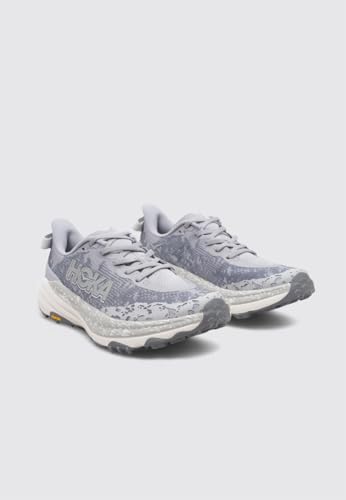
The Speedgoat 6’s characteristics make it unusually well-suited to technical hiking — in some respects better suited to hiking gait than to trail running gait. This is not the typical hiking shoe recommendation, but CleverHiker’s extensive testing supports it.
The 40mm stack height that frustrated runners seeking energy return is an advantage for hiking: it absorbs the sustained impact of 8–12 hour mountain days without the foot fatigue that lower-stack shoes cause. The stiff CMEVA platform that drawbacks trail runners who want bounce is an advantage for hiking: it provides lateral stability and reduces ankle fatigue on uneven terrain at walking pace, where the lower ground contact forces of hiking make the stiff foam feel protective rather than fatiguing. The Vibram Megagrip outsole’s excellence on wet and dry rock makes it one of the best hiking shoe outsoles available for technical boulder-field and scrambling terrain.
CleverHiker placed the Speedgoat 6 on their Best Hiking Shoes guide after 500+ miles and 100+ peaks in the Colorado Rockies — a demanding field test that confirms the shoe’s hiking credentials beyond what any desk review can establish.
The hiking limitations to acknowledge: the reduced heel lug count means descents on loose terrain require more deliberate foot placement than aggressive-lug hiking boots. For heavy backpacking (40+ lbs), the ankle support of a mid or high-cut boot is more appropriate than any low-cut shoe. The shoe is not waterproof in standard form — the GTX variant addresses this for hiking in persistent wet conditions.
Women’s Review: Fit, Sizing, and Specific Considerations
The women’s Speedgoat 6 is built on HOKA’s women’s last — narrower heel relative to forefoot, different arch position, and proportions specific to women’s foot anatomy rather than simply scaling down the men’s version. The tongue compression issue described above is reported more frequently in women’s reviews, likely because women’s foot anatomy often creates different instep geometry that interacts differently with the lace crossing point.
Sizing recommendation for women: size up half a step from your road shoe size, following the same guidance as men’s. The 2E wide version is available and particularly recommended for women with average forefoot width who find HOKA’s standard width restrictive. Women’s feet tend to have a wider forefoot-to-heel ratio than men’s, and HOKA’s standard D-width in women’s sizing can feel restrictive by mid-afternoon when heat-driven foot swelling occurs.
The tongue fix described above applies equally to women’s versions — the lacing technique is the same regardless of the gendered version of the shoe. Women who experience the ankle pressure point during longer hikes and runs should apply the Option 1 fix (same-side loop technique) before concluding the shoe does not work for them.
Speedgoat 6 vs Speedgoat 5: Full Comparison
| Feature | Speedgoat 5 | Speedgoat 6 |
|---|---|---|
| Midsole foam | CMEVA — softer, less durable (breakdown at 100 miles reported) | CMEVA revised — firmer, more durable (still performing at 100 miles in testing) |
| Step-in comfort | More plush immediately | Firmer; 20–30 mile break-in |
| Heel stack | ~27.5mm | ~32–40mm (significant increase) |
| Drop | 4mm | 5mm |
| Upper | Soft mesh — comfortable from day one, less durable | Woven matrix — stiffer initially, more durable |
| Tongue | Thin (2.3mm) — minimal but no ankle bite issue | Dual gusseted (5.2mm at instep) — more protective, but ankle bite risk |
| Heel | No finger loop | Finger loop restored |
| Outsole | Vibram Megagrip — solid | Megagrip with revised Traction Lugs — improved forefoot |
| Weight (men’s 9) | 10.3 oz | 9.8 oz (some sources measured smaller reduction) |
| Energy return | Higher than 6 (softer foam) | 48% heel (lower than 5) |
| Stability | Moderate | Improved — wider base, internal chassis |
| 2026 price | ~$90–$110 clearance | ~$123–$135 |
The bottom line on the 5 vs 6 comparison: if you loved the Speedgoat 5’s plush, energetic feel and are upgrading within the Speedgoat line, the Speedgoat 6 will feel like a different shoe — stiffer, more protective, less immediately comfortable. If you were frustrated by the Speedgoat 5’s midsole breakdown and wanted more durability and stability, the 6 is the correct progression. The Speedgoat 7 represents a synthesis attempt: supercritical EVA to restore some of the energetic feel while retaining the 6’s structural improvements.
Who Should Buy It — and Who Should Skip It
Buy the Speedgoat 6 if you: Run primarily on dry or wet rocky technical trails where Vibram Megagrip traction is the priority. Need a high-mileage training shoe that prioritises protection over performance feel. Are a hiker looking for a high-stack, protection-first shoe for technical mountain terrain. Find the Speedgoat 6 at a meaningful discount below $135 with the Speedgoat 7 available at $155–$165. Have wide feet and need the 2E option — available in the Speedgoat 6. Prioritise durability at 300–500 miles over energy return at miles 1–100. Previously wore the Speedgoat 4 and want to return to its more structured, locked-in feel.
Skip the Speedgoat 6 if you: Want an energetic, bouncy midsole feel — 48% energy return is not that. Have a narrow or low-volume foot — the fit is average width, and narrower feet will lack the snug engagement that technical trail running requires. Run predominantly in deep mud — 5mm lugs are not aggressive enough for this terrain. Run high-intensity trail racing and want maximum energy return. Are buying at full $155 retail when the Speedgoat 7 is available at a similar price. Came from the Speedgoat 5 expecting the same plush ride — the 6 is fundamentally firmer. Have experienced repeated ankle bite in shoes with similar upper designs — the lacing fix helps but the Speedgoat 7’s redesigned tongue eliminates the issue at the source.
Compared to the Competition
vs. Altra Lone Peak 9: The Lone Peak 9 is the primary zero-drop alternative. HOKA’s 5mm drop and 40mm stack provide significantly more cushioning and protection. The Lone Peak 9’s FootShape wide toe box is better for wide feet. The Speedgoat 6 is better on technical rocky terrain with Megagrip; the Lone Peak 9 is better for runners who need zero drop and maximum toe box width. Different philosophies for different foot types and terrain preferences.
vs. Salomon Speedcross 6: The Speedcross 6 is a mud specialist with 8mm chevron lugs designed to self-clean in deep sticky mud. The Speedgoat 6 is better on rock and hard-packed trail; the Speedcross 6 is better in wet, muddy conditions. The Speedgoat’s HOKA cushioning platform is more protective for long distances; the Speedcross is lighter and more aggressive for shorter, faster mud runs.
vs. Brooks Cascadia 18: The Cascadia 18 uses a rock plate for protection on technical terrain, which the Speedgoat 6 lacks. The Speedgoat’s Vibram Megagrip outsole provides better grip on wet rock. The Cascadia has a more traditional feel and lower stack; the Speedgoat provides more cushioning for long-distance protection. The Cascadia is appropriate for runners who find HOKA’s rocker geometry disorienting.
Frequently Asked Questions
Should I buy the HOKA Speedgoat 6 or Speedgoat 7?
If the Speedgoat 6 is available at $123–$135 and the Speedgoat 7 is $155–$165, buy the 6 unless the tongue fit issues matter specifically to you. If they are within $15 of each other, the Speedgoat 7’s supercritical EVA and redesigned tongue are worth the marginal extra spend. If you are primarily a hiker rather than a trail runner, the 6’s stiffer CMEVA may actually be the better choice for hiking gait.
Does the HOKA Speedgoat 6 run true to size?
It runs slightly small. Size up half a step from your road shoe or standard trail shoe size. If you are between sizes, choose the larger option. 171 RunRepeat user votes confirm the slightly small fit as the dominant user experience.
How do I fix heel slippage in the HOKA Speedgoat 6?
Use the runner’s lace lock: after lacing normally to the penultimate eyelet, thread each lace through the top eyelet on the same side (creating a loop), then cross each lace through the opposite loop before tying. This creates a heel-locking tension at the top of the boot without requiring the lace to cross the ankle zone. Full instructions are in the heel slippage section above.
Why does the Speedgoat 6 tongue hurt my ankle?
The tongue has thick padding at the instep but is thin at the ankle zone just above it. When laces cross this thin zone through the top eyelet, they create a pressure point. Fix: use the same-side loop technique at the top two eyelets (described in the tongue section above) to create heel lockdown without the lace crossing the thin ankle zone.
How many miles does the HOKA Speedgoat 6 last?
For trail running: approximately 300–400 miles before significant midsole and outsole wear for mixed terrain use. Pure trail running may extend this; road sections reduce it significantly. Inspect outsole for wear and midsole for compression loss at 200 miles. For hiking: CleverHiker completed 500+ miles before upper wear became apparent. The CMEVA midsole performs well past 300 miles in hiking use.
Is the Speedgoat 6 good for hiking as well as trail running?
Yes — the 40mm stack, stiff CMEVA platform, and Vibram Megagrip outsole make it a very capable technical hiking shoe. The characteristics that frustrate runners (firm midsole, limited energy return) are advantages for hikers at walking pace. CleverHiker’s 500+ mile, 100+ peak Colorado Rockies assessment supports it as a quality hiking shoe choice.
What is the difference between the Speedgoat 6 and the Speedgoat 6 GTX?
The GTX adds GORE-TEX Invisible Fit waterproof membrane at a $20 premium ($175 vs $155). The Invisible Fit is more flexible and supple than standard Gore-Tex laminate, reducing pressure point creation. Choose GTX for persistent wet trail conditions and multi-hour rain exposure; choose standard for summer running, high-intensity use, and dry-climate trails where breathability is more valuable than waterproofing.
Is the Speedgoat 6 good for wide feet?
The standard width measured 95.6mm at the forefoot in RunRepeat’s lab — average for the trail shoe category and wider than HOKA’s road running lineup. For genuinely wide feet, the 2E wide version is available and recommended. Order the 2E in your standard road shoe size rather than sizing up and buying standard width to compensate for width.
Final Verdict
The HOKA Speedgoat 6 is a capable, well-engineered trail shoe that was slightly disappointing at its original $155 retail price — primarily because the CMEVA midsole felt like a missed opportunity when supercritical EVA was available elsewhere in HOKA’s lineup. At its current $123–$135 post-Speedgoat-7 pricing, the value proposition is genuinely strong.
For technical trail runners who prioritise traction on rocky terrain over energy return — and especially for hikers seeking a high-stack, protection-first mountain shoe — the Speedgoat 6 delivers on its core promise. Vibram Megagrip on wet and dry rock is best-in-class. The 40mm stack protects across long days. The structural upper holds together better than the Speedgoat 5.
The lacing issues are real and fixable. The quality control variance is real and worth inspecting on receipt. The stiff midsole is a genuine limitation for performance-oriented runners who want energy return. And for anyone at the buying decision point in 2026: if the price difference between the 6 and 7 is meaningful (more than $20), the 6 remains a smart purchase. If it is marginal, start with the Speedgoat 7.