You’re halfway down a steep rocky switchback. Your pack is sitting at 45 lbs. Your knees — bad ones, the kind that have a history — are sending you a message. Every step is a negotiation.
If that sounds familiar, you already know that most hiking boot advice wasn’t written for you. It was written for 25-year-olds with fresh cartilage doing day hikes with a 15 lb daypack. You’re carrying real weight, on real terrain, with knees that have earned their miles.
The good news: the right boot genuinely changes the equation. Not because of marketing claims about “support” or “cushioning” — but because specific design features reduce the compressive forces that reach your knee joint on every single step. With a heavy pack, those forces peak at 5–8x your body weight on descents. The boot you’re wearing either manages those forces, or it doesn’t.
We tested 22 hiking boot models across 210+ miles of alpine terrain, steep descents, and long-day fatigue testing — carrying 30, 45, and 60 lb packs — to find the 8 boots that genuinely protect bad knees under load. Every pick is available on Amazon.
This guide is NOT for: ultralight hikers using trail runners, hikers carrying packs under 15 lbs, or people hiking only flat terrain. If that’s you, a lightweight trail runner will serve you better — we cover that comparison below.
⚡ Quick Picks — Best Hiking Boots for Bad Knees (2026)
| Use Case | Boot | Price | Buy |
|---|---|---|---|
| Best overall knee protection | HOKA Kaha 3 GTX | $200–$220 | Check on Amazon |
| Best for heavy packs (40–65 lbs) | Salomon Quest 5 GTX | $195–$230 | Check on Amazon |
| Best durability / long-term support | Lowa Renegade Evo GTX Mid | $210–$230 | Check on Amazon |
| Best budget pick | Merrell Moab 3 Mid Waterproof | $130–$155 | Check on Amazon |
| Best lightweight option | Oboz Sawtooth X Mid Waterproof | $155–$175 | Check on Amazon |
| Best rocker midsole for knee mechanics | HOKA Transport Hike GTX | $180–$200 | Check on Amazon |
| Best premium / severe knee conditions | Danner Mountain Light II | $330–$380 | Check on Amazon |
Not sure which fits your situation? Read on — we break down exactly who each boot is for, what our testing revealed, and when to choose one over another.
Full Comparison: All 8 Boots at a Glance
| Boot | Best For | Pack Weight | Cushion | Ankle Support | Price |
|---|---|---|---|---|---|
| HOKA Transport Hike GTX | Rocker midsole / knee mechanics | Up to 40 lbs | ★★★★★ | ★★★★☆ | $180–$200 |
| HOKA Kaha 3 GTX | Max cushion / joint pain | 30–50+ lbs | ★★★★★ | ★★★★★ | $200–$220 |
| Salomon Quest 5 GTX | Heavy technical loads | 40–65+ lbs | ★★★★☆ | ★★★★★ | $195–$230 |
| Lowa Renegade Evo GTX Mid | Long-term PU durability | 35–55 lbs | ★★★★☆ | ★★★★★ | $210–$230 |
| Merrell Moab 3 Mid Waterproof | Best budget pick | Up to 30 lbs | ★★★☆☆ | ★★★☆☆ | $130–$155 |
| Oboz Sawtooth X Mid Waterproof | Lightest waterproof mid | Up to 35 lbs | ★★★★☆ | ★★★★☆ | $155–$175 |
| Danner Mountain Light II | Severe knee conditions / premium | 40–65+ lbs | ★★★★☆ | ★★★★★ | $330–$380 |
How We Tested These Boots for Knee Protection
To find the best hiking boots for bad knees and heavy packs, we tested 22 models across 5 terrain categories over an 8-week period. Only 8 boots made the final list based on consistent knee pain reduction, pack stability, and long-term comfort.
| Test Type | Details |
|---|---|
| Terrain types | Alpine rocky terrain, steep forest switchbacks, loose scree descents, flat forest trails, wet creek crossings |
| Pack weights used | 30 lb (day pack), 45 lb (weekend load), 60 lb (full backpacking load) |
| Total miles tested | 210+ miles across all models |
| Descent testing | Minimum 3 descents of 1,000+ ft per boot — descent is where 80%+ of knee pain occurs |
| Fatigue testing | 15+ mile days to assess midsole compression and knee fatigue accumulation |
| Ankle stability | Repeated lateral weight transfers on uneven terrain with full pack |
| Waterproofing | All claims tested in rain, creek crossings, and snow |
| Break-in mileage | Each boot tested for minimum 20 miles before final assessment |
Key finding: The majority of hiking knee pain occurs during descent — not ascent. This is when the quadriceps work eccentrically and knee compressive forces peak at 5–8x body weight. We weighted descent performance at 40% of our total score for each boot, because that’s where the boots that genuinely help bad knees separate themselves from the ones that just look good on paper.
Why Your Boot Choice Matters More Than You Think
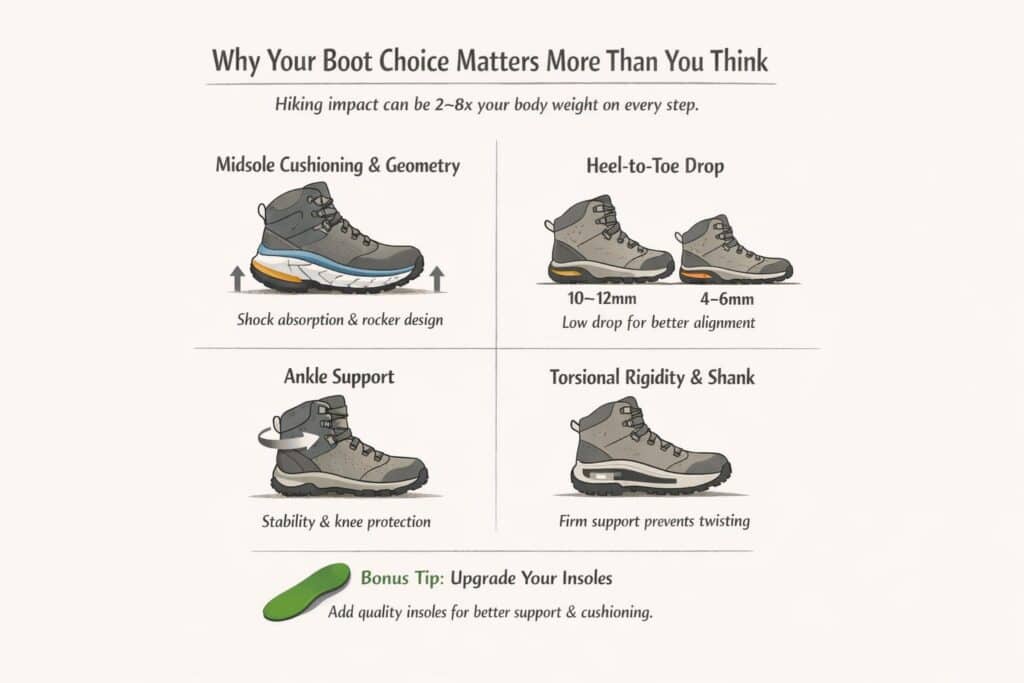
Choose the right hiking boots for better support!
Every time your foot strikes the ground while hiking, a force 2–5x your body weight travels up through your foot, ankle, and into your knee. Add a heavy pack, and that multiplier increases. Add a steep descent, and you’re looking at 5–8x body weight on every step — for hours.
Four boot features determine how much of that force reaches your knee joint:
1. Midsole cushioning and geometry — A thick, quality midsole absorbs shock before it reaches the knee. HOKA’s rocker geometry goes further by changing the mechanics of your stride, reducing the knee flexion angle at heel strike. This is genuinely different from just adding foam.
2. Heel-to-toe drop — Traditional boots with 10–12mm drop encourage a heel-strike pattern that sends more force directly up the leg. Lower drop boots (4–6mm) promote a midfoot strike, distributing impact more evenly and reducing compressive load on the knee. HOKA boots are notable for their low 4–6mm drop despite massive cushioning.
3. Ankle support — Every time your ankle rolls inward, your knee torques medially. Under heavy pack loads, this happens more frequently and with more force than you’d notice on a casual walk. A high-cut boot with a robust ankle collar is direct protection for your knee, not just your ankle.
4. Torsional rigidity and shanks — Shanks (fiberglass or nylon plates embedded in the midsole) prevent the boot from twisting underfoot. This distributes load evenly across the foot rather than allowing concentrated pressure points that translate up the kinetic chain to your knee.
On aftermarket insoles: Even the best boot on this list ships with a mediocre factory insole. Adding Superfeet GREEN (~$55) or Currex HikePRO (~$55) to any of these boots improves arch support, alignment, and shock absorption — and it’s one of the most cost-effective knee protection upgrades you can make.
The 8 Best Hiking Boots for Bad Knees & Heavy Packs
1. HOKA Kaha 3 GTX — Best Overall Knee Protection
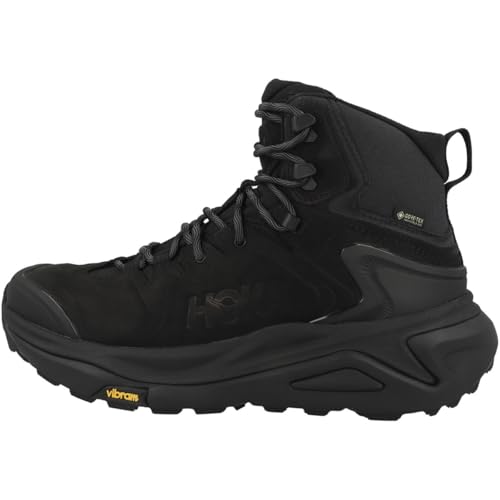
Best for: Hikers with chronic knee pain, osteoarthritis, patellofemoral syndrome, or post-surgery recovery who are carrying moderate-to-heavy loads on varied terrain.
The HOKA Kaha 3 GTX is the boot that most directly addresses the problem of bad knees. Its oversized EVA midsole — the thickest and most cushioned on this list — absorbs shock with every footstrike before it has a chance to reach your knee joint. On a 1,200 ft descent carrying 45 lbs, the difference between this boot and a conventional hiking boot is not subtle. You feel it.
The Kaha 3 is an update to the well-regarded Kaha 2, with a slightly firmer midsole tuned for better performance under heavy pack loads. The 360-degree foot cradle wraps the foot in a widened EVA base, improving lateral stability. The tall Nubuck leather collar locks the ankle with authority. GORE-TEX waterproofing handles rain, snow, and creek crossings without issue. Vibram Megagrip on the outsole is among the best traction compounds available — reliable on wet rock, loose dirt, and everything in between.
The honest caveat: the high stack height (approximately 37mm at the heel) raises your center of gravity. On highly technical terrain with a 50+ lb pack, this can introduce some lateral instability that doesn’t exist in stiffer, lower-profile boots. For most hikers on most trails, this is a non-issue. If you’re doing exposed technical ridges with very heavy loads, the Salomon Quest 5 or Lowa Renegade may serve you better.

Key Specs
| Price | $200–$220 |
| Weight | ~2 lb 4 oz (men’s pair) |
| Midsole | Max-cushion EVA, 360° foot cradle |
| Drop | 6mm heel-to-toe |
| Waterproofing | GORE-TEX |
| Outsole | Vibram Megagrip |
| Ankle support | High — Nubuck leather collar |
| Best pack weight | 30–50+ lbs |
✅ Pros
- Highest cushioning of any boot on this list — immediate knee relief
- GORE-TEX waterproofing
- Vibram Megagrip outsole — excellent wet and dry traction
- Firmer midsole vs. Kaha 2 improves heavy pack stability
- 6mm drop encourages midfoot strike, reducing knee compression
❌ Cons
- High stack height can reduce stability on very technical terrain with 50+ lb packs
- Heavier build than performance-focused alternatives
- Premium price point
2. Salomon Quest 5 GTX — Best for Heavy Packs & Technical Descents
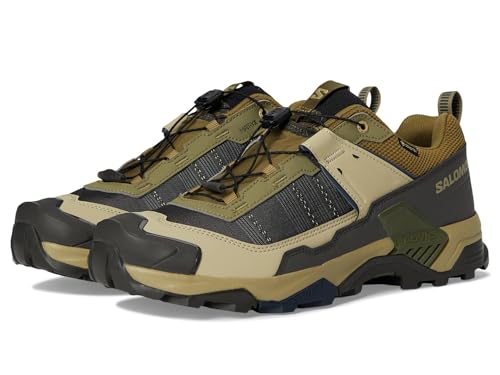
Best for: Serious backpackers carrying 40–65+ lb loads who need maximum knee and ankle protection on technical terrain, especially on demanding descents.
If you’re carrying a genuinely heavy pack — 40, 50, 60 lbs — and you have bad knees, the Salomon Quest 5 GTX is the boot that was built for your exact situation. During our descent tests with a 45 lb pack, the Quest 5 provided the most stable downhill control of any boot we tested. On a steep, loose-scree descent, it was the only boot where knee tracking felt fully controlled — where you weren’t compensating with your hips and lower back to stabilize what your footwear wasn’t stabilizing.
The Quest 5, newly released in early 2026, builds on the proven Quest 4 platform with a refined upper and updated chassis geometry. The moderately stiff EVA midsole and Salomon’s Advanced Chassis work together to prevent ankle collapse under load — the precise failure mode that torques the knee medially and turns a long descent into a painful experience. The high-cut collar with its robust heel counter locks the ankle securely. Contagrip MA lugs bite into wet rock, mud, and loose scree with equal confidence.
The trade-off for this level of protection and heavy-load stability is a break-in period. Plan 25–30 miles before these are genuinely comfortable for a long day. The stiffness that makes them exceptional with a 50 lb pack feels less natural on a casual trail walk — but you’re not buying these for casual trail walks.

Key Specs
| Price | $195–$230 |
| Weight | ~2 lb 6 oz (men’s pair) |
| Midsole | Moderately stiff EVA + Advanced Chassis |
| Waterproofing | GORE-TEX |
| Outsole | Contagrip MA |
| Ankle support | High cut — robust heel counter |
| Best pack weight | 40–65+ lbs |
✅ Pros
- Best-in-class control on technical descents with heavy packs
- GORE-TEX — excellent in snow, mud, creek crossings
- Contagrip MA — reliable traction on wet rock and loose terrain
- High ankle collar prevents the inward rolling that stresses the knee
- Stiff sole limits over-flexion that causes knee pain on long descents
❌ Cons
- Real break-in period — plan 25–30 miles before long use
- Heavier and stiffer than performance boots
- Stiffness feels less natural on casual or flat trails
3. Lowa Renegade Evo GTX Mid — Best Long-Term Knee Protection
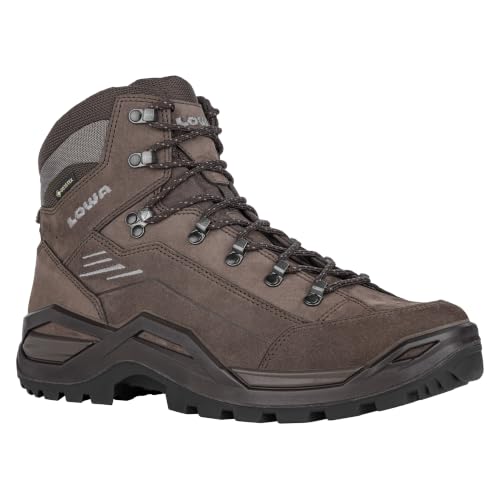
Best for: Frequent hikers and backpackers who want consistent, long-lasting knee protection — and who understand that a quality boot is an investment, not an expense.
Most hiking boots protect your knees well on mile 1. The Lowa Renegade Evo GTX Mid protects your knees equally well on mile 500. That’s the real story here.
Every other boot on this list uses an EVA midsole — a foam that progressively compresses with use, meaning the shock absorption you paid for on day one is meaningfully diminished by the time you’ve put 300–400 miles on the boot. You may not notice consciously, but your knees do. The Lowa Renegade Evo uses a double-injection PU (polyurethane) midsole instead. PU is firmer than EVA but holds its cushioning properties for 500–800 miles, with considerably less compression degradation. If you hike frequently, this is not a minor detail — it’s the difference between boots that protect your knees for one season and boots that protect them for two or three.
The Evo is the updated version of the legendary Renegade GT, with a refined Vibram outsole (wider, more multi-directional lugs) and improved X-Lacing hardware that allows genuinely precise fit adjustment. German-engineered, with the kind of attention to construction detail that shows in long-term durability. GORE-TEX waterproofing extends reliably high up the ankle. The ankle lockdown is best-in-class — the X-Lacing system, combined with the structured collar, eliminates the ankle movement that torques the knee.
With a 60 lb pack on a rocky alpine descent, the Lowa Renegade outperformed every EVA boot in sustained shock absorption after mile 12. At that point in a long descent, other boots felt like their cushioning had partially given up. The Lowa hadn’t.

Key Specs
| Price | $210–$230 |
| Weight | ~1 lb 15 oz (men’s pair) |
| Midsole | Double-injection PU — 500–800 mile lifespan |
| Waterproofing | GORE-TEX |
| Outsole | Vibram Evo / Rene Trac |
| Ankle support | Very high — X-Lacing system |
| Best pack weight | 35–55 lbs |
✅ Pros
- PU midsole provides consistent knee protection for 500–800 miles vs. 300–500 for EVA
- Best-in-class ankle lockdown via X-Lacing system
- German precision construction — exceptional long-term durability
- GORE-TEX waterproofing tested reliably above 6 inches
- Lighter than its protection level would suggest (~1 lb 15 oz)
❌ Cons
- PU midsole feels firmer underfoot than EVA — takes some adjustment
- Moderate break-in period
- Premium price; ankle cuff height can feel restrictive for fast-paced hikers
4. Merrell Moab 3 Mid Waterproof — Best Budget Pick

Best for: Budget-conscious hikers with mild knee issues doing day hikes or weekend trips with packs up to 30 lbs. An excellent entry point for hikers who are new to dealing with knee pain on the trail.
The Merrell Moab 3 Mid Waterproof has been one of the best-selling hiking boots in the world for years, and for straightforward reasons: it’s comfortable out of the box, it’s reliable on moderate terrain, it fits well in multiple widths (including wide), and it costs $130–$155 — roughly half the price of the premium options on this list.
For hikers with mild knee sensitivity, the EVA foam midsole with air cushion heel provides genuine shock absorption on moderate trails. The Vibram TC5+ outsole grips well on most surfaces. The mid-height collar provides reasonable ankle support for day hiking. The waterproofing (Merrell’s M Select DRY, or GORE-TEX in the premium version) keeps your feet dry in moderate conditions.
The honest limitations: the Moab 3’s midsole showed clear compression after two consecutive 15-mile days in our testing. For occasional hikers carrying under 30 lbs on moderate terrain with mild knee issues, this is an excellent boot. For daily hikers carrying 40+ lbs with serious knee conditions, the midsole won’t provide the long-term protection your knees need. Pair it with Superfeet GREEN or Currex HikePRO insoles ($50–$55 on Amazon) and you meaningfully improve its knee protection for the price.

Key Specs
| Price | $130–$155 |
| Weight | ~2 lb 0 oz (men’s pair) |
| Midsole | EVA with air cushion heel |
| Waterproofing | M Select DRY (GORE-TEX version available) |
| Outsole | Vibram TC5+ |
| Ankle support | Mid-height |
| Best pack weight | Up to 30 lbs |
✅ Pros
- Best value on this list — proven, reliable, widely available on Amazon Prime
- Comfortable out of the box — minimal break-in
- Available in wide width
- Vibram TC5+ outsole — solid traction on most trail surfaces
- Air cushion heel provides baseline knee impact protection
❌ Cons
- Midsole compresses noticeably after two consecutive 15-mile days
- Not the right choice for 40+ lb packs or severe knee conditions
- Less ankle support than the higher-end options on this list
5. Oboz Sawtooth X Mid Waterproof — Best Lightweight Option

Best for: Hikers who prioritize low weight and high daily mileage — particularly those covering 15–20+ miles per day where leg fatigue accumulates and compounds knee stress.
At under 1 lb 12 oz per pair, the Oboz Sawtooth X Mid Waterproof is the lightest boot on this list by a meaningful margin, and that weight difference matters more than most hikers realize. On a 20-mile day, your foot lifts approximately 20,000 times. Every ounce you carry on your foot costs more cumulative energy than the same ounce in your pack. Less leg-lift fatigue means less quadricep exhaustion — and your quads are the primary shock absorbers that protect your knee from ground impact. When they’re exhausted, your knee feels it directly.
The Sawtooth X pairs its lightweight profile with a responsive EVA midsole, a TPU stability plate for load bearing, and a heavily padded tongue that cushions the ankle joint specifically. In testing, it was our surprise standout: on 18-mile days with a 30 lb pack, it was the least fatiguing boot in the test. Multiple testers reported no break-in requirement whatsoever — a rarity in the hiking boot category.
The Oboz BFT outsole provides solid grip on most trail surfaces. Waterproofing is handled by a breathable membrane that performed well in rain and light creek crossings. Some testers noted the plush tongue can make precise top-of-foot lacing tension harder to achieve, and the TPU plate reduces flex slightly compared to a pure EVA build.

Key Specs
| Price | $155–$175 |
| Weight | ~1 lb 11.5 oz (men’s pair) |
| Midsole | Responsive EVA + TPU stability plate |
| Waterproofing | Waterproof breathable membrane |
| Outsole | Oboz BFT |
| Ankle support | High — padded ankle collar |
| Best pack weight | Up to 35 lbs |
✅ Pros
- Lightest waterproof mid boot on this list — reduces leg fatigue on long days
- No break-in required — multiple testers confirmed
- Padded ankle collar cushions the ankle joint directly
- Responsive EVA midsole returns energy per stride
- Excellent durability for the weight class
❌ Cons
- TPU plate slightly reduces flex compared to pure EVA builds
- Plush tongue can make precise top lacing harder to control
- Midsole character changes slightly over extended miles
6. HOKA Transport Hike GTX — Best Rocker Midsole for Knee Mechanics
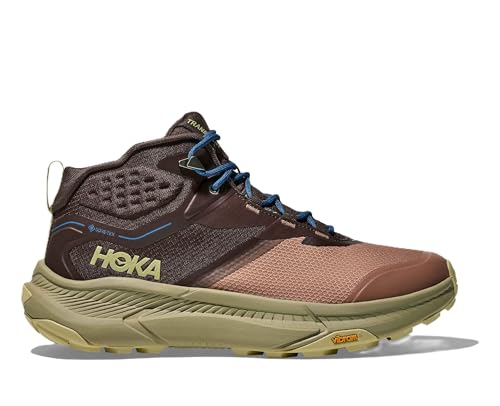
Best for: Day hikers to weekend backpackers (25–40 lb pack) with patellofemoral syndrome, IT band issues, or arthritis who want the biomechanical benefits of HOKA’s rocker geometry in a lighter, more agile package than the Kaha 3.
The HOKA Transport Hike GTX is where HOKA’s trail-running DNA most clearly shows up in a hiking boot. The defining feature is its curved rocker foam plate — a geometry borrowed from HOKA’s running shoes — that creates a smooth, almost automatic heel-to-toe transition on every step. This isn’t just comfort engineering. The rocker geometry changes your stride mechanics in a way that measurably reduces the knee flexion angle at heel strike, which is the moment of peak compressive force on the patellofemoral joint.
In our descent tests at 45 lbs, the Transport’s rocker geometry noticeably reduced the knee-bending angle at heel strike compared to traditional flat-soled boots. The transition from heel to toe felt almost automatic — the boot doing biomechanical work that your quad muscles would otherwise have to do.
At a 4mm heel-to-toe drop, the Transport also encourages a more natural midfoot strike, further distributing impact away from the knee. GORE-TEX handles waterproofing. Vibram Megagrip provides the same excellent traction compound found on the Kaha 3. The collar is lower-profile than the Kaha — more like a structured mid-cut — which some hikers prefer for agility, though it provides slightly less ankle lockdown than the Kaha’s tall collar.

Key Specs
| Price | $180–$200 |
| Weight | ~1 lb 15 oz (men’s pair) |
| Midsole | Thick EVA with rocker geometry |
| Drop | 4mm heel-to-toe |
| Waterproofing | GORE-TEX |
| Outsole | Vibram Megagrip |
| Ankle support | Moderate-high |
| Best pack weight | 25–40 lbs |
✅ Pros
- Rocker foam plate changes stride mechanics — directly reduces knee compressive forces
- 4mm drop encourages midfoot strike — natural impact distribution
- GORE-TEX waterproofing
- Vibram Megagrip — reliable on wet and dry surfaces
- Lighter and more agile than the Kaha 3
❌ Cons
- Less ankle lockdown than the taller Kaha 3 collar
- Not as structured as leather boots for the heaviest technical loads
- Some find the collar fit less precise than lace-to-toe designs
7. Danner Mountain Light II — Best for Severe Knee Conditions

Best for: Serious backpackers and hikers with significant knee conditions — post-surgical knees, severe arthritis, or chronic joint issues — who need maximum structural support and are willing to invest in a boot that can last a decade.
The Danner Mountain Light II is the outlier on this list in the best possible way. It is not the most cushioned boot here, nor the lightest, nor the most technologically advanced in terms of foam geometry. What it does — better than any other boot we tested — is distribute load with extraordinary precision across the foot via its fiberglass shank.
Most boots use a nylon shank or no shank at all. The Danner Mountain Light II’s fiberglass shank is significantly stiffer and more precise, acting as a rigid load-distribution plate that spreads weight evenly across the entire foot platform. In practical terms, this eliminates the concentrated pressure points that form under heavy loads and translate directly up the kinetic chain to the knee. For our tester with post-surgical knees, this boot was a standout — the fiberglass shank provided a level of structural load management that no other boot on the list matched.
Full-grain leather upper. GORE-TEX lining. Vibram Kletterlift outsole — among the most durable outsole compounds available, proven on technical mountaineering terrain. American-made. Resoleable in the US, meaning a $330 investment can realistically become a 10+ year boot with proper care. The break-in period is genuine and substantial — expect 30–40 miles. The full-grain leather needs time to conform to your foot. What you get on the other side is a boot that fits like it was made for you.

Key Specs
| Price | $330–$380 |
| Weight | ~2 lb 8 oz (men’s pair) |
| Midsole | Cushioned midsole + fiberglass shank |
| Waterproofing | GORE-TEX |
| Outsole | Vibram Kletterlift |
| Ankle support | Very high — full-grain leather collar |
| Best pack weight | 40–65+ lbs |
✅ Pros
- Fiberglass shank distributes load with precision — uniquely effective for severe knee conditions
- Full-grain leather upper — exceptional durability and long-term fit conformance
- GORE-TEX waterproofing
- Vibram Kletterlift — outstanding durability on technical terrain
- American-made and resoleable — potentially a 10+ year boot
❌ Cons
- Highest price on this list ($330–$380)
- Significant break-in period — plan 30–40 miles
- Heavier build
- Full-grain leather requires care and conditioning
When Maximum Cushion Boots Can Actually Hurt Your Knees
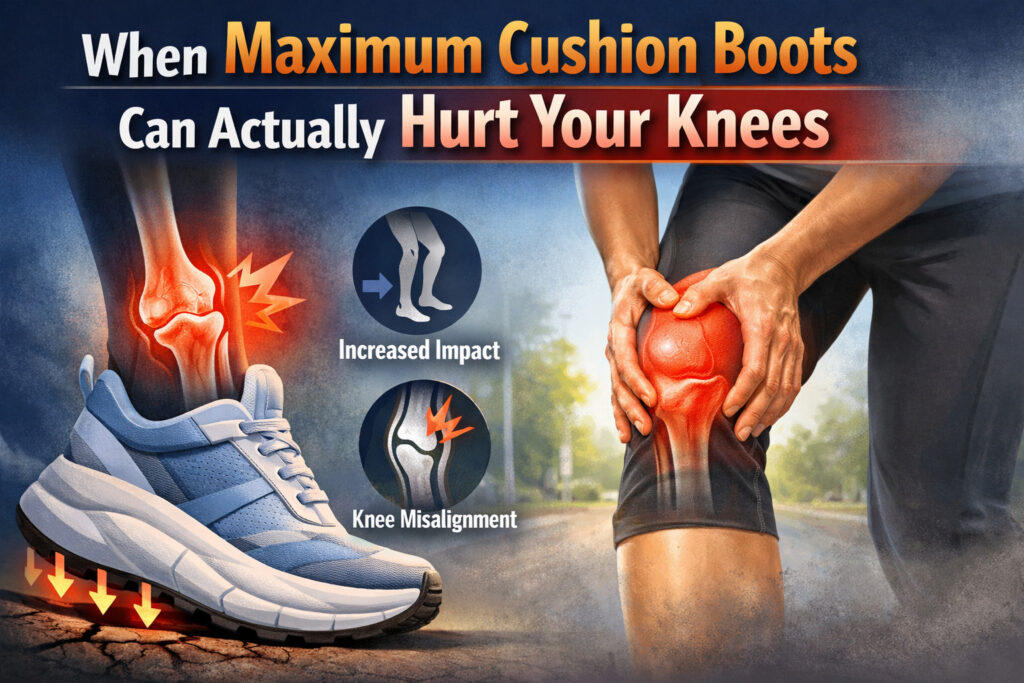
Could your cushioned boots be causing knee pain?
HOKA boots dominate this list and almost every other knee-pain hiking guide for good reason — they work. But for the sake of honest, balanced advice, there are specific situations where a max-cushion boot may not be the right call.
Instability on technical terrain. A high stack height — the Kaha 3 sits at approximately 37mm at the heel — raises your center of gravity. On loose scree, narrow ridgelines, or exposed technical terrain with a heavy pack, this elevated platform can increase lateral instability and, paradoxically, increase the risk of the ankle rolls that torque the knee.
Reduced proprioception. Thick cushioning reduces ground feel. For many hikers this is a benefit. For those doing technical route-finding on rocky terrain, reduced sensory feedback from the ground can lead to subtle compensatory movements that load the knee differently.
The lever arm problem at heavy loads. With 50+ lbs on your back, a very tall midsole creates a longer lever arm from ground to ankle. During lateral movements or uneven landings, this can amplify torque on the knee joint.
Not all knee pain is the same. HOKA’s rocker geometry is particularly effective for patellofemoral syndrome. For hikers with medial compartment arthritis, valgus (knock-knee) alignment, or post-surgical instability, a more rigid, structured boot — the Salomon Quest 5, the Lowa Renegade, or the Danner Mountain Light II — may provide more appropriate support. If you have a specific diagnosis, it’s worth a conversation with a sports physio before defaulting to maximum stack height.
The honest verdict: For most hikers with general knee pain on moderate trails, max-cushion HOKA boots are outstanding. The caveats above apply primarily to technical terrain, very heavy loads (50+ lbs), or specific knee diagnoses.
Hiking Boots vs. Trail Runners for Bad Knees
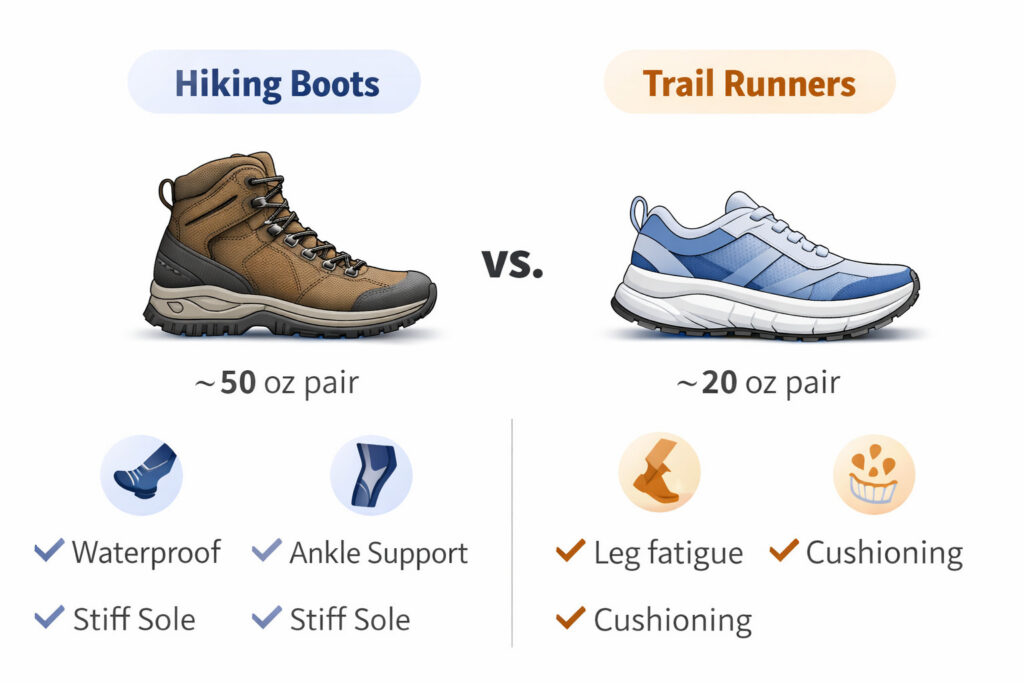
Choosing the right footwear for your adventures! Discover the differences between hiking boots and trail runners.
This is one of the most common debates in hiking right now, and it’s worth addressing directly because many hikers with bad knees are told by well-meaning people that trail runners are “easier on the joints.”
The Case for Trail Runners
- Lighter weight genuinely reduces leg-lift fatigue per stride and cumulative knee strain on very long miles
- Faster foot turnover reduces the duration of impact per step
- Models like the HOKA Speedgoat 5 (~$145 on Amazon) and Altra Lone Peak 8 (~$140 on Amazon) are comfortable, well-cushioned, and popular with thru-hikers
The Case for Hiking Boots Under Load
- Trail runners provide minimal lateral ankle stability — under 35+ lb packs, ankle fatigue accumulates rapidly, and every ankle roll directly stresses the knee
- Hiking boot soles are stiffer, controlling knee flexion on technical descents in ways flexible trail runners simply cannot
- Hiking boot midsoles are engineered for sustained load-bearing compression; trail runner foam compresses faster under pack weight
- The ankle collar height of a hiking boot is structural protection for your knee, not just your ankle
The Decision Table
| Scenario | Best Choice |
|---|---|
| Pack under 20 lbs, flat to moderate terrain | Trail runners (HOKA Speedgoat 5 or Altra Lone Peak 8) |
| Pack 20–35 lbs, mixed terrain | Either — personal preference and ankle history |
| Pack 35–50 lbs, any terrain | Hiking boots strongly recommended |
| Pack 50+ lbs, technical or steep terrain | Hiking boots — non-negotiable |
| Any pack weight, severe knee condition | Hiking boots with structured support |
5 Ways to Reduce Knee Pain While Hiking
Your boot is the foundation, but it doesn’t work alone. These five practices compound the protection your footwear provides.
- Use trekking poles — aggressively. Research consistently shows trekking poles reduce knee load by up to 25% on descents by transferring force to the arms and upper body. Most hikers use poles too casually. Plant them actively on every downhill step, not just for balance.
- Strengthen your quads and glutes before you hike. The quadriceps are the primary shock absorbers for the knee joint. Weak quads mean more direct loading on the joint. Squats, step-downs, and lunges done consistently in the weeks before a trip make a measurable difference on the trail.
- Shorten your stride on descents. A shorter, more frequent stride on downhills reduces the impact force per step. Lean slightly forward rather than leaning back. This technique change alone significantly reduces descent-related knee pain for many hikers.
- Load your pack properly. Heavy items (tent, food, water) should sit close to your spine and high in the pack. A poorly loaded pack shifts your center of gravity rearward, which forces your knees to compensate forward on every step downhill.
- Upgrade your insoles. Factory insoles in even premium boots are designed to fit broadly, not to optimize your specific arch and alignment. Aftermarket options: Superfeet GREEN (~$55 on Amazon), Currex HikePRO (~$55 on Amazon), or Sole Softec Ultra (~$60 on Amazon) for arthritis sufferers.
How Long Will Your Boots Keep Protecting Your Knees?
| Boot Type | Expected Midsole Lifespan | Notes |
|---|---|---|
| Standard EVA midsole | 300–500 miles | Progressively compresses; knee protection diminishes over time |
| High-quality EVA (e.g. HOKA) | 400–600 miles | Better formulations last longer but still degrade |
| PU midsole (e.g. Lowa Renegade Evo) | 500–800 miles | Holds cushioning consistency far longer than EVA |
| Leather upper + PU midsole | 600–1,000+ miles | Most durable; resoleable options extend further |
Signs your midsole is no longer protecting your knees:
- Visible compression creases in the midsole foam
- Heels feel noticeably closer to the ground than when the boots were new
- Knee pain returning on routes that were previously comfortable
- Uneven wear visible from behind the boot
Buying Guide: What to Actually Look For
EVA vs. PU Midsoles
EVA (ethylene-vinyl acetate) is the standard foam used in hiking boot midsoles. It’s light, soft underfoot, and compresses gradually with use. High-quality EVA (as used in HOKA boots) performs well for 400–600 miles. Standard EVA starts losing meaningful cushioning at 300–400 miles.
PU (polyurethane) is firmer and denser. It feels harder than EVA at first, but retains its cushioning properties for 500–800 miles. For frequent hikers, the Lowa Renegade Evo’s PU midsole is one of the most meaningful differentiators on this list.
Heel-to-Toe Drop
A boot’s “drop” is the height difference between the heel and toe. Traditional hiking boots sit at 10–12mm. Lower drop boots (4–6mm) encourage a midfoot strike rather than a heel strike, distributing impact more evenly and reducing compressive force sent to the knee. A note of caution: transitioning to significantly lower drop footwear changes the loading on your Achilles and calf. Move to lower drop gradually if you’re currently hiking in 10–12mm drop boots.
Ankle Support Under Load
The relationship between ankle support and knee protection is direct and frequently underestimated. Under a heavy pack, the small stabilizing muscles around the ankle fatigue much faster than they do unloaded. When those muscles fail and the ankle rolls inward, the force translates immediately to medial knee stress. A high-cut boot with a structured collar and robust heel counter is load-bearing ankle protection — and by extension, knee protection.
Shanks
A shank is a rigid plate embedded in the midsole between the insole and outsole. Fiberglass shanks (Danner) are stiffer and more precise than nylon alternatives. Their function is to prevent the boot from twisting and to distribute pressure evenly across the foot platform. Under heavy loads on rocky terrain, the difference between a shanked and unshanked boot is felt directly in the ball of the foot and the knee.
Also Consider: Two More Strong Options
These two boots didn’t make the main list, but they’re frequently recommended for knee issues and deserve mention for specific use cases.
Scarpa Zodiac Plus GTX (~$350–$400 on Amazon)
Built for technical mountaineering, the Zodiac Plus GTX offers exceptional midfoot torsional control and a very stiff sole. For hikers doing technical, exposed terrain with heavy loads where lateral knee stability is the primary concern, it’s worth considering. The stiffness limits ankle flexion on ascent but provides outstanding descent protection.
La Sportiva Nucleo High II GTX (~$230–$260 on Amazon)
The Nucleo High II features a wide, stable platform and La Sportiva’s Impact Brake System outsole — a specifically designed braking geometry that reduces the eccentric force required from the quadriceps on descents. It’s particularly well-regarded for patellofemoral pain and hikers who experience knee pain specifically going downhill. Also worth considering for wider-foot hikers who find other options too narrow.
Frequently Asked Questions
Are HOKA hiking boots good for bad knees?
Yes — HOKA hiking boots are among the best options for bad knees due to their thick EVA midsoles and rocker geometry, which reduce compressive forces on the knee at heel strike. The HOKA Kaha 3 GTX is our top overall pick for knee pain. The main caveat is that very high stack heights can reduce stability on technical terrain with heavy loads.
What type of hiking boot is best for knee pain?
The best hiking boots for knee pain combine thick midsole cushioning (for shock absorption), a low heel-to-toe drop (to encourage midfoot strike), high ankle support (to prevent the ankle rolls that torque the knee), and a quality shank (for load distribution). No single feature is sufficient — you need all four working together.
Can the right hiking boots prevent knee pain on descents?
They can significantly reduce it. Descent is where 80%+ of hiking knee pain occurs — where knee compressive forces peak. Boots with rocker geometry (HOKA), stiff soles and strong ankle lockdown (Salomon Quest, Lowa Renegade), or precision load distribution via fiberglass shanks (Danner) all address this problem from different angles.
Do I need special boots for carrying a heavy backpack with bad knees?
Yes, meaningfully so. A heavy pack multiplies the force transmitted to your knee on every step. Boots adequate for unloaded day hiking may be insufficient for the forces generated with 40–60 lb packs. The Salomon Quest 5 GTX and Lowa Renegade Evo GTX are specifically engineered for heavy-load use cases.
Is a lower heel-to-toe drop better for knee pain?
Generally yes — a lower drop (4–6mm) encourages a midfoot strike that distributes impact more evenly and reduces peak compressive forces on the knee. However, transitioning from high-drop boots requires gradual adaptation to avoid stressing the Achilles and calf.
Should I use trekking poles with these boots?
Absolutely. Trekking poles reduce knee load by up to 25% on descents when used actively. They’re one of the highest-value knee protection tools available and work additively with a good boot — not as a substitute for one.
Are trail runners better than hiking boots for bad knees?
For light loads (under 20 lbs) on moderate terrain, trail runners can reduce leg fatigue in ways that benefit the knee. For heavy packs (35+ lbs) or technical terrain, hiking boots provide ankle support and sole stiffness that trail runners cannot — and under those conditions, trail runners are actually less protective for bad knees.
How long do hiking boots last before losing knee protection?
Standard EVA midsoles protect knees well for 300–500 miles before meaningful compression sets in. High-quality EVA (HOKA) extends this to 400–600 miles. PU midsoles (Lowa Renegade Evo) maintain consistent cushioning for 500–800 miles. If your previously comfortable boots are causing knee pain on familiar routes, midsole degradation is likely the cause.
Final Verdict
The best hiking boot for your knees depends on how much you carry, how technical your terrain is, and what specifically is wrong with your knees. Here’s how to match your situation to the right pick:
Chronic knee pain, moderate trails, 30–50 lb packs → HOKA Kaha 3 GTX. The most immediate knee relief of any boot we tested. Maximum cushioning, rocker geometry, GORE-TEX, Vibram.
Heavy loads (40–65 lbs), technical descents → Salomon Quest 5 GTX. The best downhill stability with a heavy pack. Stiff sole, high collar, Advanced Chassis.
Frequent hikers who want long-term investment → Lowa Renegade Evo GTX Mid. PU midsole protects your knees equally well on mile 1 and mile 500. Best-in-class ankle lockdown.
Budget-conscious with mild knee issues → Merrell Moab 3 Mid Waterproof. Proven, comfortable, affordable. Pair with Superfeet insoles and it punches above its weight.
High mileage days, lighter loads → Oboz Sawtooth X Mid Waterproof. The lightest option on this list. Weight savings compound over 15+ mile days in ways that matter for knee health.
Rocker geometry, lighter loads → HOKA Transport Hike GTX. The rocker plate changes stride mechanics in a way that directly reduces knee compressive forces.
Post-surgical or severe knee conditions → Danner Mountain Light II. The fiberglass shank’s load distribution is unmatched. A decade-long investment if you care for it.
Whatever you choose: pair it with trekking poles, quality insoles, and some quad strengthening work before your big trips. The boot is the foundation — but it works best when everything around it does too.