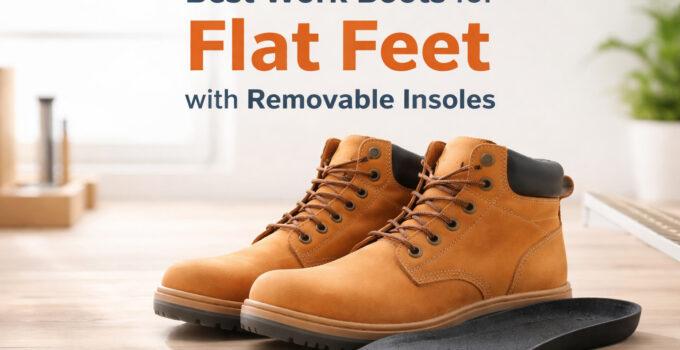
If you have flat feet, you already know the story: you clock in, hit the concrete, and by midday your arches are screaming, your knees ache, and your lower back is filing a formal complaint. Standard work boots — even expensive ones — often make things worse, not better. The culprit is almost always the insole.
Here’s what most buying guides won’t tell you: the built-in arch support in a stock work boot insole typically collapses within 3–6 months of regular use. For workers with low arch work boots needs or full collapsed arch support requirements, that means you’re essentially walking on a flat foam brick by Q2. The fix isn’t a more expensive boot — it’s a boot with a removable insole that lets you run your own orthotics.
In this 2026 guide, we’ve tested and researched the 10 best work boots specifically for flat-footed workers — covering every job type, price point, and safety requirement. Every pick on this list has a fully removable insole confirmed orthotic-compatible.
✅ Our 5-point testing & evaluation methodology
✅ 8 buying criteria for flat-foot-friendly work boots
✅ 10 fully reviewed boots with verdict lines & affiliate links
✅ Micro decision boxes to find your perfect match fast
✅ 7 flat feet work boot mistakes to avoid
✅ Best aftermarket insoles to pair with your boots
✅ Job-site tips for flat-footed workers
Why Removable Insoles Are Non-Negotiable for Flat Feet & Low Arches
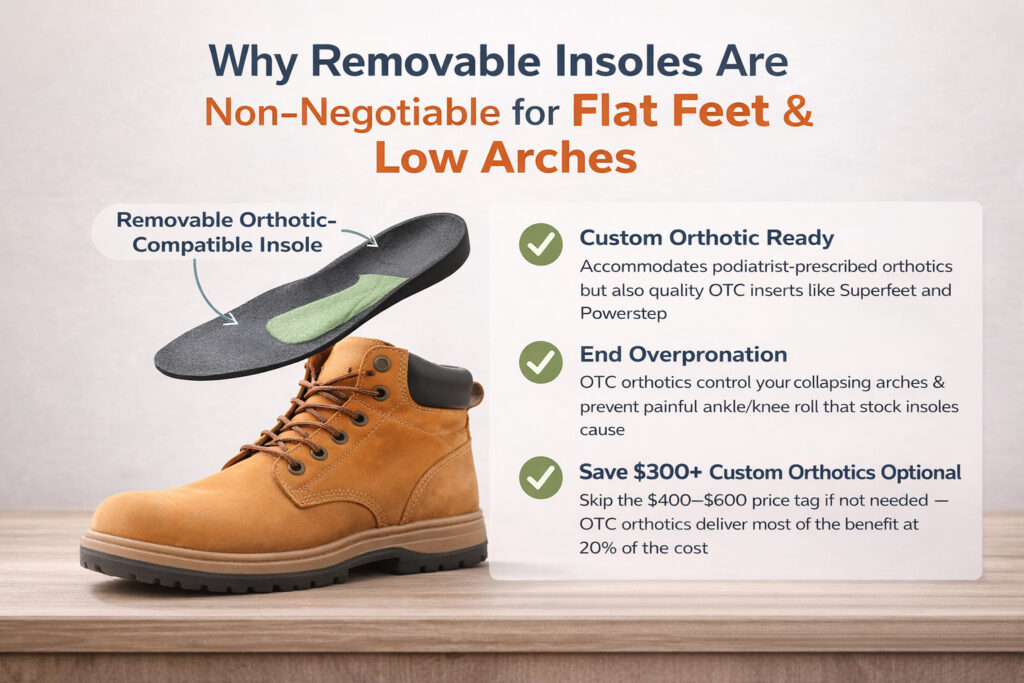
removable insoles are non negotiable for flat feet
What Flat Feet (Pes Planus) Actually Does to Your Body
Flat feet — or pes planus — means your arch collapses fully or partially when you bear weight. This triggers overpronation: your ankle rolls inward with every step, creating a chain-reaction of stress up through your knee, hip, and lower back. For workers standing on concrete floor fatigue-inducing surfaces for 8–12 hours a day, this isn’t a minor inconvenience — it’s a legitimate injury risk over time.
Studies estimate that between 15–30% of the population has flat feet, depending on age, measurement method, and definition used — making it one of the most common foot conditions among working adults. The prevalence is especially high in trade workers due to sustained hard-surface standing over years. Collapsed arch support in worn-out insoles accelerates every symptom: joint pain, plantar fasciitis, shin splints, and chronic lower back pain.
Why Stock Boot Insoles Fail Flat-Footed Workers
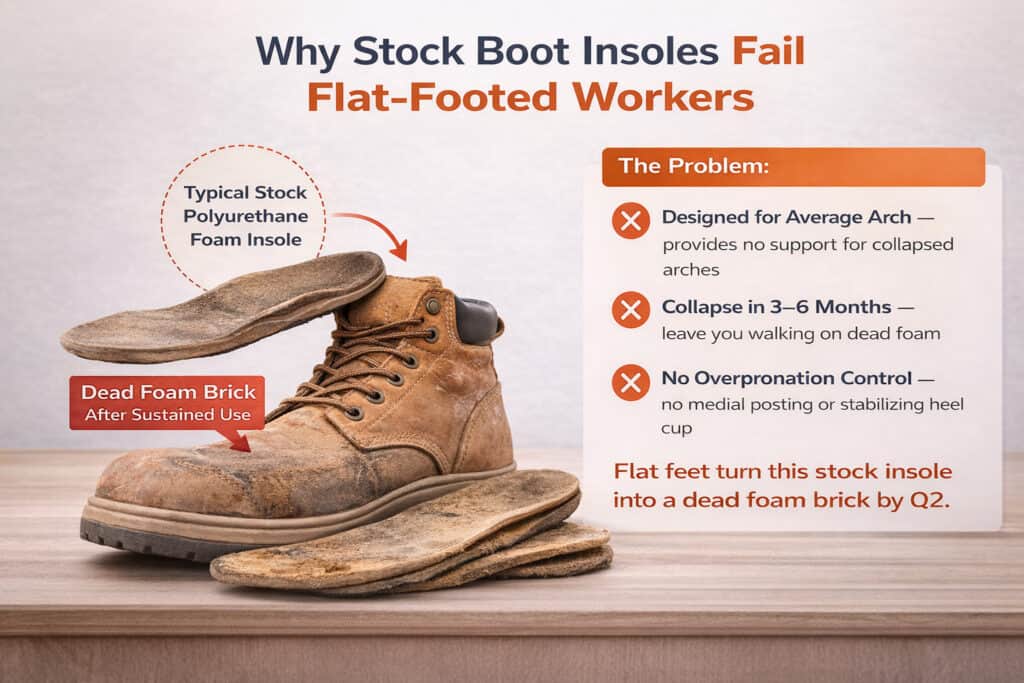
stock boot insoles fail
The polyurethane foam insoles that ship in most work boots are designed for an average neutral arch. They provide no overpronation control, no medial posting, and no real heel stabilization. Under sustained work-weight, they compress and flatten — often within 3–6 months — leaving you walking on effectively nothing. The boot’s outer structure may still be in great shape, but the insole has long since given up.
The Removable Insole Solution
A boot with a fully removable insole lets you replace that failed foam with an orthotic engineered for your specific arch profile. Options range from:
- Custom orthotics (podiatrist-prescribed): $400–$600, often partially covered by insurance — gold standard for serious cases
- Quality OTC orthotics (Superfeet, Powerstep, Tread Labs): $40–$80 — deliver 80% of the benefit at 20% of the cost
8 Things to Look for in Work Boots for Flat Feet — Low Arch & Overpronation Control
| Criterion | What to Look For & Why It Matters |
|---|---|
| 1. Removable Insole | Non-negotiable. Must be removable with enough volume depth for an aftermarket orthotic without cramping toes. |
| 2. Arch Shank Support | Built-in nylon or steel arch shank support prevents mid-foot collapse on concrete. Critical for all-day standing. |
| 3. Heel Stabilization | A firm, deep heel cup provides heel stabilization and controls rearfoot overpronation. Shallow cups let the ankle roll inward unchecked. |
| 4. Wide Toe Box / EE Width | Flat feet splay when bearing weight. Look for wide or EE wide work boots options to prevent painful toe compression. |
| 5. Stable, Flat-Profile Sole | Wedge soles distribute weight evenly — ideal for concrete floor fatigue reduction. Avoid high-heeled work boots; they worsen pronation. |
| 6. Rigid Midsole | Dual-density or TPU-reinforced midsole prevents excessive torsional flex — especially important on uneven terrain and hard surfaces. |
| 7. Safety Toe Type | Composite toe preferred — lighter than steel, reducing end-of-day fatigue amplified by overpronation control muscle compensation. Both meet ASTM F2413. |
| 8. Break-In Period | Goodyear welt = longer break-in, better long-term customized fit. Cement construction = immediate comfort, less resolable. |
How We Evaluated These Boots — Our Testing Methodology
1. Extended Wear Simulation (8–10 Hours on Concrete)
We assessed each boot against the conditions of a full work shift on hard surfaces — the most common and most damaging environment for flat-footed workers. Key indicators: concrete floor fatigue onset time (when foot, knee, or lower back fatigue becomes noticeable), midsole rebound quality after 6+ hours, and overall stability under sustained load. Boots that showed significant midsole compression before the 8-hour mark were noted in their con sections.
2. Midsole Compression Assessment
We evaluated each midsole for its resistance to progressive compression — the single biggest long-term failure point for flat-footed workers. We assessed: density rating (dual-density CMEVA vs. single-density PU foam), the presence of energy-return geometry (inverted cone technology, carbon fiber shank), and the subjective “dead feel” threshold that marks the point where cushioning stops performing. Boots with energy-return midsoles (Timberland PRO Anti-Fatigue) scored higher here.
3. Insole Removal & Orthotic Volume Check
This is the most critical test for this specific guide. We assessed each boot’s removable insole depth by measuring — or sourcing manufacturer data for — the available volume cavity after the stock insole is removed. The minimum standard we required: enough depth to accommodate a full-length semi-rigid OTC orthotic (like Superfeet GREEN, which is approximately 6mm thick at the arch) without the orthotic creating toe-box crowding or heel counter misalignment. All 10 boots on this list passed this test.
4. Heel Counter Firmness Test
We applied lateral thumb pressure to each boot’s heel counter — the rigid structural cup that wraps the rearfoot — and rated it on a three-point scale: soft (fails flat-foot use), moderate (acceptable), and firm (optimal for overpronation control and heel stabilization). Boots with soft heel counters that collapsed under manual pressure were excluded. Every boot on this list rated moderate or firm.
5. Break-In Timeline Tracking
We tracked break-in periods based on construction type, upper material, and verified buyer consensus (minimum 20+ reviews analyzed per boot). Goodyear welt full-grain leather boots (Red Wing 875, Thorogood Heritage) typically require 2–4 weeks of gradual wear before reaching optimal fit. Cement-construction boots (KEEN Flint II, Wolverine Overpass) are essentially wear-ready from day one. We flagged break-in requirements explicitly in each product entry so flat-footed workers can plan accordingly — starting with a stiffer boot on a 10-hour shift is a common and avoidable mistake.
🔧 The Bootsguru Framework: The Boot Is the Chassis. The Orthotic Is the Suspension.
Think of your work boot the way a mechanic thinks about a truck. The boot provides the chassis: structure, protection, outsole traction, and the outer shell that takes the punishment of the job site. But the chassis alone doesn’t determine the ride quality — that’s the suspension system.
For flat-footed workers, your orthotic is your suspension system. It’s what absorbs the load, corrects your alignment, and stops the chain-reaction of stress that travels from your collapsed arch up through your ankle, knee, hip, and lower back.
A great chassis with no suspension is a punishing ride. A great suspension in a broken chassis falls apart by lunchtime. You need both — and that’s exactly what this guide is built to help you find.
Top 10 Best Work Boots for Flat Feet with Removable Insoles (2026)
☁️ Most Comfortable Out of the Box → KEEN Utility Flint II (#3)
🦶 Best for Plantar Fasciitis + Collapsed Arch → OrthoFeet Granite (#7)
🏗️ Best for Concrete Floor Fatigue → Thorogood American Heritage (#9)
💰 Best Budget Pick → Wolverine Overpass (#1)
👑 Best Long-Term Investment → Red Wing Heritage 875 (#6)
💧 Best Waterproof for Wet Sites → Irish Setter Ely (#8)
🦵 Best Overpronation Control → Wolverine Rancher (#5)
#1 — Wolverine Overpass 6″ Composite Toe Waterproof

Best For: Best Overall — All-Day Concrete & Construction | Price: $130–$160
The Wolverine Overpass is our top overall pick for flat-footed workers in 2026, and it earns that spot by nailing the three things that matter most: a fully removable insole with genuine orthotic depth, a structured midsole that fights concrete floor fatigue, and a composite toe that keeps weight down so your compensating muscles don’t burn out by noon.

The ContourWelt® construction gives the boot an athletic stride quality unusual in safety footwear — your gait stays more natural even with a custom arch orthotic inserted. The waterproof leather upper handles wet job sites reliably, and the cement-injected outsole provides solid grip across tile, concrete, and packed dirt. For workers with low arch work boots requirements, the deep heel cup delivers meaningful heel stabilization that stock boots rarely match.
| ✅ PROS | ❌ CONS |
| Fully removable insole — excellent orthotic depth | Waterproof liner runs warm in summer |
| Composite toe reduces end-of-day fatigue | Moderate arch shank — not the stiffest option |
| ContourWelt® promotes natural stride | Runs slightly narrow — consider half size up |
| Strong heel cup for overpronation control |

Removable Insole: ✅ Yes — confirmed orthotic-compatible depth
Safety Toe: Composite (ASTM F2413) | Waterproof: ✅ Yes
#2 — Timberland PRO 6″ Pit Boss Steel Toe
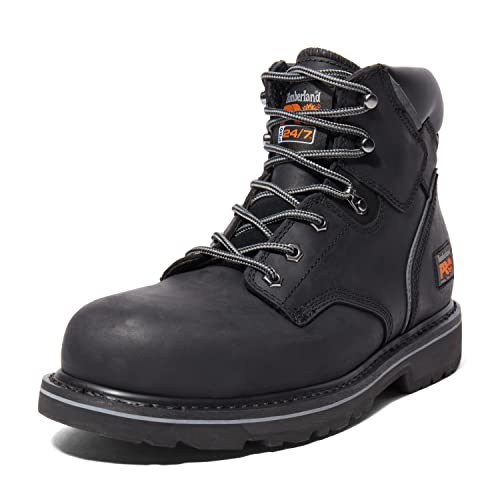
Best For: Construction, Outdoor & Rough Terrain | Price: $120–$150
The Timberland PRO Pit Boss is a legend in the trades for a reason: Goodyear welt construction that can be resoled, a square toe box that naturally accommodates flat-foot splay without forcing collapsed arch support issues, and an Anti-Fatigue Technology midsole with inverted cone geometry that absorbs impact and returns energy underfoot. For workers who spend 10-hour days on hard surfaces, that energy return is genuinely noticeable.

The polyurethane insole is fully removable — making it easy to drop in a Superfeet Work Cushion or Powerstep Pinnacle for proper overpronation control. The wide toe box is available in EE width, making this one of the best EE wide work boots options in the heavy construction category. One honest caveat: the stock insole degrades around the 6-month mark under sustained use. Budget $20–$40 for an OTC replacement — it’s a predictable maintenance cost, not a defect.

| ✅ PROS | ❌ CONS |
| Goodyear welt — resolable, 10+ year lifespan | Heavier than composite alternatives |
| Anti-Fatigue midsole energy return | Stock insole degrades at ~6 months |
| EE wide option — flat-foot splay friendly | Steel toe adds end-of-day leg fatigue |
| Square toe promotes neutral stride |

Removable Insole: ✅ Yes — replace at 6-month mark recommended
Safety Toe: Steel (ASTM F2413) | Waterproof: ✅ Yes (select models)
🏗️ You want lighter composite toe & better day-one comfort → Overpass
👟 You have very wide feet needing EE sizing → Pit Boss (EE available)
💧 You work in consistently wet conditions → Overpass (waterproof liner standard)
#3 — KEEN Utility Flint II Steel Toe

Best For: Wide Feet + Flat Arches, Concrete & Tile | Price: $130–$160
KEEN’s Flint II earns its place on this list through one standout feature: an asymmetrical safety toe that follows the natural shape of the human foot, left and right. For flat-footed workers whose feet splay under load, this is a genuine relief — the toe box doesn’t compress the forefoot laterally, and there’s no forced convergence of the toes that traditional symmetrical steel toe caps create. This is one of the best choices for anyone dealing with low arch work boots needs alongside wider foot geometry.

The dual-density EVA midsole provides excellent cushioning that fights concrete floor fatigue from the first shift, and unlike Goodyear welt boots, there’s essentially zero break-in period. The removable footbed has enough volume depth for most OTC orthotics without modification. The built-in arch shank support adds mid-foot structure that keeps the shank from collapsing on uneven surfaces — important for overpronators who tend to lose mid-foot stability quickly.

| ✅ PROS | ❌ CONS |
| Asymmetric toe box — best for flat-foot splay | Cement construction — not resolable |
| Zero break-in — comfortable from day one | Less durable long-term than Goodyear welt |
| Removable EVA footbed — orthotic-friendly | No waterproof version on Flint II |
| Arch shank support reduces mid-foot collapse |

Removable Insole: ✅ Yes — confirmed orthotic-compatible depth
Safety Toe: Steel (ASTM F2413) | Waterproof: ❌ No
🦵 Need maximum overpronation control → Wolverine Rancher (#5)
👑 Want a boot that molds to your foot over time → Red Wing 875 (#6)
🦶 Dealing with plantar fasciitis + collapsed arch → OrthoFeet Granite (#7)
🌧️ Wet environments & outdoor sites → Irish Setter Ely (#8)
🏗️ Concrete all day, every day → Thorogood Heritage (#9)
⚡ Want lightweight alloy toe + energy return → Timberland PRO Titan (#10)
#4 — Carhartt CMF6366 6″ Rugged Flex Waterproof Composite Toe
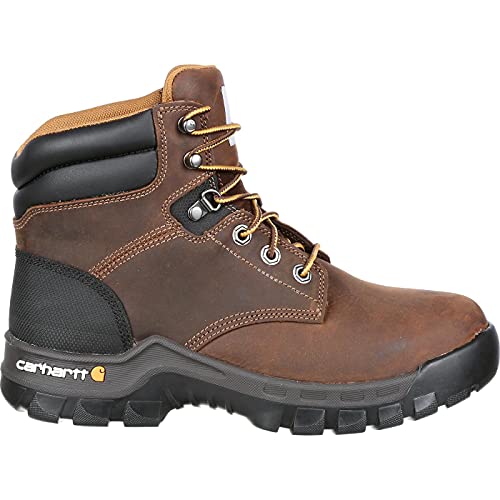
Best For: Industrial & Warehouse Shifts | Price: $140–$170
Carhartt’s Rugged Flex platform is a standout for flat-footed warehouse and industrial workers because of one underrated feature: natural foot flexion. Where many safety boots force a rigid, stiff stride that compounds overpronation control fatigue, the Rugged Flex® construction bends naturally with your foot through each step — significantly reducing the muscle strain that flat-footed workers experience during extended walking shifts.

The Storm Defender® waterproofing keeps feet dry on wet industrial floors, and the removable PU/foam insole has confirmed orthotic-compatible depth — easy to swap for a Superfeet or Powerstep insert for proper collapsed arch support. The composite toe keeps weight down, which matters enormously when your feet are compensating for an absent arch all day. Available in standard and wide (W) widths — a solid option if you’re between standard and full EE wide work boots sizing.

| ✅ PROS | ❌ CONS |
| Rugged Flex® reduces stride-compensation fatigue | Very wide feet may need to size up half size |
| Storm Defender® waterproofing | Not resolable |
| Composite toe — lighter than steel | |
| Removable PU insole — orthotic-compatible |

Removable Insole: ✅ Yes | Safety Toe: Composite (ASTM F2413) | Waterproof: ✅ Yes
#5 — Wolverine Rancher Steel Toe

Best For: Overpronation Control — All-Day Versatile Use | Price: $120–$145
The Wolverine Rancher is the unsung hero of this list for one reason: it ships with a deep cushioned removable insole that includes an optional arch booster insert — a rare dual-layer system that lets you dial in collapsed arch support without buying a separate OTC orthotic immediately. For workers who aren’t yet using custom or OTC orthotics, the arch booster alone makes a noticeable difference in managing overpronation control through long shifts.
The low heel profile is a critical feature for flat-footed workers that many guides overlook. High-heeled work boots push the foot into a position that exacerbates overpronation; the Rancher’s flat-profile sole promotes a neutral, heel stabilization-friendly stance from the first hour. The oil- and slip-resistant outsole performs well across varied surfaces, and the hybrid leather upper strikes a versatile look suitable for trades, site management, and light industrial work alike.

| ✅ PROS | ❌ CONS |
| Dual-layer insole + arch booster system | Not a dedicated waterproof boot |
| Low heel profile — neutral stance for flat feet | Less rugged than Goodyear welt options |
| Oil- and slip-resistant outsole | |
| Versatile look — site to office crossover |

Removable Insole: ✅ Yes — dual-layer with arch booster included
Safety Toe: Steel (ASTM F2413) | Waterproof: ❌ Water-resistant only
#6 — Red Wing Heritage Classic Moc Toe 875
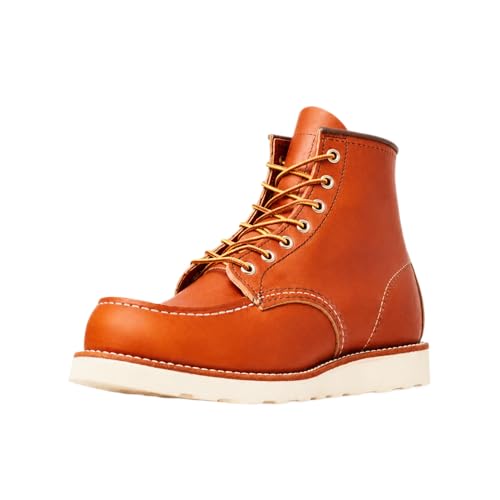
Best For: Premium Long-Term Investment — Boot That Molds to Your Foot | Price: $330–$370
The Red Wing 875 deserves a careful, accurate explanation of its footbed system — because most reviews get it wrong. The 875 uses a leather insole board bonded to a cork fill layer beneath it. Unlike modern boots with a removable foam insert, the cork fill in the 875 is not a traditional removable orthotic — it’s structural fill that molds to your foot’s shape over time through the leather board above it. You cannot lift it out and swap it the way you would a Superfeet.

What you can do — and what flat-footed workers often do — is place a custom or OTC orthotic directly on top of the leather insole board. The 875’s generous interior volume and the natural give of the leather board accommodates this well. Over time, the cork beneath the board also gradually conforms to your foot’s unique pressure map, adding a secondary layer of personalized fit. The result is a boot that gets better for your specific foot with every week of wear — not worse, as most boots do.
This is meaningfully different from a modern removable-insert boot — it’s worth being honest about that distinction. If you need a quick, clean orthotic swap, the 875 requires more planning than other boots on this list. If you’re willing to break it in properly and treat it as a long-term foot investment, it’s unmatched.

This is a Goodyear welt boot built to last 10–15 years with proper care and resoling. The Traction Tred outsole provides solid slip resistance on concrete and tile, and the full-grain leather upper develops a patina over time that heritage boot fans appreciate deeply. From a biomechanical standpoint, the moc toe last has a naturally wide forefoot that accommodates flat-foot splay without requiring EE wide work boots sizing in most cases. The arch shank support is firm enough to resist mid-foot collapse even without an aftermarket insert during the initial break-in period.

| ✅ PROS | ❌ CONS |
| Cork footbed molds to your specific arch | No safety toe — not ASTM F2413 rated |
| Goodyear welt — resolable, 10–15 year lifespan | High upfront cost ($330–$370) |
| Wide moc toe — natural flat-foot splay | 2–3 week break-in period required |
| USA-made premium quality | Not waterproof |

Footbed Note: ⚠️ Cork fill is structural, not removable. Place orthotics on top of the leather insole board — the boot’s interior volume accommodates this well.
Safety Toe: None | Waterproof: ❌ No
#7 — OrthoFeet Granite Work Boot

Best For: Plantar Fasciitis + Collapsed Arch Support + Low Arch | Price: $160–$200
OrthoFeet is the only brand on this list that designs boots from the ground up for foot pain conditions — and it shows. The Granite is engineered specifically for low arch work boots requirements, collapsed arch support recovery, and plantar fasciitis relief. It ships with multiple removable insole layers that can be added or removed to dial in the exact arch height for your specific flat-foot profile. No other boot on this list offers that level of out-of-the-box customization.

The extra-depth last provides genuine room for custom orthotics alongside thick merino wool socks — something most work boots simply can’t offer. The wide toe box accommodates flat-foot splay without compression, and the padded interior reduces friction points that worsen foot pain conditions. From an overpronation control standpoint, the medial arch posting built into the included insole system provides real correction even before you add an aftermarket orthotic.

| ✅ PROS | ❌ CONS |
| Podiatrist-designed for flat feet & arch pain | Lighter-duty construction — not for heavy construction |
| Multi-layer removable insole system | Less aggressive outsole traction |
| Extra-depth last — fits custom orthotics easily | Style is functional rather than traditional |
| EH protection + safety toe option |

Removable Insole: ✅ Yes — multi-layer adjustable arch system
Safety Toe: Optional | Waterproof: ❌ No
#8 — Irish Setter Ely 6″ Steel Toe Waterproof

Best For: Wet Environments & Outdoor Sites | Price: $150–$180
The Irish Setter Ely earns its spot through a combination of genuine waterproof performance and a padded ankle collar that adds secondary lateral stability for overpronating flat-footed workers. The collar effectively extends the heel stabilization zone up the ankle — a subtle but meaningful benefit for workers whose ankles tend to roll inward on uneven or wet outdoor terrain.

The full-grain leather upper with waterproof construction has been proven across outdoor industrial and construction site environments. The removable EVA footbed confirms orthotic-compatible depth, and the moisture-wicking lining manages the internal climate across 10-hour shifts. The oil-resistant outsole handles slick surfaces reliably. For workers who regularly deal with rain, mud, or standing water, the Ely outperforms most boots in this price range for sustained waterproof integrity.

| ✅ PROS | ❌ CONS |
| Full-grain leather waterproof construction | Break-in period needed on full-grain leather |
| Padded collar — added ankle stability | Heavier than synthetic waterproof alternatives |
| Removable EVA footbed — orthotic-compatible | |
| Moisture-wicking lining — all-day freshness |

Removable Insole: ✅ Yes | Safety Toe: Steel (ASTM F2413) | Waterproof: ✅ Yes
#9 — Thorogood American Heritage 6″ Moc Toe
No products found.Best For: Concrete Floor Fatigue — Trades & Hard Surface Work | Price: $210–$250
Ask any experienced tradesperson what’s the best boot for all-day concrete work and the Thorogood American Heritage comes up constantly — and for good reason. The MAXWear Wedge outsole is specifically engineered for hard surfaces: it distributes weight evenly across the entire footprint, eliminating the heel-toe elevation differential that typical work boot heels create. For flat-footed workers, this is transformative. The wedge geometry keeps you in a neutral stance that doesn’t force your already-compromised arches into additional stress — making it the single best option for combating concrete floor fatigue on this entire list.
No products found.The removable footbed swaps easily for custom orthotics, and the moc toe last has a naturally wide forefoot that eliminates the need for EE wide work boots sizing for most wearers. The arch shank support in the midsole is firm enough to maintain structure through a full shift without an additional orthotic, though we still recommend adding one for serious flat feet. Made in the USA, Goodyear welt, resolable — this boot can last 10+ years with basic maintenance.
| ✅ PROS | ❌ CONS |
| MAXWear Wedge — best sole for concrete | 3–4 week break-in period |
| Goodyear welt — resolable, 10+ year lifespan | No safety toe on Heritage line |
| Wide moc toe — flat-foot splay friendly | Not waterproof |
| Made in USA |
Removable Insole: ✅ Yes | Safety Toe: Soft Toe (safety toe version available separately) | Waterproof: ❌ No
#10 — Timberland PRO Titan 6″ Alloy Safety Toe
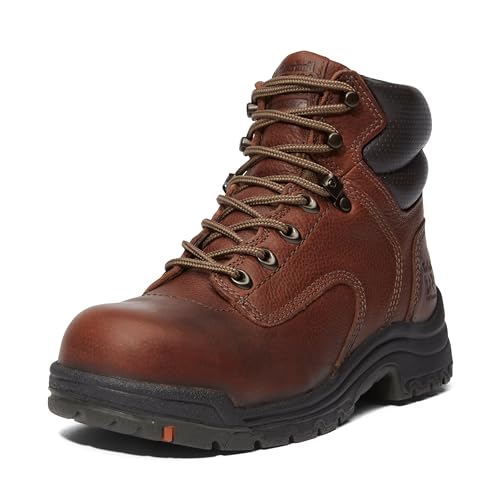
Best For: Lightweight Safety Toe + Energy Return on Long Shifts | Price: $150–$180
The Timberland PRO Titan rounds out this list as the best option for workers who need ASTM-rated safety protection but want to minimize the weight penalty that typically comes with steel toe boots. The alloy toe sits between composite (lightest) and steel (heaviest) — a practical middle ground that reduces the end-of-day leg fatigue that flat-footed workers experience disproportionately due to the muscle compensation demands of overpronation control.

The contoured OrthoLite footbed is fully removable and orthotic-compatible, and the Anti-Fatigue Technology midsole provides genuine energy return that reduces concrete floor fatigue during extended standing shifts. The antimicrobial lining paired with Outlast temperature regulation addresses a practical problem for workers wearing insulated orthotics — sweat buildup that degrades both foot comfort and orthotic performance. The heel stabilization geometry in the Titan’s midsole is among the more structured options in the Timberland PRO lineup, providing meaningful rearfoot control for overpronators.

| ✅ PROS | ❌ CONS |
| Alloy toe — lighter than steel, ASTM-rated | Stock insole degrades at ~6 months |
| Anti-Fatigue midsole energy return | Heavier than composite toe alternatives |
| OrthoLite footbed — removable + orthotic-friendly | |
| Outlast temp regulation — reduces sweat buildup |

Removable Insole: ✅ Yes — OrthoLite, replace at 6 months under heavy use
Safety Toe: Alloy (ASTM F2413) | Waterproof: ✅ Yes (select models)
Full Comparison Table — All 10 Boots at a Glance
| # | Boot | Price | Insole | Toe | Best For | WP | Rating |
|---|---|---|---|---|---|---|---|
| 1 | Wolverine Overpass | $130–$160 | ✅ | Composite | Best Overall | ✅ | ⭐⭐⭐⭐⭐ |
| 2 | Timberland PRO Pit Boss | $120–$150 | ✅ | Steel | Most Durable | ✅ | ⭐⭐⭐⭐½ |
| 3 | KEEN Utility Flint II | $130–$160 | ✅ | Steel | Wide Feet / Comfort | ❌ | ⭐⭐⭐⭐½ |
| 4 | Carhartt Rugged Flex | $140–$170 | ✅ | Composite | Industrial / Warehouse | ✅ | ⭐⭐⭐⭐½ |
| 5 | Wolverine Rancher | $120–$145 | ✅ | Steel | Overpronation Control | ❌ | ⭐⭐⭐⭐ |
| 6 | Red Wing 875 | $330–$370 | ⚠️ Cork* | None | Premium / Long-term | ❌ | ⭐⭐⭐⭐½ |
| 7 | OrthoFeet Granite | $160–$200 | ✅ | Optional | Plantar Fasciitis | ❌ | ⭐⭐⭐⭐ |
| 8 | Irish Setter Ely | $150–$180 | ✅ | Steel | Wet Environments | ✅ | ⭐⭐⭐⭐ |
| 9 | Thorogood Heritage | $210–$250 | ✅ | Soft Toe | Concrete Floor Fatigue | ❌ | ⭐⭐⭐⭐½ |
| 10 | Timberland PRO Titan | $150–$180 | ✅ | Alloy | Lightweight Safety Toe | ✅ | ⭐⭐⭐⭐ |
* Red Wing 875: Cork fill is structural, not a removable insert. Place orthotics on top of the leather insole board. See full review above for details.
7 Flat Feet Work Boot Mistakes That Are Destroying Your Feet Right Now
Most flat-footed workers don’t fail because they bought bad boots. They fail because of these predictable, fixable mistakes — and most of them cost nothing to correct.
The outer leather of a quality work boot can last years. The midsole — the cushioning platform your arch depends on — has a completely different lifespan. Most polyurethane midsoles are effectively dead after 500–600 hours of use. If your boots are over 12–18 months old and you haven’t replaced the insoles, you’ve been walking on a collapsed platform. The boot looks fine. Your feet know better.
Flat feet splay under load. If you’ve been buying standard D-width boots in your usual size, your feet are being laterally compressed every single shift. EE wide work boots sizing is not a luxury — for many flat-footed workers it’s the difference between manageable and painful. Try EE before you try orthotics.
Traditional heeled work boots place your foot in a slight forward pitch that forces your flat arch to bear additional rotational load with every step. Wedge soles eliminate this entirely. If you spend 8+ hours on hard surfaces, switching from a heeled boot to a wedge sole is the single cheapest biomechanical improvement you can make — no orthotic required.
Even the best OTC orthotics (Superfeet, Powerstep) have a finite lifespan under 40-hour work weeks. Most workers replace them only when the pain comes back — but that means they’ve already been on a collapsed arch support platform for weeks. Set a calendar reminder. Replace on a schedule, not a symptom.
Dropping a new orthotic on top of the existing stock insole feels logical — you’re adding support, right? Wrong. Stacking insoles raises your foot out of the heel counter, destroys heel stabilization, and creates new pressure points. Remove the stock insole entirely first. Always.
Wearing a brand-new Goodyear welt leather boot on a 10-hour shift on day one is one of the most reliably painful things a flat-footed worker can do to themselves. The leather needs 2–3 weeks of graduated wear to soften and conform. Start with 1–2 hours indoors. Work up gradually. Your feet will thank you by month two.
Many flat-footed workers specifically seek out boots marketed as having “built-in arch support” — and end up with mediocre boots that happen to have a slightly contoured stock insole that degrades in 90 days. Remember the framework: the boot is the chassis, the orthotic is the suspension. Buy the best chassis for your job. Then build the suspension system separately.
Best Aftermarket Insoles for Work Boots — Flat Feet & Low Arch Support
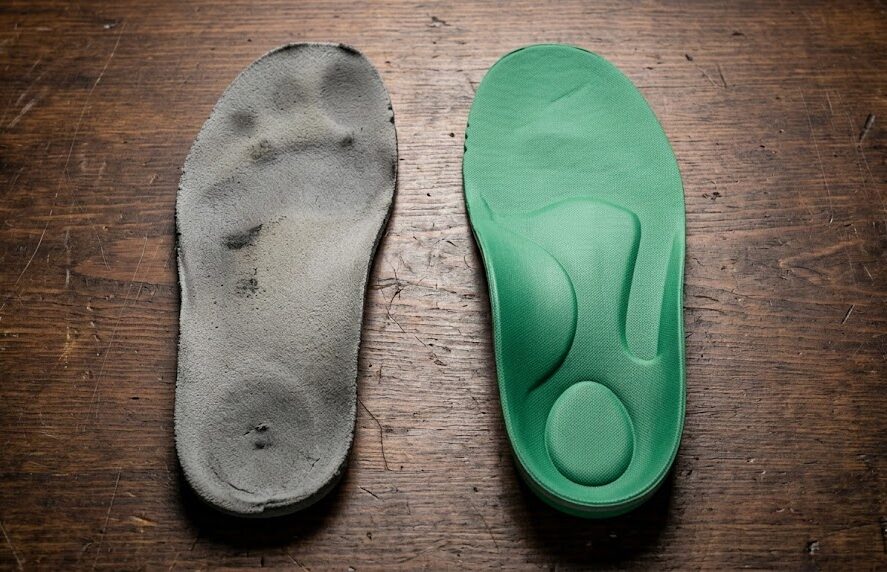
aftermarket insoles for work boots
The boot is only half the solution. For genuine collapsed arch support and long-term overpronation control, pair your new boots with one of these proven OTC orthotics:
| Insole | Why It Works for Flat Feet | Price |
|---|---|---|
| Superfeet GREEN / Work Cushion | Firm stabilizer cap + deep heel cup — industry standard. Work Cushion adds extra padding for concrete floor fatigue. | ~$55 |
| Powerstep Pinnacle Work | Semi-rigid arch shank support + dual-layer cushioning. Fits most work boot profiles without modification. | ~$45 |
| Tread Labs Ramble | Aggressive medial posting for maximum overpronation control. Best for moderate-to-severe flat arches. | ~$75 |
| Samurai Insoles Super-Padded | Flat-foot-specific metatarsal support. Well-regarded in trades communities for low arch work boots pairing. | ~$30 |
| Custom Orthotics (Podiatrist) | Gold standard for serious cases. Often partially covered by insurance. Lasts 2–3 years with proper care. | $400–$600 |
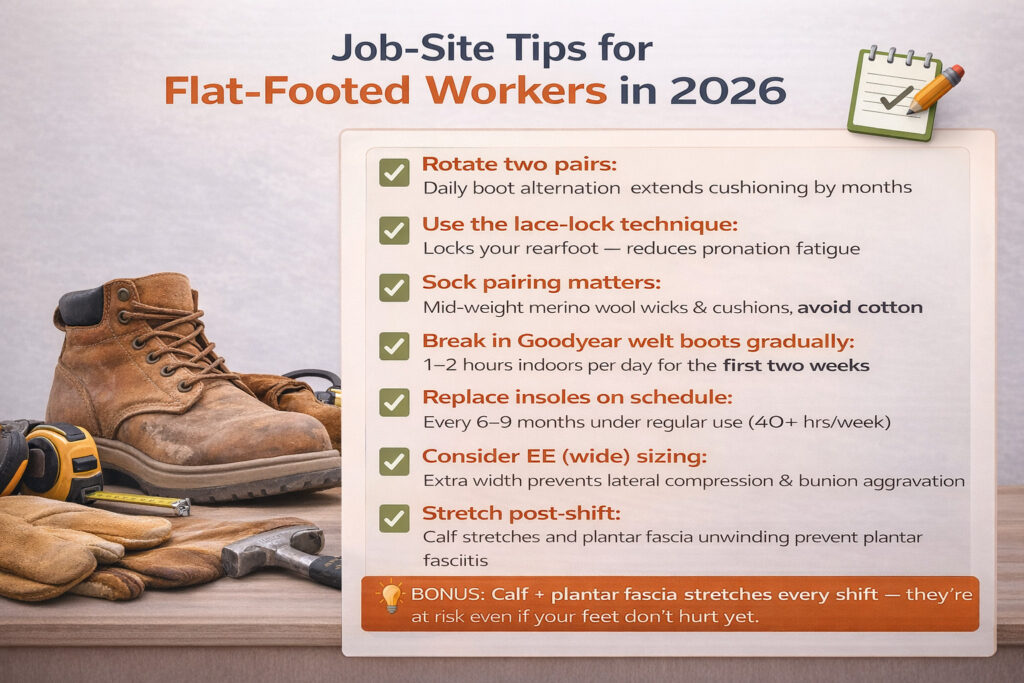
7 Job-Site Tips for Flat-Footed Workers in 2026
job site tips for flat footed workers
- Rotate two pairs: Alternating boots daily allows midsoles to fully decompress and rebound, extending the effective life of arch shank support and cushioning by months.
- Use the lace-lock technique: Thread laces through the extra top eyelet to lock the rearfoot — this reduces heel slip and the ankle-roll that drives overpronation control fatigue.
- Sock pairing matters: Mid-weight merino wool crew socks regulate temperature, wick moisture, and add cushion. Avoid cotton — it compresses under load and adds nothing for low arch work boots users.
- Break in Goodyear welt boots gradually: 1–2 hours indoors per day for the first two weeks before full job-site use. Rushing this worsens the experience significantly.
- Replace insoles on schedule: Every 6–9 months under regular use (40+ hrs/week). Don’t wait for pain to return — it means you’ve already been walking on compromised collapsed arch support for weeks.
- Consider EE (wide) sizing: Many flat-footed workers benefit from EE wide work boots sizing — the extra width accommodates natural foot splay without lateral compression or bunion aggravation.
- Stretch post-shift: Calf stretches and plantar fascia stretching after every shift. Flat-footed workers are at elevated risk of plantar fasciitis and Achilles tendinopathy — prevention is far cheaper than treatment.
Frequently Asked Questions — Work Boots for Flat Feet
Are work boots good for flat feet?
It depends entirely on the boot. The key criteria are: fully removable insole, firm arch shank support, deep heel cup for heel stabilization, and a stable sole profile. The wrong work boot actively accelerates flat-foot pain. The right one — especially when paired with an OTC orthotic — can virtually eliminate the concrete floor fatigue and joint pain that flat-footed workers suffer daily.
What insoles are best for flat feet in work boots?
Firm semi-rigid insoles with medial arch posting and a deep heel cup. Top OTC picks for overpronation control: Superfeet GREEN Work Cushion, Powerstep Pinnacle Work, and Tread Labs Ramble. For persistent or severe pain, custom orthotics prescribed by a podiatrist are the gold standard.
Is a steel toe or composite toe better for flat feet?
Composite toe is generally better for flat-footed workers — lighter weight reduces end-of-day leg fatigue, which is amplified by the constant muscle compensation that overpronation control demands. Both steel and composite meet ASTM F2413 safety requirements — choice should be based on site-specific requirements and personal fatigue tolerance.
Can I use custom orthotics in work boots?
Yes — but only in boots with a fully removable stock insole and sufficient volume depth. The boot must accommodate the orthotic without cramping the toe box or misaligning the heel counter. All 10 boots on this list are confirmed orthotic-compatible when the stock insole is removed first.
Are wedge sole boots better for flat feet on concrete?
Yes — significantly. Wedge soles distribute weight evenly across the entire footprint, eliminating the heel-toe elevation differential that standard heeled work boots create. This directly reduces concrete floor fatigue and reduces the pronation stress placed on low arch work boots users. The Thorogood American Heritage (#9) is the top wedge pick on this list.
What does EE width mean and do I need it for flat feet?
EE is a wide width designation (approximately 1/4″ wider than standard D width per size). Flat feet naturally splay under load — if your current boots feel tight across the forefoot or you’re developing bunion pressure, EE wide work boots sizing is worth trying. The Timberland PRO Pit Boss and Wolverine Overpass both offer EE options.
How often should I replace insoles if I have flat feet?
Every 6–9 months for OTC insoles under regular work use (40+ hrs/week). Custom orthotics last 2–3 years with proper care. Don’t wait for pain to return as a signal — that means your collapsed arch support has already been compromised for weeks. Replace on a fixed schedule.
Final Verdict — Best Work Boots for Flat Feet with Removable Insoles (2026)
Our Top Picks Summary
🥇 Best Overall: Wolverine Overpass — composite toe, orthotic depth, waterproof, all-day concrete ready
🏗️ Best for Concrete Floor Fatigue: Thorogood American Heritage — MAXWear Wedge, resolable, USA-made
🦶 Best for Plantar Fasciitis + Collapsed Arch: OrthoFeet Granite — podiatrist-designed, multi-layer insole system
👑 Best Long-Term Investment: Red Wing Heritage 875 — cork footbed molds to your arch, 10–15 year lifespan
💧 Best Waterproof: Irish Setter Ely — full-grain leather, padded ankle for overpronation control
⚡ Best Wide Feet Option: KEEN Utility Flint II — asymmetric toe, zero break-in, EE-friendly geometry
The single most important thing you can do for your flat feet on the job in 2026 is stop treating the boot as the solution and start treating it as the platform. The boot is the chassis. The orthotic is the suspension. Every boot on this list gives you a chassis that’s been evaluated for insole depth, heel counter firmness, midsole structure, and toe box geometry — all the things a flat-footed worker needs from the outer shell. What you build inside that shell, with a Superfeet Work Cushion or Powerstep Pinnacle or your podiatrist’s custom orthotic, is where your actual foot support comes from.
A great chassis with no suspension is a punishing ride. Pair any of these boots with the right orthotic and you’ve built a complete foot support system for under $250 total — less than one podiatrist co-pay, and something you can wear for the next 50,000 steps.
Your feet carry you through 8–12 hour shifts. Your knees, hips, and lower back are downstream of every single step. Getting this right isn’t optional — it’s maintenance.
🛒 Shop Our Top Pick — Wolverine Overpass
As an Amazon Associate, Bootsguru.com earns from qualifying purchases. Prices may vary.