This guide covers the best work boots for walking on railroad ballast, based on real-world railroader use, field durability tests, and safety requirements. If you walk track for a living, this is your survival manual.
If you are a railroader—whether you’re Maintenance of Way (MoW), a conductor walking a train, or a signalman—you know that “walking the ballast” isn’t just walking. It is an athletic event on a hostile surface.
Railroad ballast consists of sharp, fist-sized granite rocks designed to stabilize tracks. It is unstable, uneven, and absolutely merciless on footwear. If you wear standard big-box store construction boots out there, you are going to destroy your boots—and your knees—in record time.
Here is the no-BS guide to finding boots that can actually survive the track.
🛑 STOP: The “Ballast Survival” Checklist
Before you even look at a brand, look at the build. If a boot doesn’t have these three things, do not buy it for ballast work:
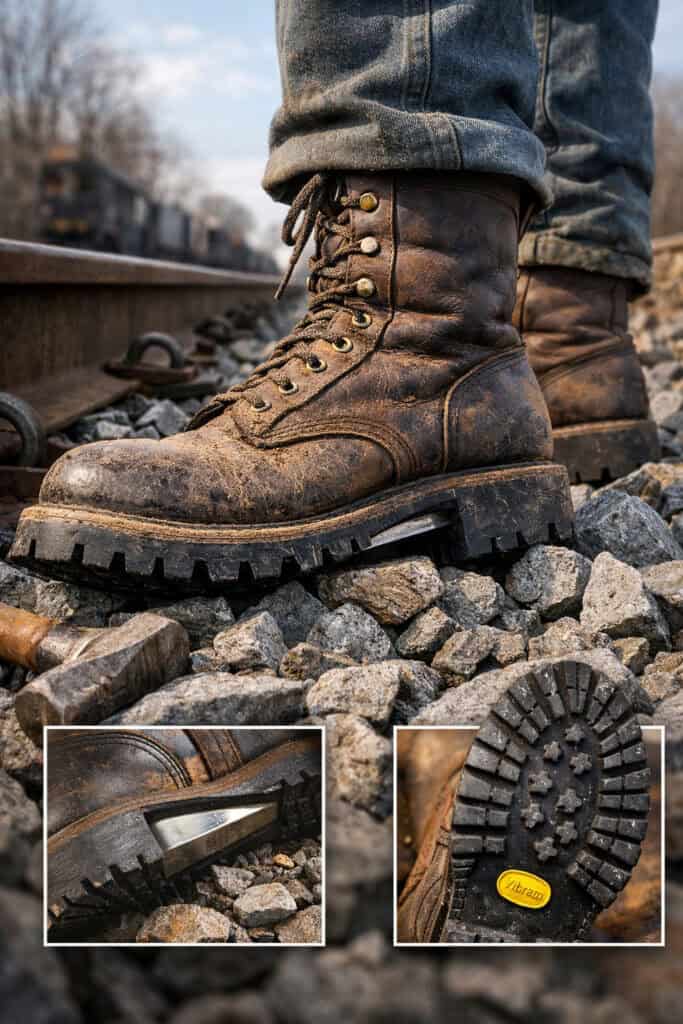
- A Steel or Triple-Ribbed Shank: This is non-negotiable. The shank bridges the gap between the heel and the ball of your foot. Without a stiff shank, your foot wraps around every single rock, which is a fast track to stone bruising and plantar fasciitis.
- Hard Rubber Lug Sole: You need a high-density, vulcanized rubber outsole (like a Vibram 100 lug). Soft wedge soles or EVA foam will get sliced to ribbons by jagged granite.
- Minimum 8-Inch Shaft: Ballast shifts under your feet. A 6-inch hiking boot offers zero mechanical support when a rock rolls out from under your heel. You need an 8-to-10-inch shaft to act as a brace against ankle rolls.
Who This Guide Is For (And Who It Isn’t)
✅ This Guide Is For:
- Trackmen & MoW: You walk 5-10 miles of ballast a day.
- Conductors & Brakemen: You are jumping off cars and walking trains in remote sidings.
- Signal Maintainers: You are climbing slick ladders and traversing embankments.
❌ This Guide Is NOT For:
- Warehouse or Shop Workers: If you work on flat concrete pads, the boots below will be too heavy and stiff for you.
- Light Construction: If you frame houses, these boots are overkill.
best work boots for walking on railroad ballast
Why Ballast Destroys Normal Boots
The physics of the railroad track are different than a construction site.
The “Cheese Grater” Effect
Granite ballast is essentially a pile of knives. It slices through soft crepe rubber (white soles) and foam midsoles instantly. You need a sole that is harder than the rock you are walking on.
The Fatigue Factor (Proven by Research)
Walking on loose rock forces your micro-stabilizer muscles to fire with every step to keep you upright. Federal Railroad Administration (FRA) safety guidance and research indicate that walking on ballast significantly increases muscle activation and joint loading compared to flat ground.
A stiff, heavy boot provides a stable platform. It effectively “flattens” the ground for you, reducing fatigue over a 12-hour shift by doing the stabilizing work for your ankles.
Quick Comparison: Top Railroad Boots
| Boot Model | Best For… | Shank Type | Outsole | Rebuildable? |
|---|---|---|---|---|
| White’s Smoke Jumper | Career MoW (Lifetime) | Leather (Extra Thick) | Vibram 100 Lug | Yes (Fully) |
| Red Wing Logger (2218) | Conductors / Yard | Steel | Vibram Lug | Yes (Resoling) |
| Timberland PRO Rigmaster | Wet / Winter / Snow | Steel | PU (Ladder Lock) | No |
| Carolina Elm | New Hires / Budget | Steel | Rubber Lug | No |
Top Recommendations: The Heavy Hitters
Based on field testing and railroader feedback, these are the boots that hold up.
1. The “Buy It For Life” Choice: White’s Smoke Jumper / Nicks BuilderPro
- Best For: Career MoW & Trackmen
- The Verdict: If you plan to retire from the railroad, this is where you should eventually put your money. These are hand-built Pacific Northwest (PNW) logger boots. They feature thick leather shanks that mold to your feet but never snap.
- Pros: Unmatched durability, custom fit options, fully rebuildable (new soles, new vamps).
- Cons: Expensive ($550+), heavy, and a brutal 80-hour break-in period.
2. The Reliable Workhorse: Red Wing Logger (Model 2218 / 4420)
- Best For: Conductors, Yardmasters, & General Utility
- The Verdict: This is the industry standard for a reason. It features a steel shank, a 9-inch height for excellent ankle support, and aggressive Vibram lugs that grip wet ballast and slippery ladder rungs.
- Pros: Waterproof, easier to find in stores than custom boots, excellent ankle stability.
- Cons: Not cheap, though often covered by railroad subsidies.
3. The “Wet & Harsh” Specialist: Timberland PRO Rigmaster

- Best For: Wet ballast, snow, and oily tie plates.
- The Verdict: If you work in a region with constant rain or snow, the Rigmaster is a top contender. It uses “Cast-Bond” construction (more durable than glue) and features a specific Ladder Lock™ outsole design meant to grip rungs and rail heads.
- Pros: True waterproofing, aggressive traction on slick surfaces, secure 8″ fit.
- Cons: Heavy build; synthetic liners eventually tear; not rebuildable like the options above.
4. The Budget Entry: Carolina Elm / Logger Series

- Best For: New Hires & Probationary Period
- The Verdict: If you are just starting and can’t drop $400 on boots yet, Carolina Loggers (like the Elm CA1821) are the most common starting point. They have the correct “logger” pattern and steel shank necessary for the job.
- Warning: While functional, the leather is thinner than Red Wing or White’s. Expect 8–12 months of life on ballast before they need replacing.
What to AVOID (The “Do Not Buy” List)
1. Wedge Sole Boots (Thorogood Moc Toe)
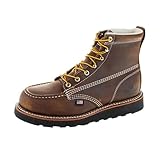
Boots like the Thorogood Moc Toe are legendary for concrete work, but they are dangerous on ballast. They lack a defined heel (necessary for locking onto ladder rungs) and the soft white sole offers no traction on loose slopes.
2. Cement Construction Hikers
Unless you are in a purely signal/electrical role that keeps you mostly off the rocks, avoid glued-sole hikers. Rock dust sucks the moisture out of the glue, causing soles to delaminate (peel off) quickly.
The Hard Truth About Break-In
Real railroad boots are not comfortable out of the box. A boot stiff enough to keep your ankle from snapping when a rock shifts will feel like a wooden clog for the first 80 hours.
- Don’t rush it: Do not wear new boots for a full 12-hour shift on day one.
- Ramp up: Wear them around the house, then for 4 hours, then 6.
- Oil them: Oil the uppers to help soften the leather, but understand that the stiffness is a safety feature, not a defect.
Maintenance: Protecting Your Investment
Railroad environments are toxic to boots. Granite dust acts like microscopic glass shards that cut into stitching, and diesel fuel dissolves glue.
- Brush Daily: Knock the dust off at the end of every shift.
- Oil Weekly: Use preservatives like Obenauf’s or Huberd’s Grease to keep the leather from cracking.
- Check Your Soles: Diesel on tie plates can make rubber slick; keep soles clean to maintain traction.
FAQ
Q: Are composite toes safe for the railroad?
A: Yes, generally. They are lighter than steel and don’t conduct cold, which is great for winter work. Just ensure the boot still has the heavy shank and ankle support required for ballast.
Q: Can I use these boots on concrete floors?
A: You can, but it won’t be fun. The high heel and aggressive lugs that bite into ballast will feel clunky on smooth concrete, potentially causing knee and back pain. If you work primarily in a yard on flat ground, you might get away with a softer boot, but for the mainline, stick to loggers.
Q: Why do my feet hurt after walking the track?
A: Aside from general fatigue, you likely have “stone bruising.” This happens when a boot has a weak shank or soft sole, allowing the jagged rocks to push up into the arch of your foot with every step. Upgrade to a boot with a steel shank to fix this.