
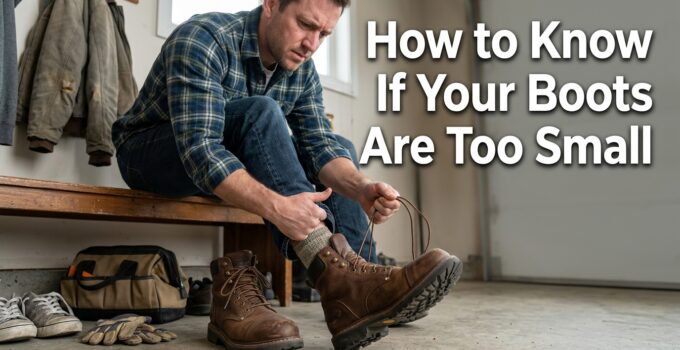
Boots that are too small don’t always announce themselves the way you’d expect. Sometimes it’s obvious from the first lace-up. Other times it creeps in over weeks of otherwise normal wear, toe pain by the end of a shift, a toenail that’s suddenly a different color, a foot that feels tired in a way that doesn’t match the work you did. If you’ve already ruled out the opposite problem, this is the other half of the question, covered in our companion piece on how to know if your work boots are too big.
This covers the real signs, why length and width are two different problems with two different fixes, why a boot that fit fine at checkout can start feeling small by afternoon, and what genuinely helps versus what just delays a return you should have made.
Signs Your Work Boots Are Too Small
- Toe pain or cramping that builds through a shift. Toes that feel jammed, cramped, or sore by the end of the day, especially if it eases noticeably once the boots come off, points to inadequate length or width, not just a tough day on your feet.
- Black or bruised toenails. Repeated pressure against the front of the boot bruises the nail bed over time, turning the nail dark. It’s a clear, physical sign the boot isn’t giving your toes enough room, whether that’s from length, from lacing too tight, or both.
- Numbness or tingling. A boot that compresses the width of your foot can put pressure on the nerves between your toes, causing numbness or a pins-and-needles feeling. This is worth taking seriously: if numbness is severe, doesn’t resolve once you remove the boot, or keeps recurring, it’s worth talking to a doctor rather than assuming it’s purely a sizing issue.
- Visible bulging or heavy creasing at the sides. If your foot is visibly pushing outward against the leather, or the boot creases sharply across the toe box, that’s a strong sign of a width problem specifically, not just length.
- Red pressure marks after you take the boots off. Indentation lines or red marks on the top or sides of your foot are a direct sign the boot has been pressing harder than it should all day.
Why This Matters More Than Just Comfort in a Safety-Toe Boot
In a soft-toe shoe, a too-small fit is uncomfortable but relatively straightforward, you feel it, and you address it. In a certified safety-toe work boot, the calculation is a little different. The composite or steel cap at the front of the boot is rigid by design. When a too-small boot pushes your toes directly against that rigid structure, repeatedly, over a full shift, day after day, you’re not just dealing with garden-variety discomfort, you’re dealing with sustained pressure against a hard surface that has nowhere to give. That’s a real escalation path from discomfort to actual toe or nail injury over time, worth taking more seriously than “just breaking them in” in a boot without a rigid toe cap.
Length vs. Width: Two Different Problems
These get confused constantly, and they need different fixes.
A length problem shows up as toe pain, black toenails, or your longest toe reaching the very front of the boot. No amount of break-in fixes this. Leather does not get meaningfully longer with wear, if your toes are hitting the front on day one, they’ll still be hitting the front in month six.
A width problem shows up as pressure on the sides of your feet, visible bulging, numbness across the forefoot, or a boot that creases sharply at the toe box even though there’s length to spare at the front. This is where sizing up in width, rather than overall length, or choosing a brand or model known to run wide, actually solves the problem, sizing up the whole boot to fix a width issue just reintroduces a length problem you didn’t have before.
Why a Boot That Fit at Checkout Can Feel Small by Afternoon
Feet swell measurably over the course of a working day, and that swelling works directly against you if your boots were already snug to begin with. A boot that felt reasonable first thing in the morning can genuinely tighten as your feet swell through a long shift, then loosen again once you’re off your feet. This is the same swelling mechanism covered in our too-big companion piece, just working in the opposite direction here: for oversized boots, swelling can temporarily mask a sizing problem; for boots that are already snug, swelling makes a marginal fit noticeably worse by mid-shift.
This is exactly why trying boots on and walking around later in the day, wearing the actual sock weight you’ll work in, matters more than a morning fit check. Our store fit-test guide covers that process in more depth.
Will Break-In Fix It?
Partially, and only for certain problems. Leather genuinely stretches and molds to the width and shape of your foot over the first several weeks of regular wear, which can meaningfully ease a mild width problem. It does not fix a length problem, and it won’t meaningfully help a boot that’s genuinely a full size too small across the board. If you’re hoping break-in will solve toe pain or black toenails specifically, that’s the wrong fix for that particular problem, length doesn’t change with wear.
What To Do If Your Work Boots Are Too Small
- If it’s a length problem and you’re still within the return window, return them. There’s no reliable fix for genuinely inadequate length, and continuing to wear them risks real toenail and toe injury over time.
- If it’s a width problem, look for a wide-width version of the same size before sizing up overall. Many work boot brands offer width options (D, EE, EEE) specifically for this reason, sizing up the whole boot to fix width alone just trades one problem for another.
- Loosen or adjust your lacing pattern across the forefoot specifically if the pressure is concentrated there, without over-loosening the ankle and heel lockdown.
- Switch to a thinner sock if you’ve been compensating for a loose heel by wearing heavier socks, since that added sock volume can be exactly what’s pushing a marginal width fit over the edge.
- Don’t try to “wear them in” past genuine pain, numbness, or toenail bruising. Mild width discomfort easing over a few weeks of break-in is normal. Toe pain, numbness, or toenail damage that persists is your body telling you the fix isn’t working.
Frequently Asked Questions
How do I know if my boots are too narrow versus too short?
Too narrow shows up as pressure on the sides of your feet, visible bulging, or numbness across the width of your foot, often with room to spare at the very front of the boot. Too short shows up as your longest toe reaching or hitting the front of the boot, toe pain, or black toenails, regardless of how the boot fits in width. Check both independently, since a boot can be right in one dimension and wrong in the other.
Will black toenails from tight boots go away on their own?
Minor bruising under the nail typically grows out over time as the nail regenerates, similar to any bruise healing. If the nail is severely damaged, extremely painful, shows signs of infection, or you’re unsure how serious it is, that’s a question for a doctor rather than something to self-manage, and it’s a clear sign to stop wearing whatever boot caused it until the fit issue is resolved.
Can insoles help boots that are too small?
Insoles are built to fill excess volume in a boot that’s too big. In a boot that’s too small, adding an insole reduces the internal space even further, which typically makes a too-small fit worse, not better. If the boot is genuinely too small, an insole isn’t the right tool for the problem.
Is it normal for new leather boots to feel tight at first?
Some initial snugness that eases over the first few weeks of regular wear is normal, particularly in width, as the leather molds to your foot. Genuine pain, numbness, or toenail bruising isn’t normal break-in, and shouldn’t be pushed through in the hope that it’ll resolve on its own.
Bottom Line
Toe pain and black toenails are the obvious signs, but numbness, side pressure, and visible bulging matter just as much, and often point to a width problem rather than a length one, which needs a different fix. Break-in can genuinely help a mild width issue. It will never fix inadequate length. And in a certified safety-toe boot specifically, sustained pressure against a rigid toe cap is a real injury risk worth taking seriously rather than pushing through. If you’ve checked this list and your boots seem too roomy instead, our too-big companion guide covers that side of the question, and our store fit-test guide is the place to start for getting the size right the next time around.