
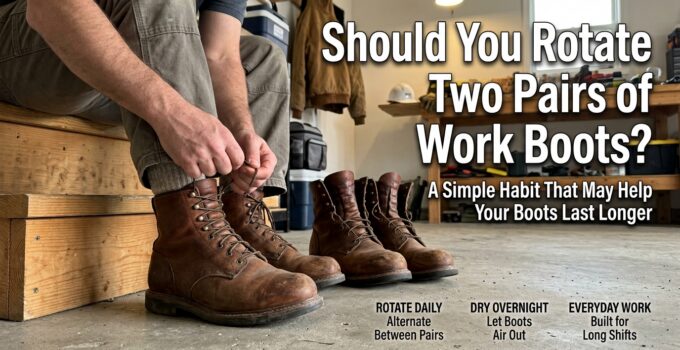
Yes, you should rotate two pairs of work boots, and there’s a real mechanism behind that advice, not just tradition passed down from a foreman who liked having options. Your boots take on real moisture every shift, the materials need genuine time to dry and recover, and wearing the same damp pair again the next morning works against both the boot and your feet.
That said, “just buy two pairs” is easier said than done, and most articles on this topic skip past the actual cost of that advice. This one covers what’s really happening inside your boots during a shift, what rotation actually does about it, and a more realistic way to get there if buying two pairs at once isn’t in the budget right now.
What Actually Happens Inside a Boot During a Shift
Feet sweat a genuinely significant amount over a working day, commonly cited in the half-pint to full-pint range depending on activity level, heat, and boot insulation. That moisture doesn’t evaporate the moment you take your boots off. It sits in the leather, the foam midsole, and especially the insole board, which absorbs and holds moisture longer than people expect.
Foam cushioning in particular loses its ability to compress and rebound properly when it’s saturated. A midsole that felt supportive at 7 a.m. can feel flat and dead by the end of a long shift, and if it doesn’t get a real chance to dry out before the next wear, it starts that next shift already behind. Leather has a similar problem: it dries out and cracks faster when it’s repeatedly re-wetted with sweat and never fully recovers between wears.
The Three Real Benefits of Rotating Two Pairs
Longer Boot Lifespan
Materials that get a genuine chance to dry out completely between wears break down more slowly than materials that stay damp on a near-daily cycle. This applies to the leather upper, the midsole foam, and the insole board alike. A boot that’s always slightly damp is a boot that’s always under stress.
Odor and Bacterial Growth Control
A warm, dark, damp boot interior is close to ideal conditions for bacteria and fungus, the kind responsible for persistent foot odor and conditions like athlete’s foot. Rotation breaks that cycle by giving the boot’s interior a real window to dry out fully rather than staying in that damp middle ground day after day.
Consistent Comfort and Support
A fully dried, fully rebounded pair of boots supports your feet the way it’s supposed to. A pair that never gets the chance to dry out completely is giving you reduced cushioning and support on a slow, cumulative basis, the kind of thing that’s hard to notice day to day but adds up over a long shift.
Does Rotating Reduce Injury Risk?
You’ll see specific injury-reduction percentages cited on some boot care sites. Worth being skeptical of those numbers, they generally trace back to blogs selling boot sprays or inserts without a cited study behind the figure, and this article isn’t going to repeat an unverifiable stat just because it sounds compelling.
There is a more credible, better-sourced version of this idea. Research on rotating running shoes has found that alternating between pairs, even similar models, can reduce repetitive strain injuries, because no two pairs load the foot, ankle, and lower leg in exactly the same pattern. Slight differences in midsole compression, wear pattern, and support distribute stress differently across your feet and joints instead of loading the same structures identically every single day.
That logic translates reasonably well to work boots. If you’re standing or walking on concrete for eight to twelve hours a day in the same pair, every day, you’re repeating the exact same stress pattern shift after shift. Alternating between two pairs, especially if they’re not identical models, gives your feet slightly different loading patterns instead of the same repetitive strain day in and day out.
The Honest Problem With “Just Buy Two Pairs”
Most articles on this topic stop at “buy two pairs and rotate them.” That’s fine advice if the money is there. For a lot of working people, dropping the cost of two quality pairs of boots at once isn’t realistic, and pretending otherwise doesn’t help anyone.
Here’s the more practical version: you don’t need to buy both pairs today. Buy your second pair around the time you’d normally be due to replace your first one, then rotate between the two newest pairs going forward, retiring the older one when it’s genuinely worn out. This spreads the cost out naturally instead of requiring a double purchase up front, and it comes with a real side benefit: you’re never breaking in two brand-new pairs at the same time, and you’re never left with two pairs wearing out simultaneously down the road.
What To Do If You Can’t Rotate Two Pairs Right Now
If a second pair isn’t in the budget yet, there are real steps that reduce the damage of daily single-pair wear, even if they don’t fully replace rotation.
- Cedar shoe trees or boot trees: raw cedar is porous and naturally antimicrobial. Placed in your boots the moment you take them off, cedar absorbs residual moisture overnight and helps control odor at the source rather than masking it.
- Pull the insoles out after every shift: insoles hold more moisture than most people realize, often more than the boot itself. Removing them and letting them dry separately, out in the open rather than inside the closed boot, speeds up the whole drying process meaningfully.
- Forced-air boot dryers: an electric boot dryer actively pushes air through the boot rather than relying on passive evaporation. This is a genuine middle-ground option if you’re serious about extending a single pair’s life while you save toward a second.
None of these fully substitute for actual rotation, a boot that’s actively worn again the next day is still under more cumulative stress than one that gets a full rest day, but they meaningfully slow the damage if a second pair isn’t realistic yet.
How Long Should Each Pair Rest?
There’s no single precise hour count that applies universally, it depends on how much moisture the boot took on, the material, and your climate. The practical test is simple: the boot’s interior should be genuinely dry to the touch, not just cool, before you wear it again. In humid conditions or after a particularly heavy sweat day, that can take longer than a single overnight rest. If you’re rotating two pairs on a strict daily alternation and one of them still feels damp inside when its turn comes back around, that’s a sign to add a cedar tree or a boot dryer into the mix rather than assuming a day off was automatically enough.
Frequently Asked Questions
How often should you rotate work boots?
Daily alternation between two pairs is the standard approach, wear one pair one day, the other the next, giving each pair roughly 24 hours minimum to dry out before its next wear. In humid climates or after unusually heavy sweat, a longer rest may be needed before a pair is genuinely dry inside again.
Does rotating work boots really make them last longer?
Yes. Materials that dry out fully between wears, leather, foam midsoles, insole boards, degrade more slowly than materials kept in a near-constant damp state. This is a real, mechanical effect, not just a comfort preference.
Can you rotate two different types of work boots, like insulated and uninsulated?
Yes, and it can work well if your job conditions vary, insulated for cold mornings or outdoor stretches, uninsulated for warmer days or more active indoor work. The rotation benefit for drying and material recovery applies regardless of whether the two pairs are identical models or different ones.
Is it bad to wear the same work boots every day?
It’s not going to ruin a pair of boots outright, but it does mean the boot rarely gets a genuine chance to fully dry out, which accelerates material breakdown, increases odor and bacterial growth risk, and gradually reduces cushioning performance compared to a boot that gets real rest between wears.
Bottom Line
Rotating two pairs of work boots is genuinely worth doing, for lifespan, for odor and bacterial control, and for giving your feet a break from identical daily strain. But you don’t have to buy both pairs on day one to get there. Buy your second pair when you’d normally be replacing your first, and you’ll end up with a sustainable two-pair rotation without the upfront cost hit. If you’re ready to add a second pair to your rotation, our guides to the best Rocky work boots and best Twisted X work boots are a good place to start comparing options built for different job types.