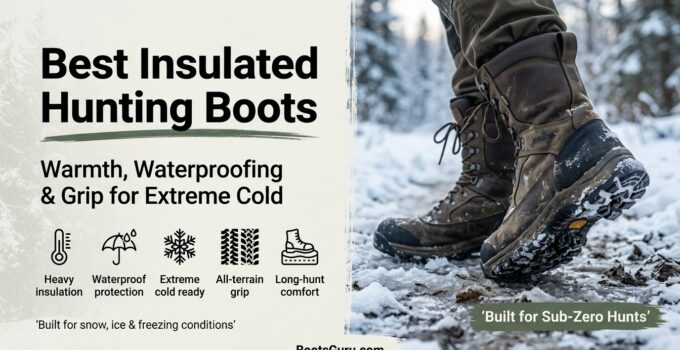
You buy 400g boots, sit in a deer stand at 15°F for four hours, and your toes go numb by hour two. You didn’t buy bad boots — you bought the wrong gram rating for the wrong hunt type. It’s the most common and most expensive mistake insulated boot buyers make, and it happens because nobody explains the gram system clearly before you hand over $180.
This guide fixes that. First, a plain-English breakdown of what 200g, 400g, 800g, and 1200g actually mean in real temperatures and real hunting scenarios. Then, the seven best insulated hunting boots of 2026 — one for every hunter type — so you buy right the first time.
Best Insulated Hunting Boots 2026 — Quick Comparison
| Boot | Insulation | Best For | Upper | Price | Link |
|---|---|---|---|---|---|
| Muck Boot Arctic Pro | 8mm neoprene + 900g equiv. | Best Overall — stand hunting | Rubber/neoprene | ~$220 | Check Price on Amazon |
| Irish Setter Elk Tracker | 400g Thinsulate | Best Active Hunter | Waterproof leather | ~$240 | Check Price on Amazon |
| LaCrosse Alphaburly Pro | 1600g equiv. neoprene | Best Rubber/Waterfowl | Rubber/neoprene | ~$200 | Check Price on Amazon |
| Rocky Blizzard Stalker Pro | 800g Thinsulate | Best Budget | Waterproof synthetic | ~$120 | Check Price on Amazon |
| Guide Gear Leather Hunting Boots | 800g Thinsulate | Best Premium Leather | Full-grain leather | ~$180 | Check Price on Amazon |
| Irish Setter VaprTrek 8″ | 400g Thinsulate | Best Mid-Range | Waterproof leather | ~$190 | Check Price on Amazon |
| LaCrosse Cold Snap II Women’s | 800g Thinsulate | Best Women’s | Waterproof leather | ~$165 | Check Price on Amazon |
The Insulation Gram Rating Explained — What 200g, 400g, 800g and 1200g Actually Mean
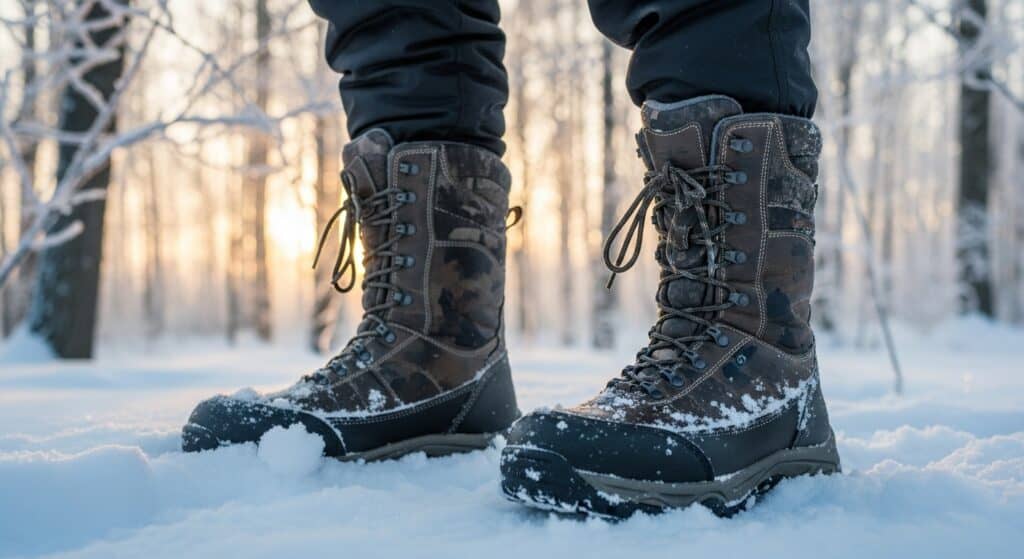
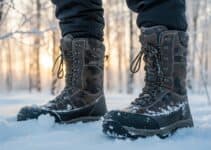
Stay warm and dry with these rugged waterproof snow boots, ideal for winter trekking, hiking, and snow activities. Designed for durability, comfort, and protection against cold, wet conditions.
The gram number on an insulated boot does not mean the boot weighs that much. It refers to grams per square meter of insulation material inside the boot. Higher gram weight = more insulation = warmer — but also heavier, less breathable, and less suited to active movement.
Here’s the table nobody provides before you buy:
| Insulation | Temp Range | Activity Level | Best Hunt Type |
|---|---|---|---|
| 200g | 40–50°F | High — hiking, active pursuit | Early season, elk approach, upland birds |
| 400g | 30–40°F | Moderate — mixed walk/stand | Fall whitetail, pheasant, moderate terrain |
| 600g | 20–30°F | Light to moderate | Late season whitetail (with walking) |
| 800g | 10–20°F | Low — stationary hunting | Deer stand, ground blind, late season |
| 1000–1200g | 0–10°F | Stationary only | Extreme cold stands, early morning sits |
| 1600g+ | Below 0°F | Stationary only | Waterfowl, ice fishing, arctic conditions |
The Activity Trap — Why Active Hunters Need Less Insulation Than They Think
This is the mistake most hunters make exactly once. You buy 800g boots for a cold November elk hunt, hike 4 miles into your spot, and arrive with soaking wet feet — not from water, from sweat. The insulation that would have kept you warm in a stand is now holding moisture against your skin. When you stop moving and the temperature drops, wet feet in over-insulated boots get colder faster than dry feet in lighter boots.
The rule: match your insulation to your activity level first, then your temperature range second. A hard-hiking hunter in 20°F weather needs 400g — not 800g. A stationary stand hunter at the same temperature needs 800g minimum.
The 7 Best Insulated Hunting Boots (2026)
1. Muck Boot Arctic Pro — Best Overall for Stand Hunting
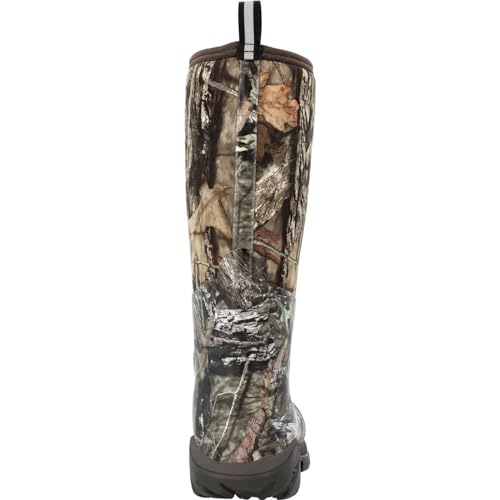
The Muck Boot Arctic Pro is the stand hunter’s boot. The 8mm neoprene construction combined with a fleece lining delivers warmth equivalent to 900g+ Thinsulate — rated to -60°F by Muck, though realistically comfortable to around -20°F for stationary hunters. The 100% rubber outer means zero scent transmission, which matters as much as warmth for whitetail hunting.
The pull-on design with stretch-fit topline eliminates laces entirely — no cold fingers fumbling in the dark at 4am. The outsole has a solid grip on frozen ground and mud, and the boot is fully waterproof without any membrane to fail. It’s heavy at around 5lbs per pair, which is why it belongs in a stand, not on a 5-mile approach.

Who it’s NOT for: Active hunters covering serious ground. The weight and neoprene construction make long hikes punishing. If you’re walking more than a mile to your stand, the Irish Setter Elk Tracker below is a better choice.

- ✅ 100% rubber/neoprene — zero scent transmission
- ✅ Rated to -60°F — most warmth per dollar on this list
- ✅ Fully waterproof — no membrane, no failure points
- ✅ Pull-on design — no laces to freeze
- ✅ Excellent grip on frozen and muddy terrain
- ❌ Heavy — not for long hikes
- ❌ Less breathable than leather options
2. Irish Setter Elk Tracker — Best for Active Hunters

The Elk Tracker is built for hunters who cover miles — and the 400g Thinsulate insulation is the reason. At 400g you get enough warmth for temperatures down to around 30°F during active movement, without the sweat buildup that kills comfort when you stop and your temperature drops. The waterproof leather upper breathes better than rubber, which matters on a long approach through mixed terrain.
Irish Setter’s UltraDry waterproofing system keeps feet dry in stream crossings and wet grass without the vapor-trapping effect of thicker membranes. The rubber lug outsole handles steep and loose terrain reliably. This is the boot for the hunter who walks hard to a spot and then sits — the 400g works for both phases of that hunt.

Who it’s NOT for: Stationary-only stand hunters in temperatures below 20°F. At those temperatures, sitting still for 4+ hours in 400g boots will leave you cold. Step up to the Rocky Blizzard Stalker or Guide Gear for that scenario.

- ✅ 400g Thinsulate — right for active hunting in cold temps
- ✅ Waterproof leather upper breathes better than rubber
- ✅ UltraDry waterproofing — reliable across wet terrain
- ✅ Aggressive lug outsole for steep and loose ground
- ✅ Lighter than rubber alternatives
- ❌ Not warm enough for stationary hunting below 20°F
- ❌ Requires scent treatment — leather holds odor
3. LaCrosse Alphaburly Pro — Best Rubber Boot for Waterfowl and Extreme Cold

The Alphaburly Pro is the waterfowl hunter’s standard. The 7mm neoprene lining delivers insulation equivalent to 1600g in a flexible, pull-on rubber boot that goes from flooded timber to frozen marsh without complaint. It’s rated to -20°F for stationary use, which covers the coldest conditions most North American hunters encounter.
The AeroForm TPR upper is lighter than traditional rubber while maintaining full waterproofing — LaCrosse shaved meaningful weight here without cutting warmth. The outsole is specifically designed for muddy, wet, and soft terrain: deep lugs that self-clean rather than packing with mud. The 18″ shaft height keeps water out in flooded fields and swamps where shorter boots fail.

Who it’s NOT for: Hunters covering significant terrain on foot. The neoprene construction and rubber upper make this a stand, blind, or marsh boot — not a hiking boot. For mixed active/stationary hunts, the Irish Setter or Guide Gear leather options serve better.

- ✅ 7mm neoprene — 1600g equivalent warmth
- ✅ 18″ shaft — keeps water out in flooded terrain
- ✅ Rated to -20°F for stationary use
- ✅ Self-cleaning lug outsole for mud and soft ground
- ✅ 100% rubber — zero scent transmission
- ❌ Too heavy and stiff for long-distance hiking
- ❌ Poor breathability in warmer early-season conditions
4. Rocky Blizzard Stalker Pro — Best Budget Insulated Hunting Boot
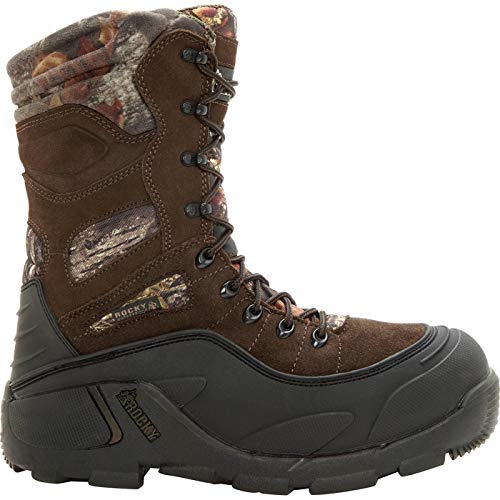
At around $120, the Rocky Blizzard Stalker Pro delivers 800g Thinsulate insulation in a waterproof synthetic upper — real warmth for stand hunting down to around 10°F without breaking the budget. Rocky’s Rocky-Dry waterproofing keeps feet dry in rain and light water crossings, and the rubber outsole handles frozen and muddy terrain without slipping.
The honest trade-off at this price: the synthetic upper is less durable and less breathable than the leather alternatives above. Expect 2–3 seasons of regular use rather than the 5+ years a quality leather boot delivers. For an occasional hunter or someone buying their first insulated boot before committing to a premium pair, that trade-off makes sense.

Who it’s NOT for: Hunters who hunt hard 3–4 days a week through a full season. At that use level the synthetic construction will break down within two seasons — spend more on the Guide Gear or Irish Setter instead.

- ✅ Best price-to-warmth ratio on this list
- ✅ 800g Thinsulate — genuine stand-hunting warmth
- ✅ Rocky-Dry waterproofing — solid for light conditions
- ✅ Good entry point before investing in premium leather
- ❌ Synthetic upper less durable than leather
- ❌ Less breathable on active hunts
- ❌ 2–3 season lifespan for heavy users
5. Guide Gear Leather Hunting Boots — Best Premium Leather

Full-grain leather with 800g Thinsulate insulation — this is the combination that serious whitetail hunters have relied on for decades, and the Guide Gear delivers it at a price well below comparable Irish Setter or Danner options. The leather upper develops a custom fit over time, breathes better than rubber and synthetic alternatives during active movement, and holds up to years of hard use when properly maintained.
The 800g insulation sits in the sweet spot for late-season stand hunting from 10–20°F. Leather requires scent control treatment — cedar spray or scent-eliminating wash — but many experienced hunters consider leather’s natural properties adequate for whitetail at normal stand distances.

Who it’s NOT for: Waterfowl hunters or anyone hunting in consistently flooded or wet conditions. Leather requires more maintenance than rubber and synthetic options, and repeated soaking accelerates wear even with proper waterproofing treatment.

- ✅ Full-grain leather — most durable upper on this list
- ✅ 800g Thinsulate — right for late-season stand hunting
- ✅ Better breathability than rubber during active movement
- ✅ Develops custom fit over time
- ✅ Premium durability at mid-range price
- ❌ Requires regular conditioning and scent treatment
- ❌ Not ideal for wet or flooded conditions
6. Irish Setter VaprTrek 8″ — Best Mid-Range All-Around

The VaprTrek sits between the active-hunting Elk Tracker and the stand-specific boots on this list — 400g Thinsulate in a lightweight waterproof leather upper that handles mixed hunting scenarios without committing fully to either extreme. It weighs significantly less than rubber alternatives, making it the right choice for hunters who split their time between walking to a spot and sitting.
Irish Setter’s RPM technology reduces overall boot weight without compromising structure — a meaningful advantage on long approaches that most heavier insulated boots can’t match. The UltraDry membrane handles wet conditions reliably. For the hunter who doesn’t want to own two pairs of boots for different conditions, the VaprTrek is the honest answer.

Who it’s NOT for: Extreme cold stand hunters below 15°F. The 400g rating is right for active movement but won’t keep stationary feet warm in the coldest late-season conditions — step up to 800g for that use case.

- ✅ Lightweight for an insulated hunting boot
- ✅ 400g — right for mixed active/stationary hunting
- ✅ UltraDry waterproofing — reliable in wet conditions
- ✅ RPM technology reduces weight without losing structure
- ✅ Solid all-around choice for one-boot hunters
- ❌ Not warm enough for stationary hunting below 15°F
7. LaCrosse Cold Snap II Women’s — Best Women’s Insulated Hunting Boot
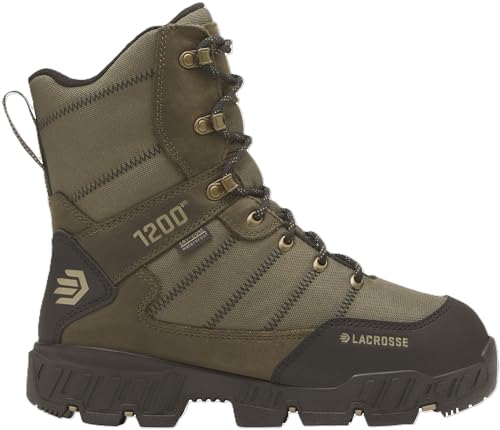
Most hunting boot brands build women’s versions by scaling down a men’s last — the result is a boot that fits poorly on a woman’s narrower heel and wider forefoot. LaCrosse designed the Cold Snap II on a women’s-specific last, which makes a tangible difference in fit, comfort, and warmth retention over a full day in the field. A boot that slips at the heel loses heat fast.
The 800g Thinsulate insulation is right for late-season whitetail and cold-weather turkey hunting at stationary or light-activity levels. The waterproof leather upper handles rain, wet grass, and light stream crossings without issue. At around $165 it’s positioned as a genuine mid-range option rather than a budget compromise.

Who it’s NOT for: Women hunters covering long distances in mountainous terrain — the 800g insulation is heavier than needed for high-activity western hunts. For that use case, look for a women’s-specific 200–400g boot instead.

- ✅ Women’s-specific last — genuine fit, not a scaled-down men’s boot
- ✅ 800g Thinsulate — right for late-season stand hunting
- ✅ Waterproof leather upper
- ✅ Mid-range price for genuine quality
- ❌ Not suited for high-activity western hunts
How to Choose Insulated Hunting Boots — 5 Questions to Ask Before You Buy

how to choose insulated hunting boots
1. How cold does it actually get where you hunt?
Not the forecast low — the real feel in your stand at 5am with wind. A 20°F forecast with 15mph wind is effectively 5°F on exposed skin. Factor in windchill when choosing your gram rating, not the thermometer number.
2. Are you walking in or sitting all day?
This matters more than temperature. An active hunter covering 4 miles of terrain in 20°F weather needs 400g maximum. A stationary stand hunter at the same temperature needs 800g minimum. Getting this backwards is the most expensive mistake in insulated boot buying.
3. Rubber or leather upper?
Rubber gives you 100% scent control and full waterproofing — the right choice for whitetail stand hunters and waterfowl hunters in wet terrain. Leather breathes better for active hunting, weighs less, and lasts longer with proper care — right for mixed-terrain and western hunters. Neoprene sits between the two: flexible, warm, fully waterproof, best for waterfowl and marshland.
4. How tall does the shaft need to be?
8″ covers most hunting scenarios — good ankle support, enough height for light water crossings. 16″+ is needed for flooded timber, marshes, and deep mud where shorter boots fill with water. Only go taller if your terrain demands it — taller boots are heavier and less comfortable on long walks.
5. Do you need scent control built in?
Rubber and neoprene boots are inherently scent-free — no treatment needed. Leather and synthetic boots require scent-eliminating spray or wash before each hunt if you’re hunting whitetail at close range. If scent discipline is critical to your hunting style, rubber is the lower-maintenance choice.
Rubber vs Leather Insulated Hunting Boots
| Feature | Rubber/Neoprene | Leather |
|---|---|---|
| Scent control | ✅ Zero scent | ❌ Requires treatment |
| Waterproofing | ✅ 100% waterproof | ✅ Good with membrane |
| Breathability | ❌ Poor | ✅ Good |
| Weight | ❌ Heavy | ✅ Lighter |
| Durability | ✅ Very good | ✅ Excellent with care |
| Best use | Stand, blind, waterfowl | Active, mixed terrain |
| Break-in period | ✅ None | ❌ 1–3 weeks |
Frequently Asked Questions
How much insulation do I need for deer stand hunting?
800g is the sweet spot for most deer stand hunters in temperatures between 10–20°F. If you hunt in consistently colder conditions (below 10°F) or sit for 5+ hours without moving, consider 1000–1200g. If temperatures stay above 25°F in your area, 600g is often sufficient and more comfortable during the walk to your stand.
Is 400g warm enough for winter hunting?
It depends entirely on your activity level. For active hunters hiking to their spot and keeping their body temperature elevated, 400g works down to around 20°F. For stationary stand hunters sitting still for hours, 400g is generally not warm enough below 30°F. Activity level determines your gram rating more than temperature alone.
What’s the difference between Thinsulate and PrimaLoft insulation?
Both are synthetic insulations that retain warmth when wet — an advantage over down. Thinsulate (3M) is the most common in hunting boots and performs consistently across its gram ratings. PrimaLoft is lighter per gram of warmth and compresses better, making it popular in performance hunting apparel. In boots, the practical difference at the same gram rating is minimal — boot construction and upper material affect warmth more than which synthetic insulation is used.
Do rubber hunting boots keep feet warmer than leather?
For stationary hunting in wet conditions, yes — rubber prevents moisture from entering and neoprene retains warmth even when damp. For active hunting in dry conditions, leather often feels warmer because it breathes better, preventing the sweat accumulation that chills feet when you stop moving. The warmest boot depends on your specific conditions, not the material alone.
Should I size up in insulated hunting boots?
For rubber and neoprene boots, yes — go up a half size to allow room for thick wool hunting socks. For leather insulated boots, follow your normal size with one pair of medium-weight wool socks — most leather hunting boots account for sock thickness in their sizing. Boots that are too tight compress the insulation and reduce warmth significantly.
Final Verdict
For most whitetail stand hunters, the Muck Boot Arctic Pro is the right call — maximum warmth, zero scent, no laces to fumble in the dark. For active hunters covering serious terrain, the Irish Setter Elk Tracker at 400g is the honest answer — lighter, more breathable, and right for mixed-activity hunts. On a budget, the Rocky Blizzard Stalker Pro delivers real 800g warmth without the premium price.
Whatever you choose — match your gram rating to your activity level first, your temperature second. That single decision determines whether you come home with cold feet or a clean shot.
Check Current Prices
- Muck Boot Arctic Pro — Check Price on Amazon
- Irish Setter Elk Tracker — Check Price on Amazon
- LaCrosse Alphaburly Pro — Check Price on Amazon
- Rocky Blizzard Stalker Pro — Check Price on Amazon
- Guide Gear Leather Hunting Boots — Check Price on Amazon
- Irish Setter VaprTrek 8″ — Check Price on Amazon
- LaCrosse Cold Snap II Women’s — Check Price on Amazon
→ Also see: Best Hunting Boots for Men (2026) — our full roundup across all conditions and price tiers.
→ Hunting in snake country? See our guide to the best snake proof hunting boots — including options with insulation for cold-weather snake season.

Written by Ethan Walker
Ethan spent 8+ years fitting hunters, tradespeople, and outdoor workers at a Midwest construction and outdoor supply store. He’s helped hundreds of hunters choose the right insulation level for their specific conditions — and seen firsthand what happens when they get it wrong.