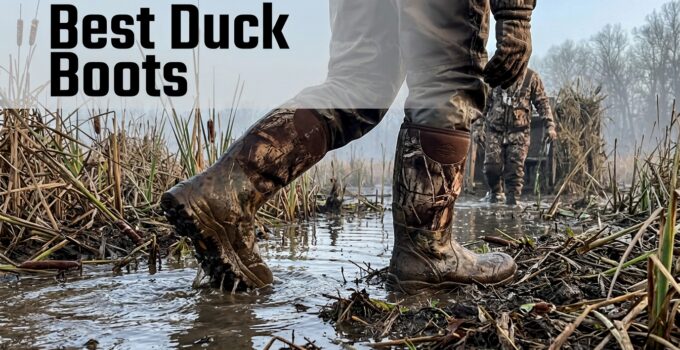
Duck hunting asks the opposite of what turkey hunting does from a boot. A turkey hunter is covering ground at dawn in mild spring weather. A duck hunter is standing still in a blind, a boat, or genuinely cold water for hours at a time, often before sunrise in temperatures well below freezing. That single difference, stationary versus mobile, changes almost everything about what boot actually works.
It also means most of what gets written about “duck hunting boots” online mixes two different pieces of gear without saying so. A 17-inch rubber boot and a pair of chest waders solve different problems, and buying the wrong one for your water depth means a wet, miserable, short hunt. We’re drawing that line clearly below, along with the insulation math that most articles skip and an honest look at the budget brand nearly every duck hunter has considered.
Quick Picks: Best Duck Hunting Boots 2026
| Best For | Model | Insulation |
|---|---|---|
| Best overall / blind hunting | Muck Boot Arctic Sport | Fleece + 5mm neoprene |
| Best budget value | Kamik Greenbay 4 | 8mm removable liner |
| Best duck-specific brand value | TIDEWE 7mm Neoprene | 7mm neoprene |
| Best for extreme late-season cold | LaCrosse Alphaburly Pro 1600G | 1600g Thinsulate |
| Best for snake-prone flooded timber | Muck Pursuit Snake Proof | Neoprene, non-insulated variant available |
| Best sweat management | Irish Setter MudTrek 800g | 800g PrimaLoft |
How Much Insulation Do You Actually Need?
Duck hunters run into a real problem general hunting-boot advice doesn’t solve: some boots are rated in grams of synthetic insulation, others are rated in millimeters of neoprene thickness, and almost nothing explains how to compare the two. LaCrosse, one of the more established names in this space, publishes a rough conversion that’s genuinely useful: about 3.5mm of neoprene performs similarly to 200 to 400 grams of synthetic insulation, 7mm lands around 600 grams, and 9mm is closer to 800 grams.
That matters because duck hunting is almost always a low-activity, stationary pursuit. You’re not burning calories walking miles the way an upland or elk hunter is. Standing still in a blind or in genuinely cold water for three or four hours calls for more insulation than an active hunt at the same air temperature would. As a rough guide: early-season hunts in mild weather call for 400 grams or less, mid-season cold calls for 600 to 800 grams, and standing in freezing water for a full morning is where 1000 to 1600+ grams earns its place.
Boots vs. Waders: Where the Line Actually Is
This is the distinction most duck hunting boot articles blur, and it costs readers a bad hunt. Knee-high boots, even tall 17 to 18 inch models, top out at knee-deep water. Step past that and you’re not wet-footed, you’re wet everywhere below the waist. If your hunt regularly puts you in water deeper than mid-shin to knee, thigh-deep flooded timber, open water decoy spreads, boat launches in soft mud, you need hip waders or chest waders, not boots, no matter how tall the boot’s marketing claims to be.
This article covers boots specifically. If your hunting grounds run deeper than knee height with any regularity, look at a bootfoot chest wader instead (LaCrosse and TIDEWE both make well-regarded options in this space), and treat what follows as the right gear for blinds, field edges, and shallow marsh rather than a wader replacement.
Why Sole Pattern Matters More Here Than You’d Think
Duck hunters spend real time on surfaces that punish a bad outsole: wet wood blind platforms, boat decks, algae-slick mud banks, and ice-crusted field edges. A deep, aggressive lug pattern that would be overkill on dry ground earns its place here specifically because a slip while carrying a loaded shotgun is a different category of problem than a slip on a hiking trail. Look for a cleated or deep-lug rubber compound rather than a shallow tread, especially if your hunt involves a boat or an elevated blind platform.
The Duck-Snake Overlap in Southern Flooded Timber
The same logic that applies to spring turkey hunting applies here in reverse geography. Cottonmouths are active well into the fall in Southern flooded timber, Arkansas green timber, Louisiana marsh, and similar habitat, and duck hunters wading into that terrain in the dark before shooting light are walking through exactly the conditions where an encounter happens. If you hunt this kind of ground, a certified snake-proof boot is worth the consideration the same way it is for a spring turkey hunter working brushy creek bottoms. We cover a dedicated option below, and our full snake proof boots guide goes deeper on the category if this is a regular concern for your hunting ground.
Quick Comparison: All 6 Duck Hunting Boots
| Model | Height | Insulation | Comfort Range | Best For |
|---|---|---|---|---|
| Muck Arctic Sport | Knee-high | Fleece + 5mm neoprene | To -40°F | Stand and blind hunting, all-around cold |
| Kamik Greenbay 4 | Knee-high | 8mm removable felt liner | To -40°F | Budget-conscious cold-weather hunters |
| TIDEWE 7mm | Knee-high | 7mm neoprene (~600g equiv.) | Moderate cold | Occasional hunters on a budget |
| LaCrosse Alphaburly Pro 1600G | 18″ | 1600g Thinsulate | Extreme cold | Late-season standing in near-freezing conditions |
| Muck Pursuit Snake Proof | 17″ | Neoprene | Moderate | Southern flooded timber with snake activity |
| Irish Setter MudTrek 800g | 17″ | 800g PrimaLoft | Mid to cold | Hunters who run hot inside rubber boots |
1. Best Overall: Muck Boot Arctic Sport
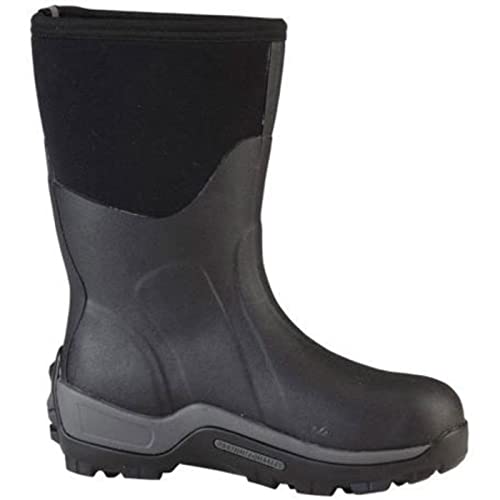
For the majority of duck hunters standing in a blind or a boat through a cold morning, the Arctic Sport is the boot that gets the fundamentals right without asking you to choose a specific insulation weight and hope you guessed correctly. The fleece lining layered over 5mm neoprene handles a wide range of temperatures without the bulk of a dedicated 1600g boot, and the fully rubber, scent-free construction means you’re not thinking about whether ducks can smell you the way a deer hunter would worry about leather.

It runs bulkier than a dedicated field boot, which is the right tradeoff for a boot built around standing still rather than covering ground. The tread is solid on mud and snow, though not the most aggressive option on this list if your hunt involves a lot of wet wood or boat decks specifically.
Specs
Height: Knee-high | Insulation: Fleece + 5mm neoprene
Waterproof: Yes | Scent control: Fully scent-free rubber
Best for: Blind and stand hunting, general cold-weather waterfowl
Skip this boot if: you’re doing a lot of walking between spots rather than sitting still. The bulk that helps in a blind works against you if you’re covering real distance.
2. Best Budget Value: Kamik Greenbay 4
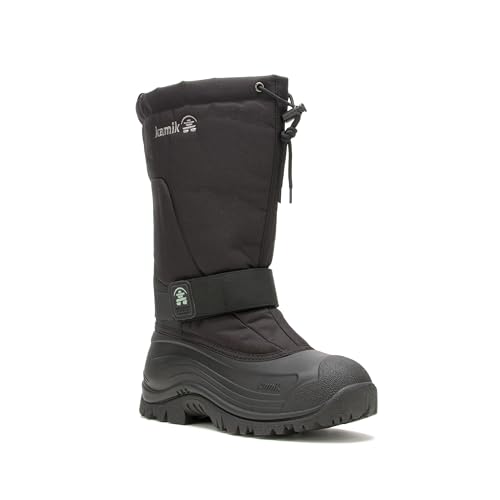
The Greenbay is a no-frills pac boot that delivers real cold-weather performance without the price of the premium brands on this list. The removable 8mm felt liner is the standout feature: pull it out to dry overnight after a wet morning, something a boot with fixed internal insulation can’t offer.

It’s bulkier and less refined than the Muck or LaCrosse options, and the ankle support is modest since this is built around warmth and simplicity rather than mobility. For a hunter who’s mostly standing in one spot rather than moving around, that’s a fair trade for the price.
Specs
Height: Knee-high | Insulation: 8mm removable felt liner
Waterproof: Yes | Rated to: -40°F
Best for: Budget-conscious hunters who want a dryable liner
Skip this boot if: you need real ankle support or plan to walk any real distance in them. This is a stand-still boot first.
3. Best Duck-Specific Brand Value: TIDEWE 7mm Neoprene

TIDEWE has become the boot nearly every duck hunter has at least considered, largely on price. The 7mm neoprene construction lands in roughly the same insulation territory as a 600g synthetic boot per the conversion above, and the air-mesh lining is a genuine feature that reduces the sweaty, humid feeling common to cheaper rubber boots.

Here’s the honest part most reviews skip: hunter forum feedback on TIDEWE’s rubber and neoprene line is mixed. Several owners report the neoprene is noticeably thinner than what LaCrosse or Muck uses at a comparable price point, and there are recurring reports of punctures or leaks developing within a single season of hard use. That doesn’t make it a bad boot. For someone hunting a handful of weekends a season, the value is real and the complaints are the kind you’d expect from a budget product pushed into harder use than it’s built for. For someone hunting 30+ days a year, a more durable premium option is the better long-term investment.
Specs
Height: Knee-high | Insulation: 7mm neoprene
Waterproof: Yes | Lining: Breathable air-mesh
Best for: Occasional hunters, budget-first buyers
Skip this boot if: you hunt frequently or hard enough that a single-season lifespan would be a real inconvenience. Step up to a premium brand instead.
4. Best for Extreme Late-Season Cold: LaCrosse Alphaburly Pro 1600G

This is the boot for the coldest, most stationary duck hunts: standing in a frozen field edge or a flooded timber hole well into December or January where a lesser boot means cutting the hunt short. At 1600 grams of Thinsulate Ultra, it’s built specifically for hunters who are sitting or standing still for hours rather than staying warm through movement, and reviewer feedback backs this up directly, with over 500 ratings averaging 4.6 stars.

The hand-laid rubber over neoprene construction is genuinely durable, and the moisture-wicking liner helps manage the sweat that heavy insulation can otherwise trap. The obvious tradeoff: this much insulation is wasted, and uncomfortable, on anything but genuinely cold, low-activity hunts. Wearing this on a mild-weather early-season hunt means sweating through your socks by mid-morning.
Specs
Height: 18″ | Insulation: 1600g Thinsulate Ultra
Waterproof: Yes | Scent control: Scent-free rubber
Best for: Late-season, deep-cold, low-activity stand hunting
Skip this boot if: you hunt anything other than genuinely cold conditions. This is a specialist boot for the coldest days, not an all-season pick.
5. Best for Snake-Prone Flooded Timber: Muck Pursuit Snake Proof
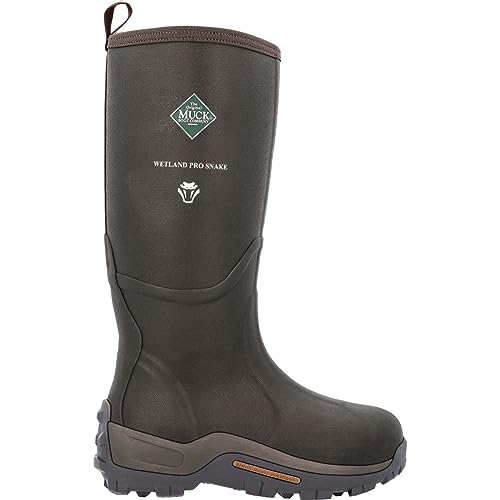
For hunters working Southern flooded timber, Arkansas green timber, Louisiana marsh, or similar habitat where cottonmouths remain active well into duck season, this is a genuinely different consideration than the boots above solve for. It carries the same scent-free, fully waterproof Muck construction as the Arctic Sport, with a flexible snake guard built into the lining rather than the stiff, sauna-like feel of a traditional rigid snake boot.

The tradeoff for the added protection is a slightly warmer, less breathable boot than a non-snake-guard equivalent, and it’s a specialist purchase: if snake activity isn’t a real concern where you hunt, the Arctic Sport or a higher-insulation option serves you better for pure cold-weather performance.
Specs
Height: 17″ | Construction: Neoprene, flexible snake guard lining
Waterproof: Yes | Scent control: Fully scent-free
Best for: Southern flooded timber with year-round snake activity
Skip this boot if: snake activity isn’t a genuine concern on your hunting ground. You’re paying for protection you don’t need.
6. Best Sweat Management: Irish Setter MudTrek 800g
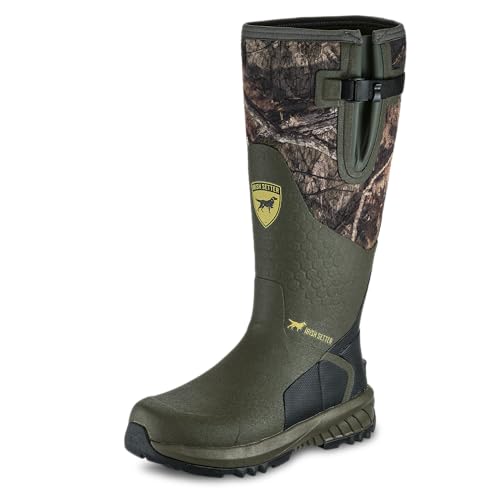
The MudTrek’s real differentiator is TempSens technology built into the neoprene lining, which reacts to body heat and sweat level rather than just insulating passively. For hunters who run hot inside standard rubber boots and end up with damp, clammy feet even in cold weather, this is a genuine solution rather than a marketing claim, working alongside 800 grams of PrimaLoft insulation placed specifically in the toe box and footbed where heat loss matters most.

One sizing note worth flagging clearly: this is a unisex boot sized in men’s sizing, so women should size down two full sizes rather than assuming a women’s-specific fit. It’s not marketed or built as a women’s boot, just sized to accommodate both.
Specs
Height: 17″ | Insulation: 800g PrimaLoft
Waterproof: Yes | Sizing: Unisex, women size down 2 full sizes
Best for: Hunters prone to sweaty feet even in cold conditions
Skip this boot if: you need the deepest cold-weather protection on this list. 800g is solidly mid-range, not built for the coldest late-season sits the way the 1600G LaCrosse is.
Frequently Asked Questions
How many grams of insulation do I need for duck hunting?
More than you’d guess for the same air temperature in an active hunt, because duck hunting is almost always low-activity and stationary. Early season and mild weather calls for 400 grams or less. Mid-season cold calls for 600 to 800 grams. Standing in freezing water or air for a full morning is where 1000 to 1600+ grams becomes worth the bulk.
When do I need waders instead of boots?
Once water depth regularly exceeds knee height, even a tall 17 to 18 inch boot isn’t enough. Thigh-deep flooded timber, open water decoy spreads, or muddy boat launches call for hip waders or chest waders rather than boots.
Do duck hunting boots need to be scent-free?
It matters less than it does for deer, since waterfowl rely primarily on eyesight rather than smell. Scent-free rubber construction is still a reasonable default when you’re already choosing between comparable boots, but it’s not the deciding factor.
Are TIDEWE boots actually good for duck hunting?
For occasional hunters on a budget, yes, with a caveat. The insulation and waterproofing perform reasonably well, but the neoprene runs thinner than premium brands and some owners report punctures or leaks developing within a season of hard use. Hunters in the field 30 or more days a season are better served by a more durable premium option.
Do I need snake protection for duck hunting?
Only if you hunt Southern flooded timber or similar habitat where cottonmouths remain active into duck season. It’s a genuine consideration for that specific terrain, not a universal requirement for all duck hunters.
What sole type is best for duck hunting boots?
A deep, aggressive lug or cleated pattern, since duck hunters regularly deal with wet wood blind platforms, boat decks, and slick mud banks where a shallow tread becomes a real safety issue while carrying a loaded shotgun.
Final Verdict: Match Insulation and Terrain, Not Just Brand
Quick Reference
General blind and stand hunting: Muck Boot Arctic Sport, the most balanced all-around pick
Tight budget, occasional hunts: Kamik Greenbay 4 or TIDEWE 7mm
Coldest late-season sits: LaCrosse Alphaburly Pro 1600G
Southern flooded timber, snake activity: Muck Pursuit Snake Proof
Sweaty feet even in cold weather: Irish Setter MudTrek 800g
The mistake that costs duck hunters the most is buying insulation for the air temperature rather than for how still they’ll actually be standing. Match the boot to your real hunting style, respect the depth limit before you need waders instead, and the right pick on this list should be straightforward.