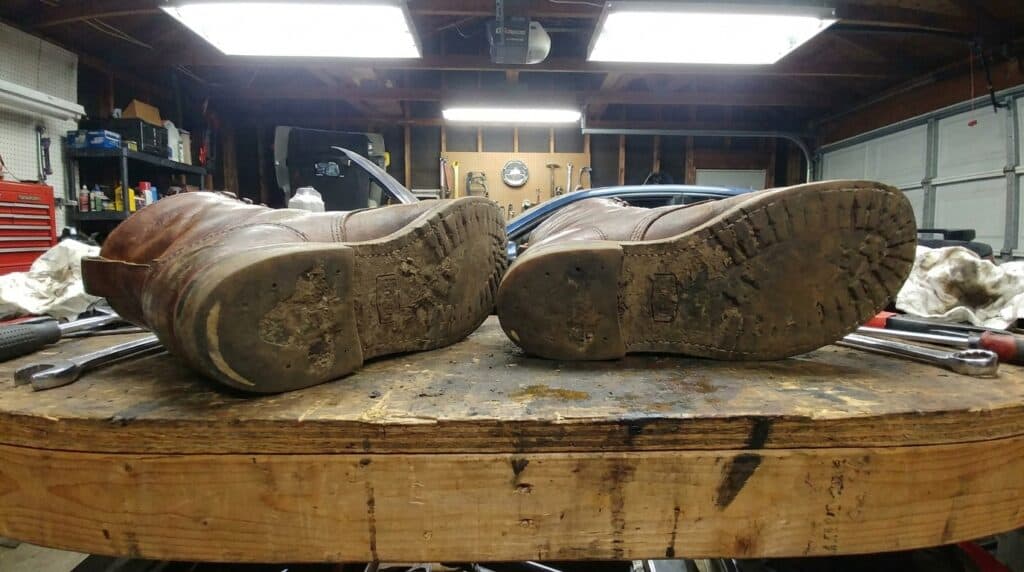

Flip your boots over. The way the soles have worn down is a record of how you stand, walk and work. Heavy wear on the outer edge, the inner edge, the toes or just one boot each points to something different.
Here's the quick answer. A little wear on the outer back corner of the heel is normal for most people. Heavy wear along the whole outer edge often goes with high arches and supination. Heavy wear on the inner edge often goes with flat feet and overpronation. Worn toes, worn heel backs and one boot wearing faster than the other usually point to how you move at work, not a foot problem.
One thing up front: a wear pattern is a clue, not a diagnosis. Physical therapist Matt Klein, DPT, of Doctors of Running points out that wear patterns show where force goes, not why, and that they mean little without watching how a person actually moves (Doctors of Running, retrieved 2026-10-23). We'll keep that in mind through this guide.
Shoe Wear Pattern Chart
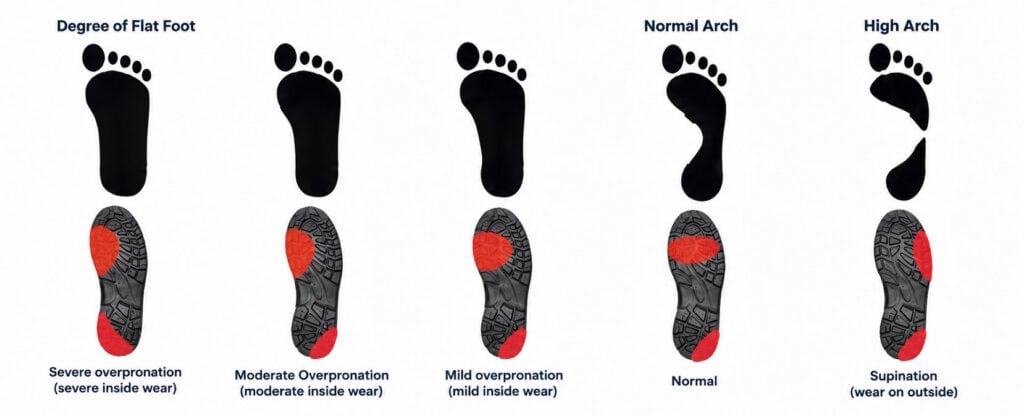
Use this chart to match what you see on your soles. Each pattern is explained in detail below.
| Where the wear is | What it often means | What to do |
|---|---|---|
| Outer back corner of the heel, small area | Normal heel strike | Nothing. Replace or resole when worn down. |
| Whole outer edge, heel to little toe | Supination (underpronation), often high arches | Cushioned insole with arch fill, check ankle stability |
| Inner edge of heel and under the big toe | Overpronation, often flat or low arches | Supportive insole with firm arch, stability boot |
| Center of the ball of the foot | Normal push-off, or lots of standing and pivoting | Usually nothing. Check for forefoot pain. |
| Toe tip and toe cap scuffed | Kneeling, crawling, toe drag or boots too short | Check fit, add toe protection, consider kneeling-friendly boots |
| Back edge of the heel | Shuffling, dragging feet, or pivoting on pedals while driving | Check fit and walking habit, repair heel early |
| One boot wears much faster | Job habits (lead foot on a shovel, ladder or pedal), sloped surfaces, or a leg length difference | Look at your work habits first, then see a professional if you have pain |
| Arch area of the sole | Ladder rungs, shovels, pedals or pegs | Normal for many trades. Choose boots with a defined heel and shank. |
| Even wear across the whole sole | Neutral gait, just mileage | Replace or resole when the tread is flat |
How to Read the Wear on Your Boots (5-Step Check)
You'll get the most from your boots if you check them the same way every time. It takes about five minutes.
- Use boots with at least a few months of regular wear. New boots don't have enough wear to read. Your most-worn pair tells the clearest story.
- Clean the soles. Brush off mud and rinse the tread so you can see where the lugs are worn flat.
- Look at both soles side by side. Put them heel to heel on a table, sole up. Compare the heels, the outer edges, the inner edges, the balls of the feet and the toes.
- Do the tilt test. Set both boots on a flat table and look at them from behind at eye level. Do the heels sit straight, or do they lean in or out? A heel counter that leans shows the same thing as uneven sole wear.
- Pull out the insoles. Look for dark spots, deep dents and toe prints. The insole often shows pressure points more clearly than the outsole.
Take a photo of the soles every few months. Wear builds slowly, and photos make it easy to see a change.
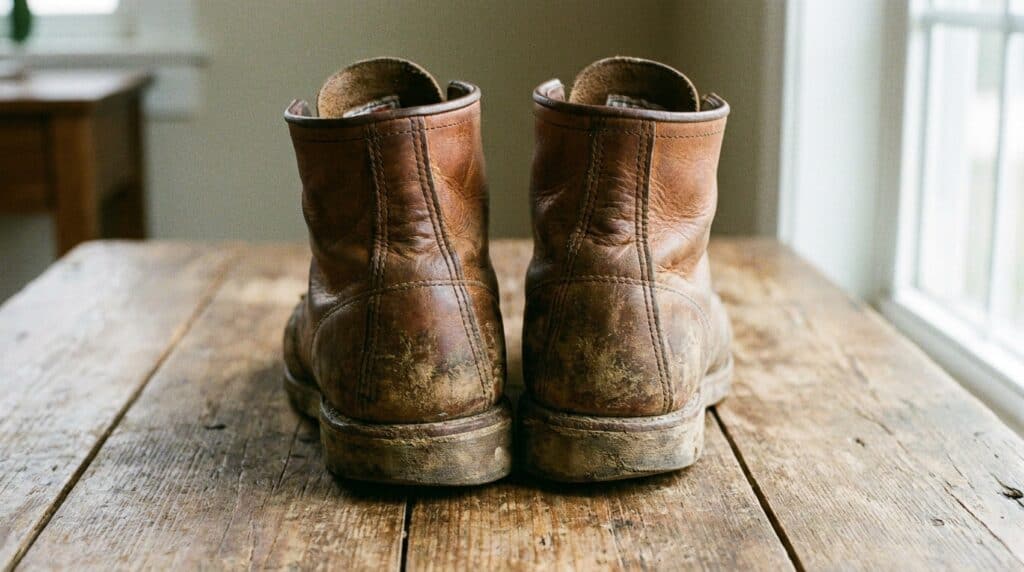
What Normal Shoe Wear Looks Like
Before you worry about any pattern, know what normal looks like.
Most people land on the outside of the heel, roll their foot slightly inward and push off from the ball of the foot and the big toe. That's normal foot motion. So a normal sole usually shows:
- A small worn patch on the outer back corner of the heel
- Fairly even wear across the ball of the foot, a little more under the big toe and second toe
- Both boots wearing at about the same rate
Klein notes that wear on the back outer corner of the heel is considered normal for people who land on their heel (Doctors of Running, retrieved 2026-10-23). If that's what your boots look like, your feet are probably doing what they should.
Shoe Wear Patterns Explained
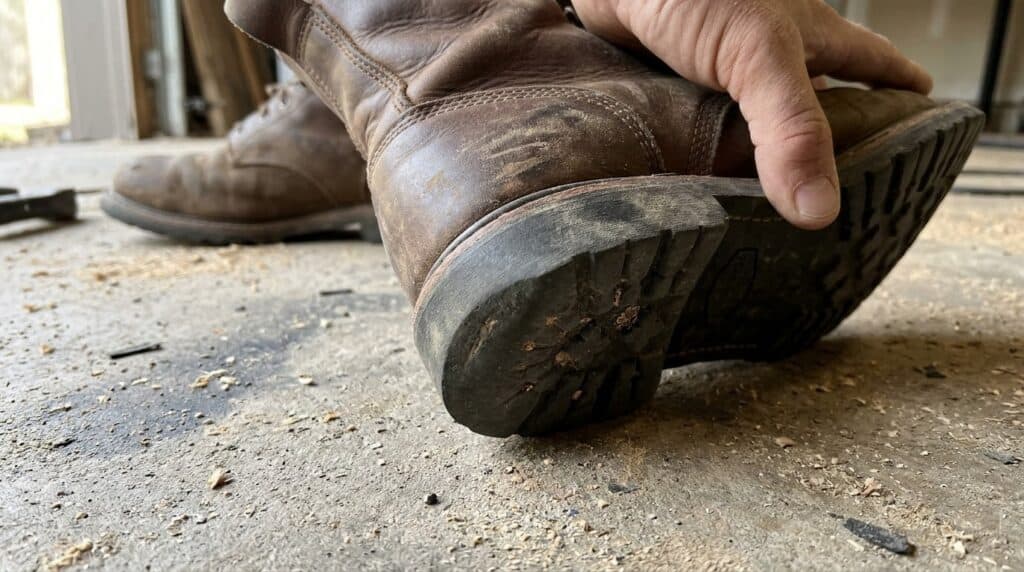
1. Outer Back Corner of the Heel
What you see: A worn, angled patch on the outside of the heel, roughly where the heel meets the ground first.
What it usually means: Normal heel strike. Your heel lands slightly turned out, and that corner takes the first hit.
When to pay attention: If the corner wears so fast that the heel becomes a ramp, your foot will start landing at a tilt. That can make your ankle roll outward more over time. Fix the heel early or resole before it gets that far.
2. Heavy Wear Along the Whole Outer Edge
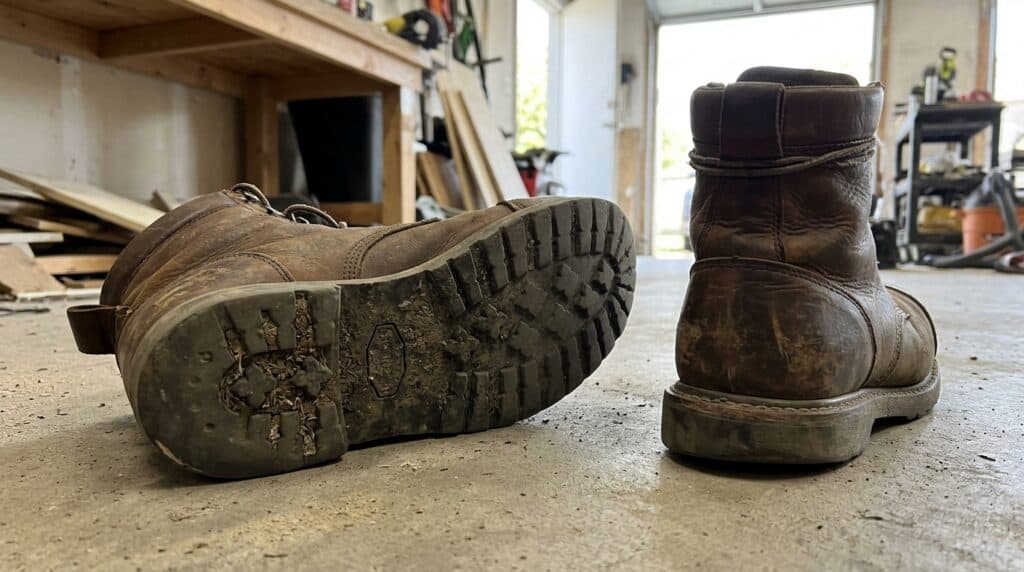
What you see: Wear that starts at the outer heel and runs along the outside of the sole up to the little toe. The inner edge looks almost new. From behind, the boots may lean outward.
What it often means: Supination, also called underpronation. Your foot stays rolled to the outside instead of rolling inward to absorb shock. Banner Health podiatrist Joseph Dobrusin, DPM, says supination is often seen in patients with high arches (Banner Health, retrieved 2026-10-23).
Why it matters in work boots: A supinated foot absorbs less shock, so more impact goes up your legs. On uneven ground, ladders and scaffolding, feet that roll outward are also more likely to roll an ankle.
What can help:
- An insole that fills the arch so weight spreads across more of the foot, like the Superfeet High Arch
- Boots with good cushioning and a stable, wide heel
- Our guide to the best work boots for high arches
3. Heavy Wear on the Inner Edge
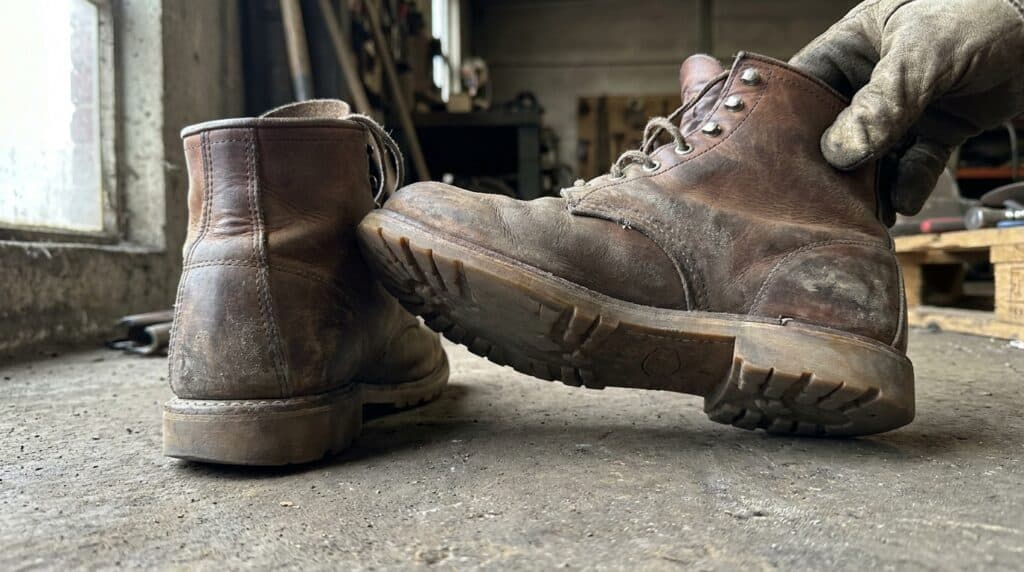
What you see: Wear on the inside of the heel and under the big toe. The inner edge of the sole may be rounded off. From behind, the heel counters lean inward, and the boots may look like they're collapsing toward each other.
What it often means: Overpronation. Your foot rolls inward too far after landing. This often goes with flat feet or low arches. Banner Health describes heavier wear on the inner side as a sign of overpronation (Banner Health, retrieved 2026-10-23).
Why it matters in work boots: When the foot rolls in too far, the arch and the inside of the ankle take more strain. Many people with this pattern notice arch ache, heel pain or sore knees after long shifts.
What can help:
- An insole with a firm arch and heel post, like the PowerStep Pinnacle Maxx
- Boots with a firm heel counter and a stiffer midsole
- Our guides to the best boots for overpronation and the best work boots for flat feet
4. Wear in the Center of the Ball of the Foot
What you see: A worn patch under the ball of the foot, with the tread flattened there first.
What it usually means: Normal push-off, especially if you walk a lot. It also shows up in people who stand and pivot all day, like warehouse pickers and assembly line workers.
When to pay attention: If the wear sits mostly under the second or third toe and you have burning or aching in the ball of your foot, the forefoot may be taking too much load. A cushioned insole or a boot with more forefoot padding can help.
5. Worn Toes and Scuffed Toe Caps
What you see: The tip of the sole is rounded off, the toe cap leather is scuffed through, or the rubber toe bumper is worn.
What it can mean: In work boots, this is usually about the job, not your feet.
- Kneeling and crawling. Mechanics, plumbers, electricians and tile setters drag the toe across the floor every time they kneel.
- Climbing. Ladders and stairs wear the toe where you push off.
- Toe drag. If you don't lift your feet fully when you walk, the toe catches the ground. This gets worse with fatigue at the end of a shift.
- Boots that are too short. If your toes push into the end of the boot, the toe flexes harder and wears faster. Check the toe print on your insole. If it reaches the very end, the boots may be too small.
What can help: Boots with a rubber toe cap or bumper hold up much better. See our best work boots for kneeling and crawling. If fit is the issue, re-check your size with our guide on how to measure your feet at home.
6. Worn Back Edge of the Heel
What you see: The very back of the heel is rounded off or worn at an angle, more than the outer corner.
What it can mean:
- Driving. Truck drivers and equipment operators often wear the back of the right boot heel from pivoting on the gas and brake pedals. If only the right heel looks like this, that's the likely reason.
- Shuffling or dragging your feet. This happens more when you're tired or wearing heavy boots.
- Loose boots. If your heel slips, you may drag the boot instead of lifting it.
What can help: A heel repair or a boot with a harder rubber heel. Drivers can look at our best work boots for truck drivers.
7. One Boot Wears Faster Than the Other
What you see: One boot is clearly more worn, or the two boots wear in different places.
What it can mean: Look at your work habits first. Many jobs load one foot more than the other:
- Your shovel foot drives the blade into the ground over and over
- You lead with the same foot on ladders and stairs
- You work on a slope, a pitched roof or a cambered road with the same side downhill
- You drive a lot, which wears the right boot more
If none of these fits, uneven wear can come from a weaker side, an old injury or a leg length difference. Klein lists weakness, abnormal mechanics and leg length differences as possible causes of uneven wear, along with things like always running the same way on a track (Doctors of Running, retrieved 2026-10-23). If you also have back, hip or knee pain on one side, it's worth getting checked.
8. Wear in the Arch Area of the Sole
What you see: The middle of the sole, between the heel and the ball of the foot, is scraped or worn. You might see grooves or a polished spot.
What it usually means: In work boots this is almost always the job. Ladder rungs, shovel blades, pedals and machinery pegs all sit under the arch.
What can help: Boots with a defined heel and a steel or composite shank hold up better and give a safer grip on rungs. See our guide to ladder-safe work boots for electricians.
9. Even Wear Across the Whole Sole
What you see: The tread is worn down fairly evenly from heel to toe on both boots.
What it usually means: A fairly neutral gait and a lot of miles. This is the pattern you want. The only question is when to resole or replace.
Wear Signs Above the Sole
The outsole isn't the only place to look. Several other parts of a boot show the same patterns.
Heel Counter Leaning In or Out
The heel counter is the stiff cup around your heel. If it leans inward when the boot sits on a table, it lines up with overpronation. If it leans outward, it lines up with supination. A collapsed heel counter also means the boot has lost its support, even if the tread looks fine.
Midsole Wrinkles and Compression
On boots with a foam (EVA or PU) midsole, look at the side of the sole. Deep wrinkles or a squashed look on one side show where your weight goes. Compressed foam on the inner side lines up with overpronation. Compression on the outer side lines up with supination. Once the midsole is badly compressed, the boot won't cushion well anymore.
Creases in the Upper
Every boot creases across the toe box where it flexes. That's normal. A deep crease on only one side, or creases that press into the top of your toes, can mean the boot is the wrong size or shape for your foot.
The Insole
Pull out the insole and look at the dark marks and dents:
- Deep heel dent: Heavy heel strike. A cushioned heel pad can help.
- Dark spot under the big toe: Normal push-off, or overpronation if it's heavy and the inner edge is worn too.
- Dark marks along the outer edge: Lines up with supination.
- Toe prints at the very tip: Your boots may be too short.
If the insole is flat and shaped like your foot, it's done its job. Our guide on whether you need insoles in work boots explains what a replacement can fix.
Common Wear Patterns by Job
Work boots wear differently from sneakers because of what you do in them. Here's what we often see by trade, so you don't mistake job wear for a foot problem.
| Job | Typical wear | Why |
|---|---|---|
| Mechanics, plumbers, electricians, HVAC | Toe tips and toe caps | Kneeling and crawling |
| Truck drivers, equipment operators | Back of the right heel | Pivoting on pedals |
| Linemen, electricians, roofers | Arch area, plus toes | Ladder rungs, climbing, pushing off |
| Landscapers, farm workers | Arch area of the shovel foot, one boot faster | Driving a shovel with the same foot |
| Warehouse and factory workers | Ball of the foot | Standing, pivoting and walking on concrete |
| Roofers | One side of each boot, depending on the roof pitch | Working on a slope |
If your wear matches your job, it says more about your work than about your feet. If you see job wear plus heavy inner or outer edge wear, both are probably happening.
What Shoe Wear Patterns Can't Tell You
Wear patterns are useful, but they have limits.
- They show where, not why. Outer edge wear could come from high arches, a stiff ankle, an old sprain or just a sloped job site.
- Surfaces change the pattern. Rough concrete, gravel, sloped roofs and cambered roads all wear soles in their own way.
- The boot matters. A soft rubber sole wears faster and shows patterns sooner than a hard one. A boot with a built-in tilt or a worn heel will change how you land.
- The research isn't clear-cut. Klein notes that most wear-pattern advice online is based on experience rather than research, and that no single wear pattern has been tied to a single condition (Doctors of Running, retrieved 2026-10-23).
Use your boots as a starting point. If the wear lines up with pain, that's when it's worth acting on.
How to Fix or Reduce Uneven Shoe Wear
1. Match the Insole to the Pattern
This is the cheapest and quickest fix.
- Inner edge wear (overpronation): a firm, supportive insole with a strong arch and heel cup
- Outer edge wear (supination): an insole that fills a high arch, with some cushioning
- Even wear with sore feet: a cushioned insole for impact
See our full guide to the best insoles for work boots for more picks.
2. Fix Heel Wear Early
A worn heel corner changes the angle your foot lands at, which can make the wear pattern worse. On rubber soles, a shoe repair adhesive like Shoe Goo can build up a worn heel corner before it gets deep. It won't replace a resole, but it can buy time.
3. Resole Before the Midsole Shows
Goodyear-welted and stitchdown boots can be resoled. Get them resoled before the wear reaches the midsole or welt. Cemented boots usually can't be resoled well, so replace them once the tread is gone. Our guide on when to replace your work boots covers the signs.
4. Choose the Right Boot Next Time
- Overpronators: a firm heel counter, a stiffer midsole and a removable insole so you can add support
- Supinators: good cushioning, a wide stable heel and enough room for an arch-filling insole
- Toe wear: a rubber toe bumper or toe cap
- Heavy all-day standing: a cushioned midsole built for concrete
5. Rotate Your Boots
Wearing two pairs on alternate days lets foam midsoles and insoles recover, and wet boots dry out. See should you rotate two pairs of work boots.
Products That Help With Uneven Wear
We picked these by checking each Amazon listing's features, star rating, number of ratings and buyer feedback (Amazon, retrieved 2026-10-23). We haven't tested them ourselves. Each one matches a specific wear pattern. Prices vary by size.
| Product | Wear pattern it helps | Amazon rating | Approx. price |
|---|---|---|---|
| PowerStep Pinnacle Maxx | Inner edge wear, overpronation | 4.5 (19,000+) | $55 |
| Superfeet All-Purpose High Arch | Outer edge wear, high arches | 4.4 (34,000+) | $60 |
| PowerStep Pinnacle Work | Mild inward roll, long shifts | 4.4 (3,100+) | $45 |
| Shoe Goo (Black) | Worn heel corners and toe tips | 4.6 (5,900+) | $9 |
Ratings and prices from Amazon, retrieved 2026-10-23. Verify the current price on Amazon.
PowerStep Pinnacle Maxx - Best for Inner Edge Wear
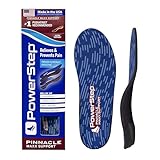
The Pinnacle Maxx has a slightly angled heel post to control overpronation, a firm but flexible arch and dual-layer cushioning. It has 4.5 stars from more than 19,000 ratings and costs about $55.
Buyers say it works especially well for flat feet and plantar fasciitis pain, with strong arch support.
Buy it if: your boots wear on the inner edge and lean inward from behind.
Skip it if: your wear is on the outer edge. The heel post pushes the wrong way for supinators.
Check the PowerStep Pinnacle Maxx price on Amazon
Superfeet All-Purpose High Arch Support (formerly Green) - Best for Outer Edge Wear

This is the insole long sold as Superfeet Green. It has a high, structured arch and a deep heel cup that fill the space under a high arch so weight spreads across more of the foot. It has 4.4 stars from more than 34,000 ratings and costs about $60.
Buyers praise the arch support and say it gives quick relief from plantar fasciitis.
Buy it if: you have high arches and your boots wear on the outer edge.
Skip it if: your boots are snug. It's a high-volume insole and can crowd your foot.
Check the Superfeet High Arch price on Amazon
PowerStep Pinnacle Work - Best for Mild Inward Roll on Long Shifts

PowerStep made this version for work boots. It has a firm but flexible neutral arch, a deep heel cradle, dual-layer foam cushioning and an odor-control top fabric. PowerStep says it helps with mild to moderate pronation. It has 4.4 stars from more than 3,100 ratings and costs about $45.
Buyers say the arch support is strong and it helps with foot pain. Durability gets mixed reviews, and a few buyers find the arch slightly high.
Buy it if: you see light inner edge wear and want support plus cushion for long shifts.
Skip it if: your inner edge wear is heavy. The Pinnacle Maxx has more motion control.
Check the PowerStep Pinnacle Work price on Amazon
Shoe Goo Repair Adhesive (Black) - Best for Rebuilding Worn Heels
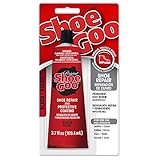
Shoe Goo is a flexible repair adhesive that you can spread on a worn heel corner or toe tip to build it back up. The black version blends in on dark rubber soles. It has 4.6 stars from more than 5,900 ratings and costs about $9. A clear version is also available.
Buy it if: you catch heel or toe wear early and want to slow it down on rubber soles.
Skip it if: the wear has reached the midsole or welt. At that point, resole or replace the boots.
Check the Shoe Goo price on Amazon
When to See a Professional
Uneven wear on its own isn't a reason to worry. See a doctor, podiatrist or physical therapist if the wear comes with:
- Pain in your feet, ankles, knees, hips or lower back that lasts more than a few weeks
- Repeated ankle sprains
- One boot wearing much faster than the other, with pain on that side
- Numbness, tingling or swelling
Bring your most-worn boots to the appointment. A professional can watch you walk and use the wear as one more clue.
Frequently Asked Questions
Is it normal for shoes to wear on the outside of the heel?
Yes, a small worn patch on the outer back corner of the heel is normal for most people. It only becomes a concern when the wear runs along the whole outer edge or the heel becomes a ramp.
What does it mean if the inside of my shoes wears out first?
Heavy wear on the inner edge often goes with overpronation, where the foot rolls inward too far. It's common in people with flat feet or low arches. A supportive insole with a firm arch can help.
Why do I wear out the outside of my shoes?
Heavy wear along the whole outer edge often goes with supination, where the foot stays rolled to the outside. It's common in people with high arches. It can also come from working on slopes or from a worn heel that tilts your landing.
Why does one of my shoes wear out faster?
In work boots, it's usually the job: a shovel foot, a lead foot on ladders, working on a slope or driving. If none of those fit and you have pain on one side, a leg length difference or weakness may be the cause, and it's worth getting checked.
Can shoe wear patterns diagnose overpronation or supination?
Not on their own. They're a useful clue, but surfaces, boots and job habits all affect wear. A gait check by a professional is the only reliable way to know.
Why are the toes of my work boots wearing out?
Usually from kneeling, crawling or climbing. It can also come from dragging your feet or from boots that are too short. Boots with a rubber toe cap last much longer for kneeling work.
Can you fix uneven wear on boots?
You can slow it down. Use the right insole for your pattern, fix worn heel corners early, rotate your boots and resole welted boots before the wear reaches the midsole.
How often should I check my boots?
Every two to three months is enough for most people. Check more often if you work on rough surfaces or put in long hours.
The Bottom Line
Your boot soles are an honest record of how you work. Here's how to use them:
- Small outer heel wear: normal, nothing to fix
- Whole outer edge: likely supination, try an arch-filling insole like the Superfeet High Arch
- Inner edge: likely overpronation, try a firm support insole like the PowerStep Pinnacle Maxx
- Toes, heel backs, arch area or one boot only: usually your job, so choose boots built for it
- Wear plus pain: see a professional and bring the boots
When the tread is gone, check our guide on how to know if your boots are worn out before you buy your next pair.