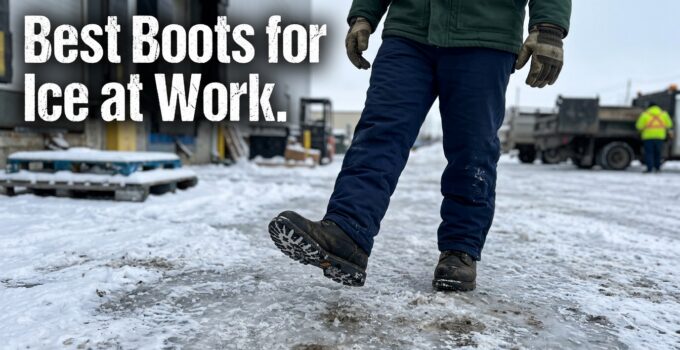
If your job requires walking on ice, loading docks, parking lots, job sites, or outdoor equipment, traction is not optional. But the right solution depends on two questions most articles ignore: does your employer allow or require add-on traction devices, and does strapping cleats or spikes over your certified safety boots void their slip-resistance rating? This guide covers the real workplace decision framework for ice traction at work, including built-in winter outsoles, add-on cleats, fit considerations for safety-toe boots, and employer liability under OSHA’s hazard-assessment framework.
The Question Nobody’s Answering: Does Adding Traction Void Your Boot’s Slip Rating?
Certified slip-resistant outsoles, rated under ASTM F2913, SATRA, or a brand-specific standard, are tested and rated as sold, as a complete system. Strapping an aftermarket traction device over that outsole is a genuinely untested variable in most cases. There’s no universal answer here, but the safest approach is to check with your employer’s safety officer, the boot manufacturer, or the traction device manufacturer directly before assuming your certification carries over.
If your job requires certified slip-resistant footwear, don’t assume that adding ice cleats or microspikes keeps your boots certified. Check before relying on that combination in a workplace that requires certification.
If you need both certified slip resistance and real ice traction in one product, a boot with a genuinely ice-specific built-in outsole is the safer starting point, since it’s tested and rated as a complete system rather than an aftermarket combination.
Built-In Traction: When It’s the Right Call
Built-in traction makes the most sense if you move constantly between indoor and outdoor icy conditions, can’t practically remove and reattach a device throughout the day, or work somewhere metal spikes and cleats aren’t allowed indoors at all.
Muck Arctic Sport Steel Toe Insulated Boot
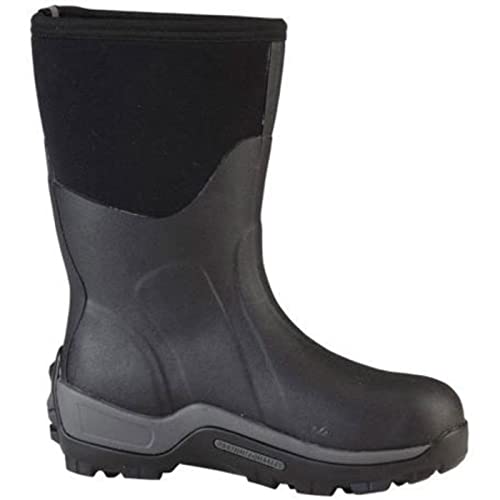
A genuine certified steel toe (ASTM F2413 M/I/C EH) paired with an aggressive Bob-Tracker molded outsole built specifically for traction on loose, icy, and uneven surfaces, insulated with 5mm CR flex-foam and fleece lining, rated for temperatures down to extreme cold. This is a real ice-specific work boot, not a general-purpose boot with ice-adjacent marketing.

Not the right fit if: you need a lighter, more athletic boot for indoor and outdoor mixed use. This is a substantial, insulated rubber boot built specifically for extreme cold and ice.
Pros: Certified steel toe, genuinely ice-specific outsole design, rated for extreme cold, tested and certified as a complete system.
Cons: Bulkier and warmer than needed for milder conditions or mostly indoor work.
Check price and available sizes on Amazon
A Note on General Slip-Resistant Boots: KEEN Utility Gibson Mid Composite Toe

Worth knowing the distinction here rather than assuming: this boot carries a genuine certified composite toe and meets ASTM F2913 and F1677 non-slip testing standards, real, verified slip resistance. What it doesn’t have is ice-specific outsole technology the way the Muck Arctic Sport above does. It’s a strong, comfortable, certified boot for general workplace slip hazards, wet floors, oil, standard winter conditions, but it isn’t marketed or built specifically for hard ice the way a dedicated winter outsole is.

Not the right fit if: you’re dealing with genuine, hard ice regularly. This is a certified slip-resistant boot, not an ice-specific one, the distinction matters more than it sounds.
Pros: Certified composite toe, genuine ASTM slip-resistance testing, lightweight and athletic feel, versatile for general workplace hazards.
Cons: No ice-specific outsole compound or tread pattern; not a substitute for dedicated ice traction on genuinely icy conditions.
Check price and available sizes on Amazon
Baffin TITAN Unisex Steel Safety Toe & Plate Boot
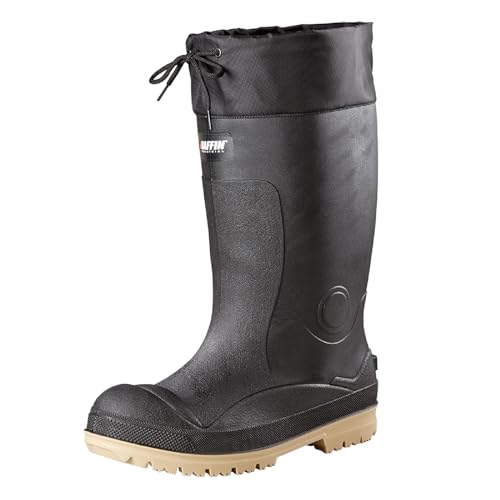
A third genuine option, and a unisex one. The TITAN carries a certified steel safety toe with an added protective plate underfoot, a real step up in protection over a toe cap alone, wrapped in a Polar Rubber outsole specifically formulated to keep grip in cold temperatures rather than stiffening up the way standard rubber does. The removable multi-layer inner boot system lets you adjust warmth without buying a second pair for milder days.
Not the right fit if: you need a lighter, lower-profile boot. This is a tall, substantial industrial boot built for serious cold and genuine underfoot hazards, not a everyday walking-around boot.
Pros: Certified steel toe and plate protection, unisex sizing, cold-rated outsole compound, removable liner system for adjustable warmth.
Cons: Tall, heavy, and substantial, more boot than needed for lighter-duty conditions.
Check price and available sizes on Amazon
RefrigiWear Women’s PolarForce Hiker

The composite-toe option in this section, and a genuinely women’s-specific one rather than a men’s boot sized down. 800 grams of insulation carries a comfort rating down to -30°F, and the Vibram Q765 dual-density outsole with IceTrek technology is a real, dedicated ice-traction compound, not a general slip-resistant sole doing double duty. It meets EN ISO 20345 PPE safety footwear standards and is EH compliant.

Not the right fit if: you need steel toe specifically, or you’re looking for a men’s sizing option, this is a women’s-specific composite-toe boot.
Pros: Genuine composite toe, real ice-specific IceTrek outsole compound, high insulation rating for extreme cold, EH compliant.
Cons: Composite toe only, no steel toe version in this exact model.
Check price and available sizes on Amazon
RefrigiWear Men’s Platinum Leather Safety Toe
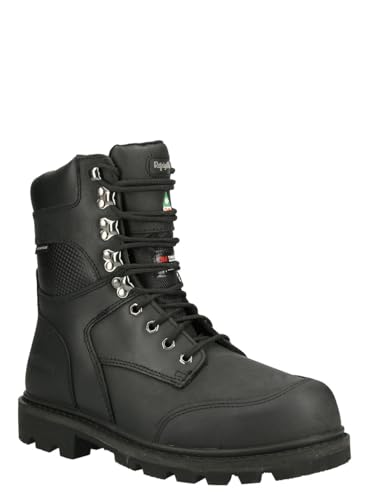
The men’s counterpart to the standard-silhouette approach above, a genuine lace-up leather work boot rather than another tall rubber pull-on. Full-grain buffalo leather, 1000 grams of insulation, a composite safety toe with an added puncture-resistant plate, and a real Vibram IceTrek outsole built specifically for slick, uneven surfaces.

Not the right fit if: you need a fully sealed rubber boot for standing water or deep slush. This is a waterproof leather boot, not a submersible rubber one.
Pros: Genuine composite toe plus puncture-resistant plate, real Vibram IceTrek ice-specific outsole, standard lace-up silhouette, heavy 1000g insulation.
Cons: Leather construction means more maintenance than a rubber boot over time.
Check price and available sizes on Amazon
Wolverine Glacier Ice Insulated Waterproof Composite Toe
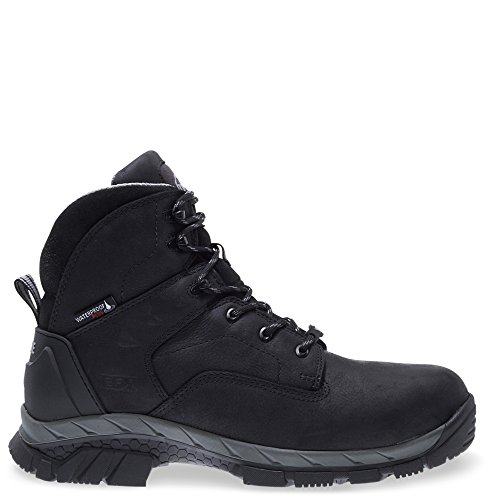
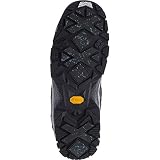
An established American brand’s take on the same category, a genuine composite toe work boot built specifically around Vibram Arctic Grip, the same technology developed to be safe enough for indoor use while still gripping wet ice outdoors. A two-compound lug outsole and Wolverine’s EPX anti-fatigue system round out a boot built for real all-day wear, not just cold-weather marketing.
Not the right fit if: you need maximum insulation for extended stationary outdoor exposure. This is built for active work with real ice risk, not extreme sustained cold.
Pros: Genuine Vibram Arctic Grip outsole, composite toe, established brand with a long track record, dual-compound lug design for real traction variety.
Cons: Not the warmest option here for genuinely extreme, sustained cold.
Check price and available sizes on Amazon
Why built-in traction wins for the right worker: tested and rated as a complete system, no need to remove and reattach devices throughout a shift, no liability or facilities concerns with indoor flooring, no fit concerns with a safety-toe cap.
Caveat: ice-specific outsole compounds can wear faster on dry pavement than a standard all-season outsole, and they’re generally less aggressive than dedicated microspikes or ice cleats built purely for traction.
Add-On Traction: When It’s the Right Call
Add-on traction makes more sense if you only need grip for brief outdoor stretches, a loading dock, a parking lot, walking to a job site, want it removable for indoor spaces, or work somewhere spikes are allowed outdoors but not inside.
This guide won’t re-review specific microspike or Yaktrax products here, that ground is already covered in depth in our microspikes guide and our general boots for ice guide. What’s worth covering here instead is the workplace-specific practical concern those pieces don’t touch: metal spikes and aggressive cleats can damage indoor flooring, create tripping hazards on hard surfaces, and violate facility policies outright. If your job means moving between indoor and outdoor spaces, removable traction only works if you can reliably remove it before entering the building every time.
Practical guidance: use add-on traction only for the outdoor portions of your shift, remove it before entering indoor spaces, and keep it somewhere accessible, a jacket pocket, a bag, or your vehicle, so removing it doesn’t become the step you skip.
Can You Wear a Traction Device Over a Safety-Toe Boot?
This is a genuinely underexplored fit question. Most add-on traction devices are sized and designed around a standard boot sole shape, not accounting for how a steel or composite toe cap changes the front profile of the boot.
Before buying: check the traction device’s sizing chart directly against your specific boot model, measure the length and width of your boot sole including the toe cap area, and look specifically for traction devices marketed for work boots or safety-toe footwear rather than general hiking or casual use. Avoid devices built for a snug fit tight across the toe area specifically, since a safety toe cap’s shape may not accommodate that fit the way a standard boot toe would.
Caveat: not every traction device fits securely over a safety-toe boot. A device that doesn’t fit properly can slip off mid-shift, create its own tripping hazard, or damage the boot over time.
Employer Requirements and Liability
If a job site has documented ice hazards, this is exactly the kind of PPE requirement that falls under OSHA’s general duty clause and hazard-assessment framework, the same framework that governs safety toe requirements generally. For the fuller breakdown of how that hazard-assessment process works, our steel toe requirements guide covers it in depth rather than repeating it here.
Employers are generally required to assess workplace hazards and provide appropriate PPE where a real hazard exists, which can include ice traction devices. Don’t assume your employer will automatically supply traction gear, ask directly whether it’s required for your role and whether the employer provides or reimburses for it. If specific footwear or traction devices are mandated, that’s generally something the employer should be covering, not a cost you should assume falls on you by default.
Frequently Asked Questions
Does adding ice cleats to work boots void the slip-resistance certification?
There’s no universal answer. Certified slip-resistant outsoles are tested and rated as sold, as a complete system. Adding an aftermarket traction device changes that system in a way that typically hasn’t been independently tested. Check with your safety officer, the boot manufacturer, or the traction device manufacturer before relying on that combination where certification matters.
Can I wear microspikes over steel toe boots?
It depends on the specific device and boot. Most add-on traction devices are sized around a standard boot sole and don’t account for a steel or composite toe cap’s shape. Check the device’s sizing chart against your specific boot model, and measure your boot sole including the toe cap area before assuming a standard-fit device will work.
Is my employer required to provide ice traction devices?
If your job site has documented ice hazards, OSHA’s general duty clause and hazard-assessment framework may require your employer to provide appropriate PPE, which can include traction devices. Ask your employer directly whether traction devices are required for your role and whether they’ll supply or reimburse for them.
Built-in ice traction or add-on cleats, which is better for a job that’s mostly indoors?
For a job that’s mostly indoors with brief outdoor exposure, add-on cleats are usually the more practical choice since they can be removed before you’re back inside. If you’re moving constantly between indoor and outdoor spaces throughout a shift, built-in traction is generally more practical since there’s nothing to remove and reattach.
Do built-in winter outsoles wear faster on dry pavement?
Yes, generally. Winter-specific outsole compounds are formulated to stay flexible and grippy in cold, icy conditions, which can mean faster wear on dry pavement compared to a standard all-season outsole. If most of your time is on dry surfaces with only occasional ice, a certified slip-resistant boot plus add-on traction for the icy stretches may hold up better long-term.
Bottom Line
The best ice traction solution for work depends on how much time you actually spend outdoors and whether removability matters for your specific job. For workers moving constantly between indoor and outdoor icy conditions, the Muck Arctic Sport Steel Toe, the unisex Baffin TITAN, and the composite-toe RefrigiWear PolarForce or Platinum Leather are the safest, most practical choices, all tested and certified as complete systems. If you want a lighter, more traditional leather boot silhouette instead of a rubber pac boot, the Wolverine Glacier Ice covers that ground with genuine Arctic Grip traction. For workers who only need traction for brief outdoor stretches, add-on cleats or microspikes are more versatile, provided you actually remove them indoors. Either way, verify certification status before assuming, and check with your employer or safety officer about what’s actually required and who’s responsible for providing it.