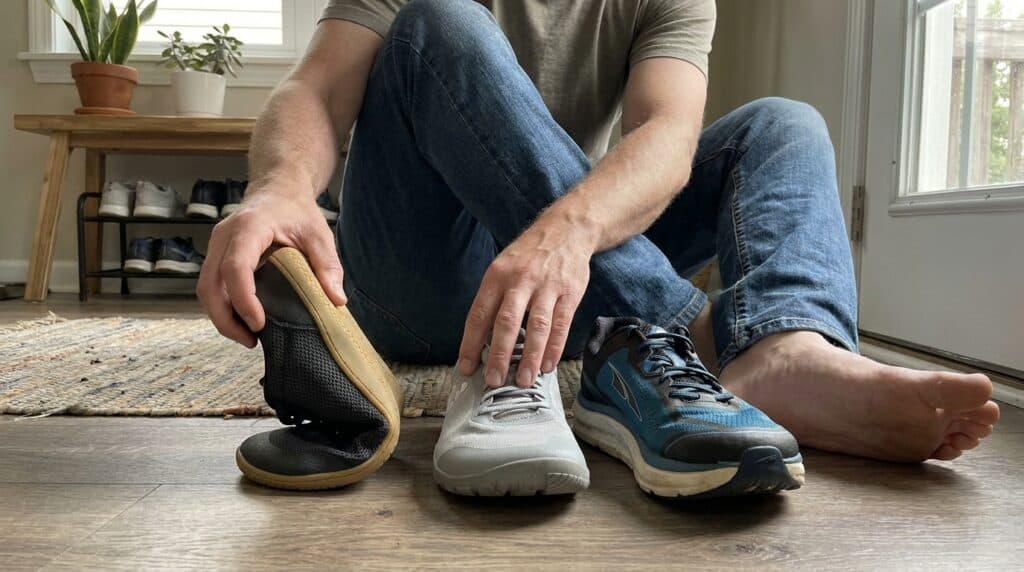

Walk into any shoe store today and you will see three labels on the shelf: barefoot, minimalist and zero-drop. Brands use them loosely, and sometimes they use them for the same shoe. That makes shopping confusing.
Here is the simple version. Barefoot shoes typically combine zero drop, a thin and flexible sole, and a foot-shaped toe box. Minimalist shoes vary in how much structure they remove. Zero drop only means the heel and the forefoot sit at the same height. That is all it means.
So a barefoot shoe is almost always zero-drop, but a zero-drop shoe is not always a barefoot shoe. Some zero-drop shoes have thick, soft soles that block most of the ground feel. There is also no official standard for these terms, so the label on the box is only a starting point. This guide shows you how to read the specs yourself.
The Short Answer: Barefoot vs Minimalist vs Zero-Drop
This table shows how the three types usually compare. Treat it as a rule of thumb, not a set of hard cutoffs. Brands label their shoes differently, and real shoes often sit between columns.
| Feature | Regular shoe | Zero-drop shoe | Minimalist shoe | Barefoot shoe |
|---|---|---|---|---|
| Heel-to-toe drop | Often around 8 to 12 mm | 0 mm | Low to zero | 0 mm |
| Sole thickness | Thick | Thin to very thick | Thin to medium | Very thin |
| Flexibility | Often stiff | Varies | Flexible | Very flexible |
| Toe box | Often tapered | Varies | Varies | Wide and foot-shaped |
| Ground feel | Low | Varies | Medium to high | High |
| Cushioning | Medium to high | Any level | Low to medium | Minimal |
What "drop" looks like
Drop is the height of the heel minus the height of the forefoot. It says nothing about how thick the whole sole is. The picture below shows three example soles. Each one is an illustration only. These are not category cutoffs.
6 mm heel / 6 mm forefoot
Drop: 0 mm
25 mm heel / 25 mm forefoot
Drop: 0 mm
30 mm heel / 22 mm forefoot
Drop: 8 mm
heel (left), toe (right)
The first two soles both have zero drop, yet one is very thin and the other is very thick. Only the first would feel close to barefoot. The third sole has 8 mm of drop, even though its heel and forefoot are both fairly thick. Drop and thickness are two different measurements.
What Are Barefoot Shoes?
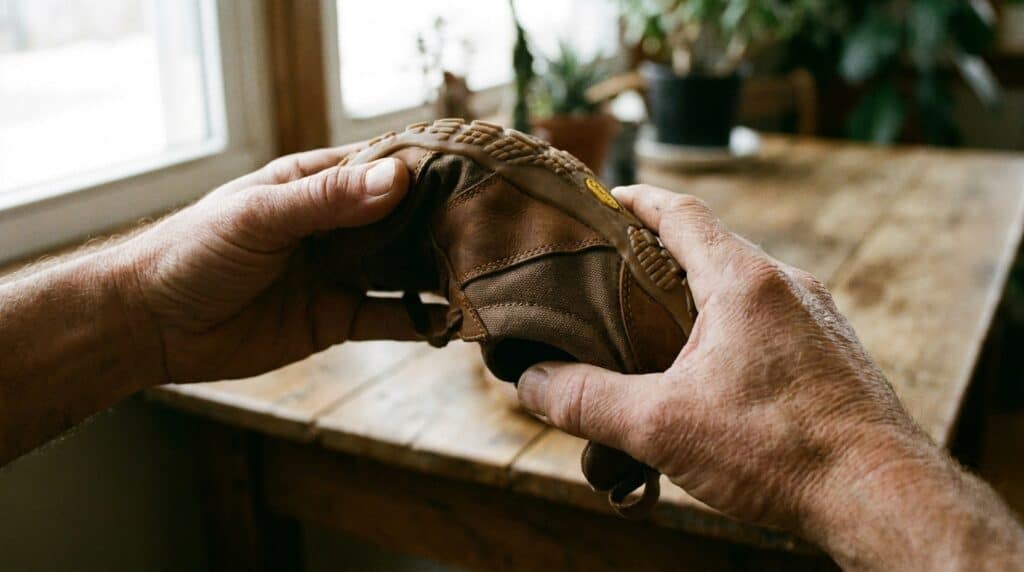
Barefoot shoes are built to get in the way of your foot as little as possible. They are not the same as walking with nothing on your feet. They still protect the sole from glass, rocks and hot pavement.
Most barefoot shoes share these features:
- Zero drop. The heel and forefoot sit at the same height.
- A thin sole. You can feel the shape of the ground through it. This is often called ground feel.
- A flexible sole. It bends and twists easily in your hands.
- A foot-shaped toe box. The front is wide enough for your toes to spread out. Many regular shoes taper toward the toe.
- Little or no arch support. Your foot does the work, not a built-in ramp.
- Light weight.
You will find them as sneakers, sandals, toe-sock shoes, work boots and hiking shoes. Some brands list the sole thickness. Others list only the total stack height, which includes the insole and the lugs. Check which number you are looking at.
What Are Minimalist Shoes?
Minimalist shoes remove some of the structure and cushion of a regular shoe, but not always all of it. The idea is to interfere less with the natural movement of your foot. That is why this label covers such a wide range, from nearly barefoot to lightly cushioned.
Researchers have tried to pin this down. A 2015 expert consensus study in the Journal of Foot and Ankle Research, with 42 experts from 11 countries, defined minimalist footwear by features such as high flexibility, low heel-to-toe drop and low weight. The same project built a rating scale that looks at several features, including flexibility, stack height, drop and stability features such as motion control. In other words, there is no single magic number. A shoe can be more or less minimalist depending on how it scores across those features.
One more warning: in fashion, "minimalist" can simply mean a clean, simple look. A minimalist-looking leather loafer may not be minimalist at all underneath. Always check the sole.
What Does Zero-Drop Mean?
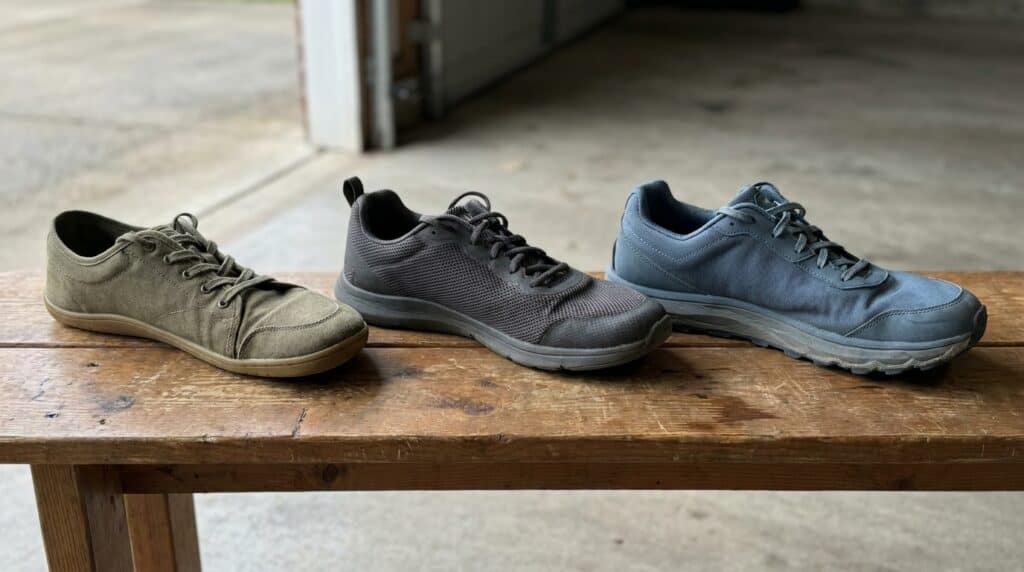
Zero-drop means the heel and the forefoot sit at the same height above the ground. Many cushioned road shoes have a raised heel, often around 8 to 12 mm higher than the forefoot. A zero-drop shoe takes that slope away, so your foot sits level.
The important part is what zero drop does not tell you:
- It does not tell you how thick the sole is.
- It does not tell you how soft or stiff the shoe is.
- It does not tell you whether the toe box is wide.
That is why a cushioned trail shoe can be zero-drop and still be nothing like a barefoot shoe. Zero drop is one feature. It is not a shoe category.
How to Tell If a Shoe Has the Barefoot Features You Want
Ignore the marketing words and check these five things instead:
- Is the number outsole thickness or total stack height? Some brands quote only the rubber outsole. Others quote everything under your foot. These can differ by several millimeters, so compare like with like.
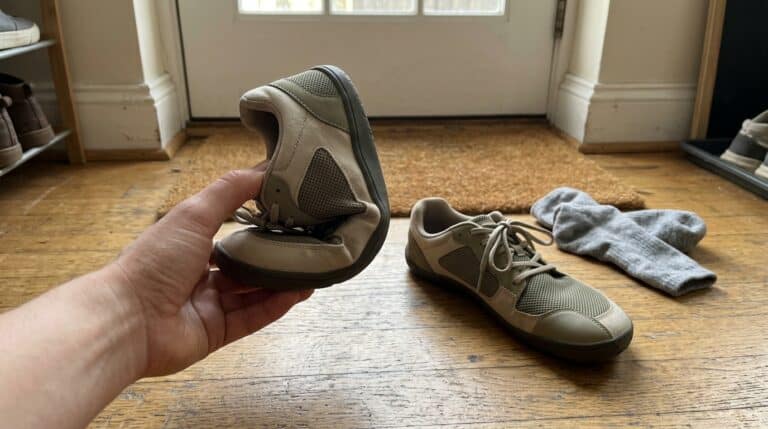
- Can you bend and twist it easily? Hold the shoe by the heel and toe. A flexible shoe folds in half without a fight and twists like a wet towel. A stiff one resists.
- Can your toes spread while your heel stays secure? Stand up and wiggle your toes in the shoe. Your toes should have room, and your heel should not slip. A foot-shaped toe box is only one part of a good fit.
- Is there a thick foam midsole? If there is, you will get less ground feel, even if the drop is zero.
- How structured is the upper? Stiff overlays and rigid heel counters take away from the natural feel.
Barefoot Shoes vs Regular Shoes
Neither type is better for everyone. They trade different things.
- Ground feel. Barefoot shoes give you more. Regular shoes give you less, which many people prefer on hard surfaces.
- Toe room. Barefoot shoes usually have a wider front. Regular shoes often taper.
- Cushioning. Regular shoes absorb more impact. Barefoot shoes ask your feet and legs to do more of that work.
- Protection. A thin sole gives less protection against sharp rocks, rough ground and falling objects.
- Adjustment time. A regular shoe feels familiar right away. A barefoot shoe can feel odd at first, and your calves and feet may need time to adapt.
Choose by What You Want From the Shoe
You do not have to aim for the thinnest shoe possible. Start with what you actually want, then pick the type that matches.
- You want more toe room. Start with fit. Look for a wide, foot-shaped toe box. This one feature helps many people even if the rest of the shoe is fairly normal.
- You want more ground feel. Look for a thinner, flexible sole. Check the stack height and do the bend test.
- You want a level platform but still want cushioning. Look for a cushioned zero-drop shoe. You get the level heel without giving up a soft ride.
- You need protection first. Pick the protection your job or trail requires, then compare toe room, drop and flexibility among the boots that qualify.
Minimalist footwear is not a ladder everyone must climb to reach "true barefoot." Many people are happy in the middle for good.
Barefoot, Minimalist and Zero-Drop Boots: Work and Hiking
Boots are where this gets tricky. More protection usually means less ground feel, so you have to decide which one matters more for your day.
Work boots
Start with what the job requires. If you need a certified safety toe, that comes first. Then compare toe room, drop and flexibility among the boots that meet your safety rating. If you do not need a safety toe, you have many more barefoot options. Our guides to the best barefoot work boots and the best minimalist boots go through the details.
Hiking
On trails, grip and underfoot protection matter as much as drop. Rocky ground and loose gravel are harder in a thin sole. Mud and wet roots need a good outsole. Thin shoes can be great on smooth dirt paths and less pleasant on sharp rock. Our guide to barefoot hiking shoes covers this in depth, and our article on minimalist trail boots explains the safety trade-offs.
Six real examples across the range
These six pairs show how different two "zero-drop" or "barefoot" shoes can be. We checked each product page on Amazon for the model name and current availability. The stack heights below come from retailer and reviewer spec sheets, which is why a few are given as ranges. Use them as examples of the spectrum, not as a ranking.
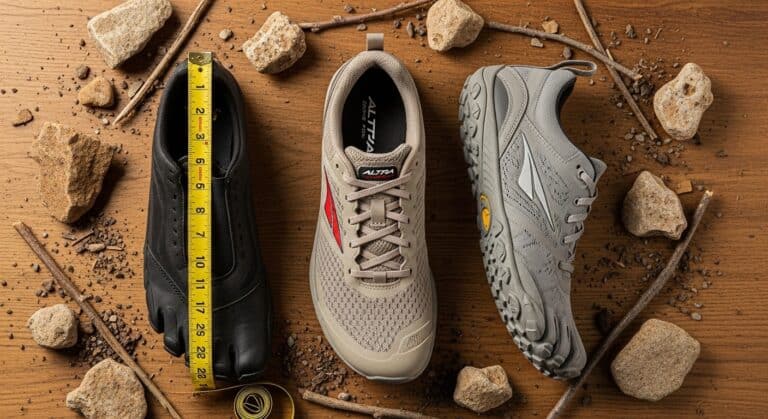
Altra Lone Peak 9: cushioned zero-drop

The Lone Peak 9 is a trail shoe with a 25 mm stack and 0 mm drop, according to retailer spec sheets. It also has a wide toe box. It is a clear example of a shoe that is zero-drop but not barefoot, because of the thick midsole. It holds about 4.5 stars on Amazon for both the men's and women's versions.
- Good for: people who want a level platform and a roomy toe box with plenty of cushion.
- Trade-off: less ground feel than a thin barefoot shoe.
Check Women's on Amazon → | Check Men's on Amazon →
Xero Shoes Mesa Trail II: thin and grippy

The Mesa Trail II is a zero-drop trail shoe with a wide toe box. Reviewers and retailers list a total stack of roughly 8 to 11 mm depending on how it is measured, with lugs for grip. That puts it much closer to barefoot than the Altra. It sits at about 3.9 stars on Amazon, so read the recent reviews on fit and durability before you buy.
- Good for: people ready for real ground feel on trails and dirt paths.
- Trade-off: thin protection on sharp rock.
Merrell Vapor Glove 6: true barefoot

The Vapor Glove 6 is about as barefoot as a mainstream shoe gets. It has a total stack of about 6 mm and zero drop, and it is very light. The thin sole means you feel almost everything underfoot. It holds about 4.5 stars on Amazon across a large number of ratings.
- Good for: experienced minimalist wearers who want maximum ground feel.
- Trade-off: little cushioning and little protection, so it is not a first pair for most people.
KEEN Utility San Jose 6": wide toe, safety toe, not zero-drop

This one is here as a contrast. The San Jose is a work boot with an alloy safety toe and a flat wedge sole. It is not zero-drop, but KEEN's roomy toe box and the flatter wedge keep your foot closer to level than many heeled work boots. It holds about 3.9 stars on Amazon. Owners often mention the roomy toe area, and some report wear on the sole over time.
- Good for: workers who need a safety toe and want more toe room.
- Trade-off: heavier and less flexible than a true barefoot boot.
Jim Green African Ranger: barefoot leather boot

The African Ranger is a water-resistant, full-grain leather boot. Jim Green says it is built on its zero-drop last, with a wide toe box. It has no safety toe. It holds about 4.6 stars on Amazon, one of the highest ratings in this group, though from fewer ratings than the big-name shoes above.
- Good for: farm work, outdoor labor and DIY where you do not need a safety toe.
- Trade-off: no safety rating. Water-resistant, not waterproof.
Xero Shoes Ridgeway: waterproof barefoot boot

The Ridgeway is a hiking-style boot listed as zero-drop and waterproof, with a wide toe box. Waterproof barefoot boots are rare, which is why it is on this list. It holds about 4.1 stars on Amazon, but from only a few dozen ratings, so the picture is still forming.
- Good for: wet yards, light trails and cool, damp days.
- Trade-off: a small number of reviews, so there is less long-term feedback to go on.
For women's options, see our guide to the best barefoot shoes for women. For running, see the best zero-drop and minimalist running shoes. If you want a flat, minimal look in a boot, our sock boots guide is a good place to start.
What the Research Does and Does Not Show
Barefoot and minimalist shoes come with big claims. The evidence is more modest.
Foot strength. The clearest finding is about the muscles inside the foot. A 2022 systematic review by Xu, Saliba and Jaffri looked at nine studies and found that minimalist shoes were linked to increases in foot muscle strength and size. Reported strength gains ranged from about 9 to 57 percent, and size gains from about 7 to 11 percent.
The caveats. The same field also reports little consensus on how well minimalist shoes build foot muscle. A 2025 review of barefoot and minimalist strength training found that some studies saw changes in muscle size without matching gains in strength or function. In short, the signs are promising for foot strength, but they are not settled.
What this does not prove. A stronger foot muscle does not automatically mean better posture, fewer injuries or relief from heel pain. Those claims go further than the research we looked at, so we do not make them.
A note on safety. If you have ongoing foot pain, heel pain or reduced feeling in your feet, talk to a clinician or podiatrist about footwear before you switch. This article cannot tell you whether barefoot shoes are right for your feet.
How to Try Barefoot Shoes Gradually
Your feet and calves are used to a raised heel and a lot of cushion. Changing everything at once is the most common way to end up sore. Go slowly, and let how you feel set the pace.
- Start with short walks. Wear the new shoes for errands or a short stroll, not an all-day hike.
- Alternate with familiar shoes. Wear your old shoes on some days, or for part of the day, while your feet get used to the change.
- Build up based on how you feel. Add time only when your feet, calves and Achilles feel normal the next day. There is no single schedule that fits everyone.
- Treat running and long hikes separately. These put more load on your body. Build up much more slowly there, and start with shorter, easier outings.
- Stop if something is wrong. Sharp arch pain, pain along the shin, or numbness and tingling in the toes are signs to back off. Tingling can also mean the shoe is too tight.
Frequently Asked Questions
Are barefoot shoes good for you?
They can be a good fit for some people, especially if you want more toe room and ground feel. The research on foot strength is encouraging but mixed. They are not a cure-all, and they are not right for everyone. If you have foot pain or a medical foot condition, ask a clinician first.
Are zero-drop and barefoot shoes the same?
No. Zero-drop only describes the heel-to-toe height difference. Barefoot shoes also have thin, flexible soles and wide toe boxes. A thick, cushioned zero-drop shoe is not a barefoot shoe.
Are minimalist and barefoot shoes the same?
Not exactly. Barefoot shoes sit at the far end of the minimalist range. Minimalist shoes can still have some cushion, some drop or some structure.
Do barefoot shoes have arch support?
Usually very little or none. The idea is that your foot works for itself. If you rely on arch support today, change slowly and see how your feet respond.
Can you run or hike in barefoot shoes?
Yes, many people do. But running and long hikes put more load on your feet and legs, so build up much more slowly than you would for walking. Terrain matters too. Sharp rock is harder in a thin sole.
How long does it take to get used to them?
It varies a lot from person to person, and there is no proven timeline that works for everyone. Let how your feet feel guide you instead of a calendar.
Are barefoot shoes okay if I have plantar fasciitis?
We cannot tell you that. Barefoot shoes are not a proven treatment, and a level heel may feel uncomfortable for some people with active heel or arch pain. Talk to a clinician or podiatrist before you try them.
Can I wear barefoot shoes every day?
Many people do, once their feet have adapted. Start by wearing them part of the day and alternate with other shoes. Some jobs also need safety footwear, which may not be available in a barefoot style.
Bottom Line
The terms are not the same, and labels can mislead. Check the actual features: drop, sole thickness, flexibility and toe box. Then pick based on what you want from the shoe.
- Want more toe room? Start with a wide, foot-shaped toe box.
- Want more ground feel? Look for a thin, flexible sole, like the Merrell Vapor Glove 6.
- Want a level heel with cushion? Try a cushioned zero-drop shoe, like the Altra Lone Peak 9.
- Need a safety toe for work? Start with the rating you need, then compare toe room. See our barefoot work boots guide.
- Heading out on trails? See our barefoot hiking shoes guide.