
You just spent $200 on a pair of safety boots. Naturally, you want to know: How long will these actually last?
There is a lot of conflicting advice out there. Some say work boots have no expiry date; others say you should toss them after six months. Then there is the "crumbling sole" phenomenon that catches many workers off guard.
In this guide, we answer the definitive questions about work boot longevity, when to replace them, and the truth about using household oils (like olive oil or Vaseline) on your leather.
The Big Question: Do Work Boots Have an "Expiry Date"?
The short answer generally given is no—boots don't spoil like milk. However, the technical answer is yes, depending on the materials.
The "Hydrolysis" Danger (The Hidden Expiry Date)
If your work boots have a Polyurethane (PU) midsole (common in brands like Keene, Timberland Pro, and Red Wing), they do have a shelf life, even if they are never worn.
- The Science: PU is a fantastic shock absorber, but it needs air circulation to stay healthy. If you leave a pair of PU boots in a box for 3–5 years without wearing them, moisture gets trapped in the pores. This triggers a chemical reaction called Hydrolysis.
- The Result: The sole will crumble into dust the first time you wear them.
- Advice: Never buy "New Old Stock" boots that have been sitting on a shelf for 5 years. And if you buy boots, wear them. Using them actually keeps the molecules aligned and prevents rotting.
Realistic Expectations: How Long Should Boots Last?
How long a boot lasts depends entirely on construction quality and your job site. Here is the realistic breakdown:
| Boot Tier | Price Range | Expected Lifespan |
|---|---|---|
| Budget | $50 - $90 | 3 - 6 Months |
| Mid-Range | $130 - $180 | 6 - 12 Months |
| Premium (Heritage) | $250 - $500+ | 5 - 10 Years (w/ Resoling) |
Why the difference?
- Budget Boots: Use glue (cement construction) that fails when wet.
- Premium Boots: Use stitching (Goodyear Welt). The sole wears out in a year, but you can pay a cobbler ($80-$120) to replace just the sole while keeping the broken-in leather upper.
5 Signs Your Work Boots Are Dead (Replace Them Now)
Don't wait until your toes are wet to swap your boots. Worn-out boots are the leading cause of plantar fasciitis and knee pain in tradespeople.
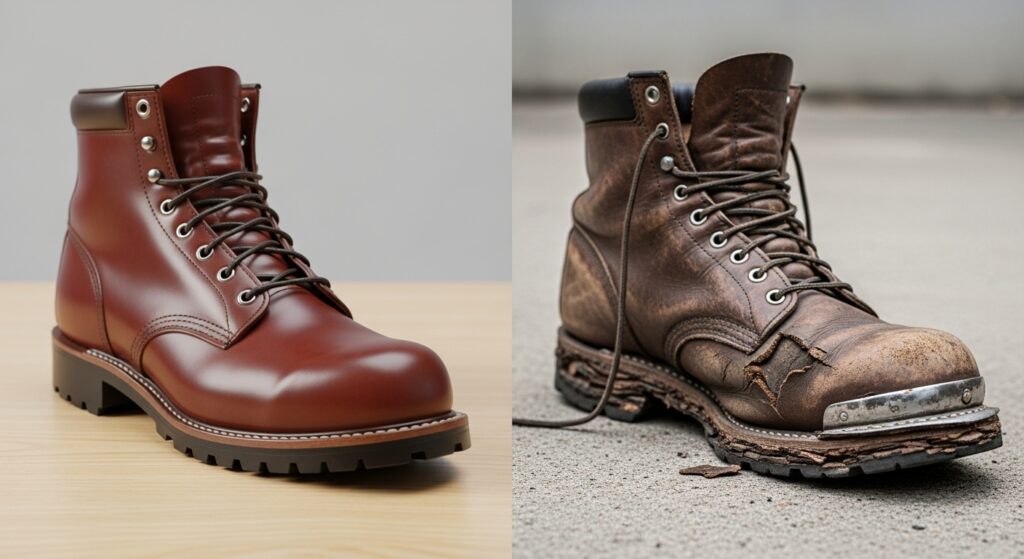
- The "Lean" Test: Place your boots on a flat table. Do they lean heavily to the left or right? If so, the midsole has collapsed. Wearing these will ruin your knee alignment.
- The Pressed Midsole: Look at the foam layer between the tread and the leather. If it looks wrinkled and compressed like a dried raisin, it has lost its shock absorption.
- Bald Treads: If the tread pattern is worn smooth, you are a slip-and-fall accident waiting to happen.
- Exposed Safety Toe: If the leather has worn away and you can see the steel or composite cap, the structural integrity is compromised.
Home Remedies vs. Real Care: What Oil Should You Use?
We see people asking if they can use kitchen oils on their boots. Here is the definitive "Boots Guru" verdict on DIY conditioners.
🛑 Olive Oil / Vegetable Oil (AVOID)
Olive oil is for salads, not boots. It is a biological oil that will eventually go rancid (rot). It can make your boots smell terrible and can actually accelerate the rotting of the stitching.
⚠️ Vaseline / Petroleum Jelly (USE CAUTION)
Vaseline creates a waterproof seal, but it doesn't "nourish" the leather fibers deep down. It can also rot stitching over time if the thread is cotton-based. Use it only in an emergency for waterproofing, not for long-term care.
✅ Coconut Oil (ACCEPTABLE)
Coconut oil is better than nothing. It conditions reasonably well, but it can darken the leather significantly and stiffen up in cold weather.
🏆 Mink Oil or Neatsfoot Oil (BEST)
Animal-based fats (Mink) or specialized blends (Neatsfoot) mimic the natural oils of the leather hide. They penetrate deep, keep the leather flexible, and prevent cracking without rotting the stitches.
How to Double Your Boot Life: The "Two-Pair" Rule
The single most effective way to make boots last is to buy two pairs and rotate them.
- The Logic: When you sweat, your leather boots absorb moisture. If you wear them the next day, they are still damp inside. This dampness causes "Work Boot Rot" (bacteria eating the lining) and mold.
- The Strategy: Wear Pair A on Monday. Wear Pair B on Tuesday.
- The Result: By letting each pair dry for 24 hours, you don't just double their life—you often triple it because the materials stay healthier.
FAQ: Common Questions
Does Red Wing clean boots for free?
Yes. If you live near a Red Wing store, they offer free oiling, cleaning, and lace replacement every 30 days. Take advantage of this!
Is it worth resoling work boots?
Only if the boots are "Welted" (stitched) and the uppers are in good shape. Resoling costs $80-$150. If your boots cost $100 new, buy new ones. If they cost $300, resole them.
How often should I oil my work boots?
Apply a good leather conditioner every 3 to 6 months for normal use, or monthly if you work in wet/muddy conditions.