
Let's get something out of the way first: having small feet as a man is not a problem to be embarrassed about — it's a fit and style consideration to navigate intelligently. The average US men's shoe size is around 10 to 10.5, which means millions of men wear a size 6, 7, 8, or 9. You are not unusual. You are underserved — and there's a difference.
The reality is that men with smaller feet face two completely distinct challenges that most boot guides lump together or ignore entirely. The first is availability: many boot brands simply don't stock below size 8 in their men's lines, leaving buyers in a frustrating cycle of stock-outs, redirections to the women's section, or settling for whatever happens to come in their size rather than what actually suits them. The second is proportion: even when you find the right size, the wrong boot style can make small feet look stumpy, infantile, or visually disproportionate — not because your feet are the problem, but because certain boot designs are engineered around an average foot size that isn't yours.
This guide solves both problems. We've identified exactly which boot styles, design elements, heel heights, and sole profiles create the most flattering visual proportions for small feet. We've sourced ten boots that are actually available in size 6 to 8 men's — no redirecting you to the women's section. And we've included outfit pairing guidance that no other boot guide covers: because what you wear above the boot matters almost as much as the boot itself.
These are the best boots for men with small feet, selected for availability, proportion, and genuine quality.
Quick Comparison: Best Boots for Men with Small Feet
| Boot | Style | Toe Shape | Heel Height | Best For | Price Range | Link | |
|---|---|---|---|---|---|---|---|
| Blundstone 500 Chelsea | Chelsea | Round/Almond | ~1 inch | Best overall / casual | $200–$230 | View on Amazon → | |
| Thursday Boot Duke Chelsea | Chelsea | Almond | ~1.25 inch | Premium leather Chelsea | $175–$200 | View on Amazon → | |
| Clarks Desert Boot | Chukka | Round/Almond | ~0.75 inch (crepe) | Casual everyday | $100–$150 | View on Amazon → | |
| Thursday Boot Captain | Lace-up Ankle | Almond | ~1.5 inch (stacked) | Smart-casual / dress | $175–$200 | View on Amazon → | |
| Dr. Martens 1460 | 8-Eye Lace-up | Round | ~1.25 inch (DM sole) | Street / casual | $150–$180 | View on Amazon → | |
| Timberland PRO Boondock 6" | Work Boot | Composite Toe | ~1.5 inch | Work / safety toe | $180–$220 | View on Amazon → | |
| Red Wing 8146 Moc Lug | Heritage Work | Moc toe | ~1.75 inch | Heritage / investment leather | $300–$400 | View on Amazon → | |
| Wolverine 1000 Mile | Heritage Lace-up | Round/Almond | ~1 inch | Classic leather heritage | $350–$400 | View on Amazon → | |
| Salomon X Ultra 5 Mid GTX | Hiking | Athletic | ~1.25 inch | Hiking / outdoor | $160–$200 | View on Amazon → | |
| Amazon Essentials Chelsea | Chelsea | Almond | ~1 inch | Best budget / entry Chelsea | $30–$50 | View on Amazon → |
What "Small Feet" Actually Means for Men — and Why It's More Common Than You Think
In the context of men's footwear, "small feet" typically refers to US sizes 6 through 9 — with 6 and 7 being genuinely undersupported by most brands, and 8 to 9 being the lower end of what most mainstream brands stock well. Given that the average US men's size is approximately 10 to 10.5, anything below a 9 puts you in territory where selection starts to narrow, and below a 7 where it can become genuinely frustrating.
But here's what matters: a significant portion of adult men wear size 7 to 9. Shorter men, men of certain ethnic backgrounds, and men who simply ended up on the smaller end of the normal distribution all share this sizing. You're not alone, and you're not a niche edge case. The boot industry just hasn't built its product lines and retail strategies around you — yet.
The key insight that this article starts with: availability and proportion are different problems with different solutions. The man who can't find his size at all has a sourcing problem. The man who finds his size but looks wrong in the boot has a style and proportion problem. Many men with small feet have both simultaneously. The sections below address each in turn.
The Visual Proportion Science: Design Elements That Make Small Feet Look Longer
Before we get to the product picks, this is the section that will change how you buy boots permanently. Understanding which design elements visually lengthen and which visually shorten small feet gives you the ability to evaluate any boot — not just the ones on this list — and make a confident decision.
These are the six elements that matter most, in order of impact:
| Design Element | Effect on Small Feet | Verdict |
|---|---|---|
| Pointed / almond toe | Extends the perceived tip of the foot beyond where it actually ends — the single most effective lengthening element | ✅ Seek out |
| Round toe (moderate) | Neutral — neither shortens nor lengthens significantly | Acceptable in most styles |
| Square / wide toe box | Adds visual width relative to length — makes the foot look short and wide simultaneously | ❌ Avoid where possible |
| Heel height 1–1.75 inches | Creates a heel-to-toe angle that elongates the visual profile of the foot — the sweet spot | ✅ Seek out |
| Flat or low heel (under 0.75") | The foot reads as a flat block with minimal length-to-height ratio | ❌ Avoid where possible |
| Slim sole profile (under 1") | Keeps proportions lean and elongated without adding visual bulk | ✅ Prefer slim soles |
| Chunky platform sole (1.5" or more) | Adds visual volume in all directions — makes the foot look wide and stubby rather than long | ❌ Avoid |
| Clean smooth vamp | An uninterrupted vamp reads as longer — no visual interruption to break the line | ✅ Prefer clean vamps |
| Heavy brogue or medallion detailing across the toe | Adds visual weight at the toe that shortens the perceived length of the foot | Use sparingly |
| Ankle straps or horizontal hardware | Creates a visual "stop" at the ankle that shortens the perceived foot length above it | ❌ Avoid |
| Monochromatic boot and trouser colour | Matching boot and trouser tone creates a continuous leg-to-foot line that reads as a much longer visual unit | ✅ Most impactful styling rule |
The monochromatic rule is particularly underused. Dark jeans with dark brown or black Chelsea boots create a visual line that extends from hip to toe with no interruption. The foot reads as the terminal point of the leg rather than as a separate small object attached to the bottom of it. This is probably the single highest-leverage style adjustment a small-footed man can make, and it costs nothing.
The Heel Height Sweet Spot for Small Feet
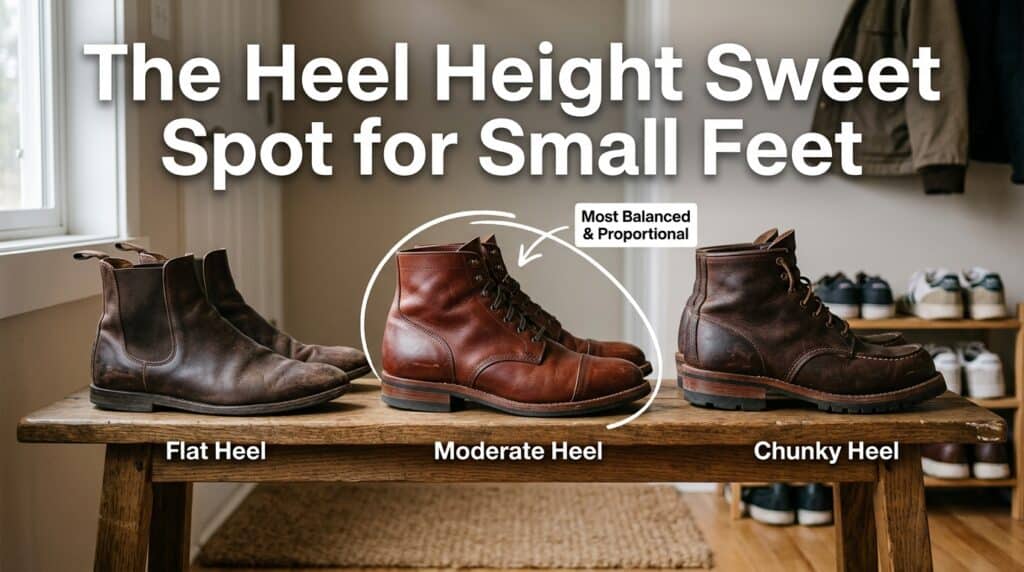
This is one of the most searched and least-answered questions in men's footwear for small feet. The answer is specific: a heel height of 1 to 1.75 inches is the optimal range for visual proportion on small feet.
Here's why. A heel below three-quarters of an inch — including the nearly-flat soles found on some casual Chelseas and most sneakers — gives the foot a low profile that reads as a flat rectangular block. There's no heel-to-toe angle to create the illusion of length. At the other extreme, heels above two inches enter territory that can look conspicuous or artificial on everyday footwear, and start to create a different set of proportion problems.
The 1 to 1.75-inch range corresponds exactly to the traditional Cuban heel, stack heel, and work boot heel found on Chelsea boots, chukka boots, heritage work boots, and western boots. These are not specialty modifications — they're standard construction. You don't need to seek out height-increasing footwear to hit this range. You just need to pay attention to which boots fall in it.
Blundstone's classic sole sits at approximately 1 inch heel differential — barely within the sweet spot. The Thursday Boot Captain's stacked heel hits about 1.5 inches — ideal. Red Wing's heritage heel sits around 1.75 inches — right at the upper edge of the sweet spot and visually excellent for proportion.
Boot Styles Ranked: Best to Worst for Small Feet
Not all boot styles are created equal when it comes to how they look on smaller feet. This is the complete ranked guide, from the most flattering to the most challenging:
1. Chelsea Boot — Best overall. The elastic-panel silhouette with no laces or hardware creates a clean, uninterrupted visual line from ankle to toe. Available with almond or pointed toes. Slim-profile sole options are widely available. No competing visual elements to interrupt the length of the vamp. The Chelsea is the single best boot style for small feet across all contexts.
2. Chukka Boot — Excellent. Two eyelets, clean design, typically round or almond toe. Minimal visual complexity. The crepe sole on the Clarks Desert Boot is slim enough to keep proportions clean. Second only to Chelsea in how well it works for small feet.
3. Cowboy / Western Boot — Surprisingly very good. The pointed toe is the most aggressively lengthening toe shape available, and the 1.5 to 2-inch riding heel hits perfectly in the sweet spot. The narrow shaft and pointed toe work particularly well at small scale. Many small-footed men overlook western boots, which is a mistake — they are among the most flattering styles available.
4. Dress / Smart Ankle Boot — Good. Low-profile lace-up or side-zip ankle boot with a stacked heel and almond toe. Works well in formal and smart-casual contexts. Keep the toe pointed or almond — square-toed dress boots are the worst offender for making small feet look stumpy.
5. Work Boot (6-inch) — Challenging but workable. Heavy construction, wide toe boxes, and chunky safety soles create proportion problems at small sizes. Choose composite toe over steel (narrower profile) and athletic-construction work boots over traditional heavy welted options. The Timberland PRO and similar lightweight composites are significantly more proportionate than traditional logger-style boots at small sizes.
6. Lace-up Combat Boot — Mixed. Multiple eyelets can work if kept to six or fewer. Dr. Martens 1460 works specifically because the 8-eyelet count is manageable and the DM sole adds visual presence without excessive bulk. Avoid 10+ eyelet options where the hardware overwhelms a small boot.
7. Hiking Boot — Difficult. Aggressive lug soles, wide toe boxes, and chunky construction amplify proportion issues at small sizes. The Salomon X Ultra 5 Mid GTX is included in this list specifically because it avoids the worst offenders — its lightweight construction and athletic profile work far better than traditional heavy leather hiking boots.
8. Engineer / Harness Boot — Avoid. The stovepipe shaft, buckle hardware, and logger heel create visual bulk that overwhelms small feet. The shaft-to-foot-length ratio looks disproportionate at size 7 to 8. If you need this style, choose a 10 to 11-inch shaft over a 13 to 16-inch option.
The 10 Best Boots for Men with Small Feet
1. Blundstone Men's / Unisex 500 Original Chelsea Boot — Best Overall
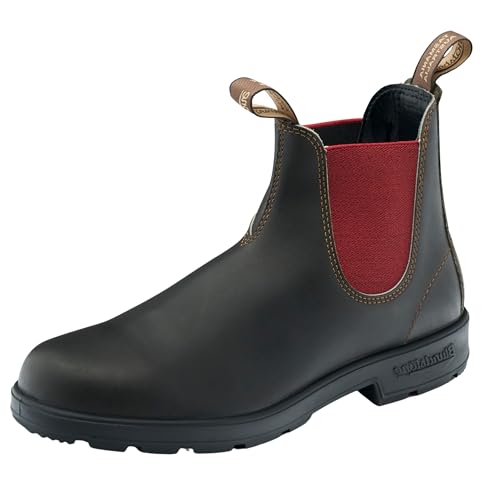
If you wear a size 5 to 8 and you've spent years being told "we don't have that in men's," the Blundstone 500 is the boot that solves the availability problem at a stroke. Blundstone markets this boot explicitly as unisex — not women's with a men's footnote, genuinely unisex, built on a last that works for all feet — and it's available starting from US size 5. For men who wear a size 6 and have been directed to the children's section, this changes everything.
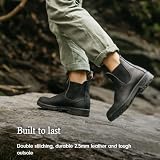
The 500's construction is straightforward and proven: full-grain leather upper, elastic side panels, removable leather insole, and Blundstone's TPU outsole with approximately 1 inch of heel differential. That heel height puts it just within the proportion sweet spot, and the rounded-to-almond toe with a clean, undecorated vamp creates a visual line that's longer than you'd expect from a casual Chelsea. This is not a dramatically dressed boot — it's a daily driver that works with jeans, chinos, casual trousers, and will outlast cheaper alternatives by years.

For outfit pairing with small feet, match the tan or rustic brown Blundstone to camel, khaki, or mid-wash jeans. The black version pairs cleanly with dark indigo denim or charcoal chinos. In both cases, opt for a slim or tapered trouser with zero to slight break — the elastic panel should be visible, not swallowed under fabric.
Small Feet Specs: Available from US 5 (unisex) | Round/Almond toe | ~1 inch heel | Slim TPU sole | Unisex last — works well on men's narrow feet | Proportion rating: 4/5
✅ Small Feet Verdict: The safest first boot recommendation for any small-footed man. Unbeatable size availability, clean proportions, and unisex construction mean this is the one boot you can order with complete confidence regardless of whether you're a size 5, 6, 7, or 8.
Pros: Unisex sizing from US 5 — the widest small-size availability of any quality Chelsea; proven durability with decades of testimonials; clean elongating silhouette with no decorative interruption; removable insole allows for orthotic use.
Cons: 1-inch heel is the low end of the proportion sweet spot — could be taller; not Goodyear welted so resoling is limited.
2. Thursday Boot Company Duke Men's Chelsea Boot — Best Premium Chelsea
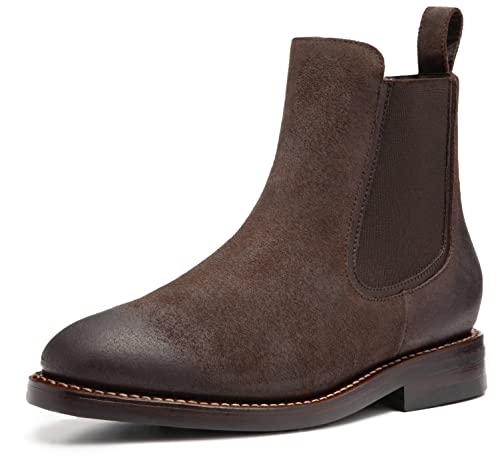
Thursday Boot Company is one of the most important brands for small-footed men, full stop. Their men's sizing starts at US 6 — genuine men's sizing, not a conversion, not a workaround — which makes them one of very few quality leather boot companies that actually stocks your size in a men's line. The Duke Chelsea takes that availability advantage and pairs it with the right proportion elements: an almond toe, a heel of approximately 1.25 inches, and a slim-profile Chelsea silhouette that creates a clean, elongated look on smaller feet.

Construction is full-grain leather with a leather lining, YKK zipper side option, and Goodyear welt construction at this price point — a significant quality marker for a boot under $200. The full-grain upper develops patina over time rather than cracking, and the Goodyear welt means the sole can be replaced when it eventually wears. Thursday also offers free returns, which removes the risk that comes with ordering boots you can't try on in a store — particularly relevant for small-footed men who often can't try stock at retail.

Styling note for small feet: the Duke's slim profile works best with dark denim or slim chinos in a similar or slightly darker tone to the boot. The almond toe does significant work here — it extends the visual line of the foot further than a round toe would, and paired with a tonal colour match between boot and trouser, the effect is noticeably lengthening. Avoid cuffing trousers wide over the boot shaft; a clean, tight cuff or simple trouser break at the boot collar is ideal.
Small Feet Specs: Available from US 6 men's | Almond toe | ~1.25 inch heel | Slim leather sole | Medium-narrow last suits small narrow feet | Proportion rating: 5/5
✅ Small Feet Verdict: The best premium Chelsea boot for small-footed men. Starts at US 6 in genuine men's sizing, has the almond toe and slim profile that work best for proportion, and comes with free returns for confident online ordering.
Pros: Genuine US 6 men's sizing; almond toe is the best single proportion element for small feet; full-grain leather with long-term durability; free returns make online sizing risk-free.
Cons: Medium-narrow last may require a half-size up for wider small feet; premium price point.
3. Clarks Men's Desert Boot — Best Chukka

The Clarks Desert Boot has been in continuous production since 1950 and it's on this list for a specific reason: it is one of the cleanest, most proportion-friendly boot designs ever made. Two eyelets. Almond-to-round toe. Crepe sole at approximately three-quarters of an inch. No hardware, no decorative stitching across the vamp, no visual noise. For small feet, the Desert Boot's clean minimalism means the vamp reads long and uninterrupted — which is exactly what you want. It's available from UK 6, which converts to approximately US 7.
The crepe sole is the key technical detail here. It's slim — far slimmer than a lug or commando sole — and the slight natural wedge of the crepe gives a modest heel elevation that's close to the proportion sweet spot without being a traditional stacked heel. The suede version in sand or beeswax is the most classic, but leather versions are available for those who want a slightly dressier finish. Both materials take on character with wear rather than looking cheap over time.

The Desert Boot works extraordinarily well with slim chinos and a tuck or no-break hem. Match the sand suede to light khaki chinos or pale grey trousers for a tonal combination that extends the visual leg line. The beeswax leather version pairs better with dark denim or olive chinos. This is a boot you can wear to a casual office, a weekend market, or a city walk with equal confidence.
Small Feet Specs: Available from UK 6 / US 7 | Round/Almond toe | ~0.75 inch crepe heel | Slim crepe sole | Proportion rating: 4/5
✅ Small Feet Verdict: The definitive casual boot for small-footed men. The minimal design and slim crepe sole create excellent proportions, and the two-eyelet construction means no hardware distracts from the clean vamp. Start at size US 7 and up only.
Pros: Cleanest, simplest design on this list — fewest proportion-disrupting elements; iconic silhouette that's never out of style; crepe sole is comfortable from day one with minimal break-in.
Cons: Doesn't go below US 7 (UK 6) — US 6 wearers need to look elsewhere; crepe sole wears faster than leather or rubber alternatives.
4. Thursday Boot Company Captain Men's Lace-Up Boot — Best Smart-Casual / Dress Boot

The Thursday Boot Captain occupies the smart-casual space that Chelsea boots can't quite reach — it has enough formality for business-casual dressing and enough character for weekend wear, with a stacked heel and almond toe combination that happens to be near-ideal for small feet. The stacked heel sits at approximately 1.5 inches — right in the middle of the proportion sweet spot — and the almond toe does the visual lengthening work that makes the boot look right even at size 6 or 7.

Like the Duke Chelsea, the Captain is available from US 6 in genuine men's sizing, which is the key logistical advantage Thursday Boot Company offers over most competitors at this quality level. Full-grain leather, leather lining, Goodyear welt, and a resolable construction make this a long-term investment at under $200. The lace-up construction with a relatively modest number of eyelets keeps the visual complexity controlled — you get the dressy formality of laces without the boot looking overwhelmed by hardware at small sizes.

For small-footed men, the Captain works best with slim dress trousers or slim chinos in a tonal match with the boot — dark cognac or walnut leather paired with camel or khaki trousers, or black leather with charcoal or navy trousers. The slight break or no break hem keeps the boot visible and the visual line continuous. This is the boot to reach for when the office dress code is smart-casual, or for evening wear when a Chelsea feels too casual.
Small Feet Specs: Available from US 6 men's | Almond toe | ~1.5 inch stacked heel | Slim leather sole | Medium-narrow last | Proportion rating: 5/5
✅ Small Feet Verdict: The best dress and smart-casual boot for small-footed men. The stacked heel and almond toe are the two most impactful proportion elements working together, and US 6 availability makes it genuinely accessible. The Thursday Boot Company Captain is the go-to when you need a boot that looks as good with dress trousers as it does with denim.
Pros: Optimal heel height for small-foot proportion; almond toe extends visual foot length; genuine US 6 sizing; versatile across dress and casual contexts; Goodyear welt construction.
Cons: Lace-up construction requires more break-in time than a Chelsea; narrow last may not suit wide small feet.
5. Dr. Martens 1460 8-Eye Boot — Best Street Style / Casual

The Dr. Martens 1460 starts at UK size 3 — which translates to approximately US men's 5 to US women's 6 to 7 — making it one of the few iconic boots that genuinely goes small enough for the smallest men's feet. The 8-eyelet construction and DM air-cushioned sole create a visual presence that works specifically well for small feet in streetwear and casual contexts: the sole adds enough visual weight to avoid the boot looking flimsy on a small foot, without crossing into the chunky platform territory that hurts proportions.

The DM sole sits at approximately 1.25 inches of heel differential and about the same in platform height — it's within proportion range but at the boundary. The key is choosing the right colourway and upper: smooth black or cherry leather versions are the most visually clean at small sizes. Avoid heavy-textured, patent, glitter, or contrast-stitched versions where the visual complexity adds bulk that overwhelms a small boot. The round toe of the 1460 is the main proportion limitation — it's not as lengthening as an almond or pointed toe — but the DM sole compensates with its visual assertiveness.

Important sizing note for small-footed men: Dr. Martens boots are notoriously wide-lasted. If you have narrow feet — which is common for men with small feet — consider going down half a size or using a thicker insole to reduce the forefoot volume. A boot that's correct in length but swims in width will make small feet look larger than they are for all the wrong reasons, with the boot appearing wider than the foot inside it.
Small Feet Specs: Available from UK 3 / US ~5 | Round toe | ~1.25 inch DM sole | Air-cushioned DM sole | Wide last — size down half step for narrow feet | Proportion rating: 3.5/5
✅ Small Feet Verdict: The best casual streetwear boot for small-footed men. Exceptional size availability from UK 3, iconic design that holds its own visually, and DM sole that adds presence without looking excessive. Verify width fit carefully — the wide last is this boot's main caveat for small narrow feet.
Pros: Available from UK 3 — smallest size on this list; iconic silhouette with strong visual presence; DM sole adds proportion-helping visual weight; massive colour and finish selection.
Cons: Wide last creates fit issues for narrow small feet; round toe is less lengthening than almond alternatives; heavy — not suited for all-day walking comfort.
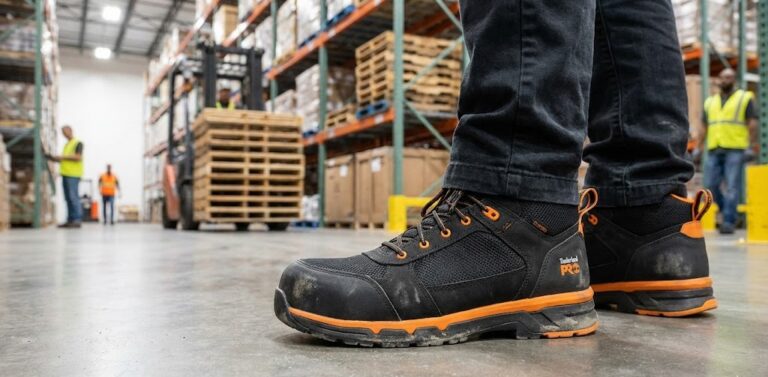
6. Timberland PRO Mens Boondock 6" Composite Safety Toe — Best Work Boot
More detail: our full Timberland PRO Boondock review.
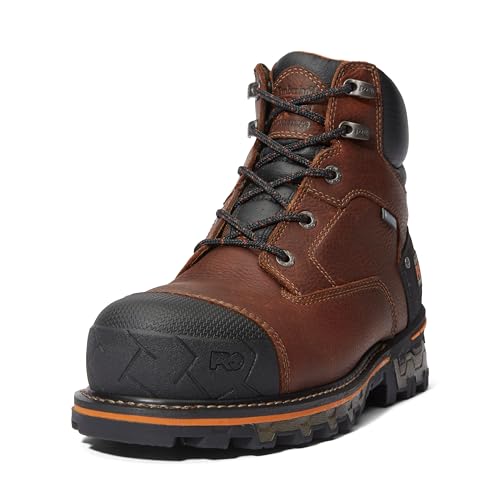
Work boots are the most challenging style category for small-footed men from a proportion standpoint — the heavy construction, wide safety toe boxes, and aggressive lug soles that make work boots durable and protective also make them look disproportionately large on smaller feet. The Timberland PRO Boondock addresses this specific problem through its composite safety toe construction: a composite toe is narrower in profile than a steel toe, and the Boondock's overall construction is more athletic and less boxy than traditional welted logger-style work boots, which means it wears proportionally better at small sizes.

The Boondock is built for genuine work use — ASTM F2413 composite safety toe, waterproof membrane, anti-fatigue technology, and slip-resistant outsole. For small-footed men who need real safety protection on a worksite, this is not a fashion compromise — it's a legitimately capable work boot that happens to be more proportionate at small sizes than its competitors. The 6-inch shaft height keeps the visual profile of the boot contained relative to the foot length, which is an improvement over taller shaft options.

Verify size availability carefully in the listing before ordering — work boot sizing for small men can vary between specific colourways and stock levels. The composite toe is the non-negotiable choice here for small-footed men: the slimmer profile at the toe compared to steel significantly reduces the visual overhang that makes work boots look too large.
Small Feet Specs: Available in small men's sizes (verify per listing) | Composite safety toe | ~1.5 inch heel | Athletic construction sole | Proportion rating: 3/5 (best of work boot category)
✅ Small Feet Verdict: The most proportionate work safety boot for small feet. The composite toe, athletic construction, and 6-inch shaft make this a significantly better-looking option at small sizes than traditional heavy welted work boots. The right choice for small-footed men who need genuine ASTM protection.
Pros: Composite toe is slimmer than steel — better proportions; athletic construction is more proportionate than heavy welted alternatives; genuinely capable work boot with safety ratings; anti-fatigue technology for all-day comfort.
Cons: Work boot proportions are always challenging for small feet — this is the best of a difficult category, not the most flattering boot on the list; verify size availability before ordering.
7. Red Wing Men's Heritage 8146 6" Moc Lug — Best Heritage Leather Boot
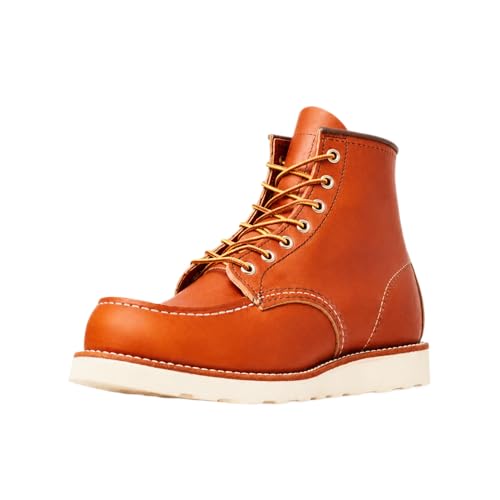
Red Wing Heritage boots are among the most respected heritage work and lifestyle boots made in America, and the 8146 Moc Lug is the model that makes most sense for small-footed men considering an investment-tier leather boot. The moc toe is a rounder, more relaxed shape than the pointed or almond toes that work best for visual proportion — but the heel height at approximately 1.75 inches compensates significantly, and the Moc Lug's aggressive lug outsole adds visual weight that works at small sizes by giving the boot a presence the foot fills rather than being swallowed by.

The construction is the story here. Goodyear welt. Genuine leather that develops a patina unique to your wear patterns over years of use. A last built for the shape of a working foot. Red Wing's Irish Setter outsole on the 8146 specifically adds a lug profile that's visually assertive without being a platform — important for keeping the boot's proportions readable as intentional rather than just large. This is a boot you buy once and wear for a decade, and that lifespan calculation changes the value proposition significantly even at the $300 to $400 price point.

For outfit pairing with small feet, the Red Wing Moc Lug works best with slim dark jeans or work-weight canvas trousers with a clean break at the shaft. The boot's heritage character means it reads best in casual and outdoor contexts — don't attempt to dress it with formal trousers. The copper-rough-and-tough leather version is the most versatile finish; the Hawthorne Muleskinner for a lighter, more casual look.
Small Feet Specs: Available from US 6 in select styles (verify per listing) | Moc toe | ~1.75 inch heel | Lug outsole | Proportion rating: 3.5/5
✅ Small Feet Verdict: The best heritage investment boot for small-footed men who want a boot that lasts a decade and improves with age. The tall heel compensates for the round moc toe, and the lug outsole gives the boot enough visual weight to fill the frame at small sizes. Verify small-size availability before ordering.
Pros: Exceptional build quality with Goodyear welt and genuine leather — will outlast most boots on this list; made in the USA; 1.75-inch heel is near-ideal for proportion; deep heritage character that improves with age.
Cons: Moc toe is less proportionally ideal than almond or pointed alternatives; premium price; requires significant break-in; verify size availability before ordering.
8. Wolverine 1000 Mile Boot — Best Classic Heritage Lace-Up
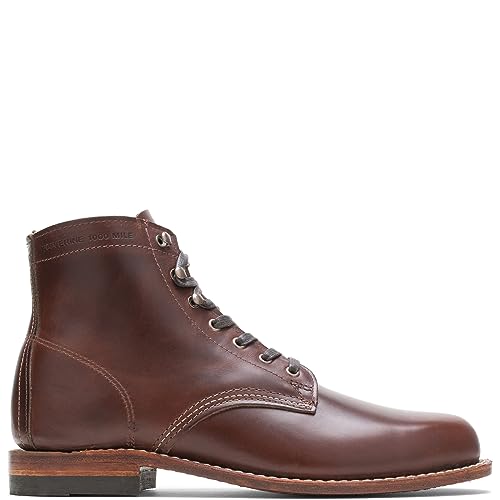
The Wolverine 1000 Mile is one of America's most storied boots, and it earns its place on this list through a combination of genuine small-size availability, clean proportions, and a classic silhouette that has never looked wrong on any foot. Named for the alleged mileage the original boots could cover, the 1000 Mile is built on a traditional round-to-almond toe with a Goodyear welt, chrome-tanned leather, and a 1-inch heel that sits just within the proportion sweet spot. It's available from US 6, which makes it accessible to the full range of small-footed men covered in this guide.

The construction is conventional in the best sense: no gimmicks, no compromises. The upper is full-grain leather available in a range of browns and blacks. The leather sole is slim enough to maintain elongated proportions at small sizes. Six to seven eyelets depending on the version — a number that works well at small sizes without creating the visual overload that comes from 10-plus eyelet work boots. The lacing creates a secure fit across the instep that helps with the heel-slip issue that small-footed men sometimes experience with boots that run slightly wide.

The 1000 Mile is a versatile boot that works with everything from selvedge denim and workwear to khaki chinos and a field jacket. For small feet, the key is trouser choice: slim or straight-leg denim in a tonal match with the boot colour creates the continuous leg-to-foot line that makes the boot look right. Avoid heavy fabric bunching at the shaft — this boot is meant to be seen.
Small Feet Specs: Available from US 6 | Round/Almond toe | ~1 inch heel | Slim leather sole | Proportion rating: 4/5
✅ Small Feet Verdict: The best all-American heritage lace-up for small-footed men. Classic proportions, genuine US 6 availability, and a slim leather sole that keeps the visual profile clean. A boot you'll still own in ten years.
Pros: Available from US 6; slim leather sole maintains clean proportions; exceptional craftsmanship at the price point; versatile across casual and smart-casual contexts; iconic American heritage design.
Cons: 1-inch heel is the low end of the sweet spot; significant break-in period; leather sole requires regular care and conditioning.
9. Salomon X Ultra 5 Mid GTX — Best Hiking Boot

Hiking boots are the hardest category for small-footed men: aggressive lug soles, wide toe boxes, and heavy construction all amplify the proportion issues that come with smaller feet. The Salomon X Ultra 5 Mid GTX is specifically chosen because it breaks from the traditional heavy hiking boot mould and builds instead on Salomon's trail-running DNA — a lighter, more athletic construction that sits significantly better on small feet than traditional leather hiking options.

The X Ultra 5 Mid GTX features Gore-Tex waterproofing throughout, Salomon's Contagrip outsole (assertive traction without the visual bulk of traditional lug soles), an EnergyCell midsole for cushioning, and the lightweight synthetic upper that Salomon uses across their trail range. The mid-height shaft provides ankle support without the heavy visual mass of a traditional 6-inch leather hiking boot. Available from US 6.5 men's, which covers most small-footed men in this guide.

This is the boot for small-footed men who need genuine trail or outdoor performance in a boot that doesn't look absurd off the trail. It pairs well with slim technical trousers or hiking-specific pants, and its athletic aesthetic means it also works with slim dark jeans for urban wear — a versatility that heavy leather hiking boots can't match.
Small Feet Specs: Available from US 6.5 men's | Athletic toe | ~1.25 inch midsole | Contagrip lug sole | Proportion rating: 3.5/5 (best of hiking category)
✅ Small Feet Verdict: The best hiking boot for small-footed men. The athletic construction is far more proportionate at small sizes than traditional heavy hiking boots, and the Gore-Tex waterproofing and Contagrip sole deliver genuine trail performance. For small feet, this is the hiking boot that won't look out of proportion.
Pros: Athletic construction proportionally far better than traditional heavy hiking boots at small sizes; genuine Gore-Tex waterproofing; Contagrip traction; lightweight; versatile enough for urban wear.
Cons: Athletic aesthetic doesn't suit formal or heritage contexts; lug sole is slightly chunky — the main proportion caveat for small feet; starts at US 6.5, not ideal for US 6 wearers.
10. Amazon Essentials Men's Slip-On Chelsea Ankle Boot — Best Budget Pick

The Amazon Essentials Chelsea is the entry point for small-footed men who want to test the Chelsea silhouette before committing to a premium price, or who simply need a functional Chelsea without a significant investment. Available in small sizes including US 6, with an almond toe and a slim sole, it hits the key proportion requirements despite its budget price point. The Chelsea silhouette is the most forgiving for small feet even at the entry level — a budget Chelsea in the right colour and the right toe shape is more flattering than a premium boot in the wrong style.

The construction is straightforward PU or faux-leather upper with elastic side panels and a slim outsole. At this price you're not getting full-grain leather, Goodyear welt, or longevity measured in years — this is a boot with a 12 to 18 month lifespan under regular wear. But for the small-footed man who wants to verify the Chelsea silhouette works for his wardrobe before buying a Thursday Boot or Blundstone, it's a completely reasonable first step. The almond toe is the key detail that elevates this above even cheaper Chelsea alternatives.

Wear this with slim jeans and a clean break at the collar. Avoid heavy-soled versions or styles with decorative hardware — the clean, minimal Chelsea is what you want at this price point and for these proportions. Black is the most versatile option for small-footed men as it matches the widest range of trouser colours with the least contrast.
Small Feet Specs: Available from US 6 | Almond toe | ~1 inch heel | Slim synthetic sole | Proportion rating: 3.5/5
✅ Small Feet Verdict: The best budget Chelsea for small-footed men. Hits the key proportion requirements — almond toe, slim sole, clean vamp — at a fraction of the cost of premium alternatives. The right starting point for men who want to confirm the Chelsea silhouette works for them before upgrading.
Pros: Best price point on this list; available in small sizes from US 6; almond toe provides good proportion for small feet; clean Chelsea silhouette that works well with most trouser styles.
Cons: Not genuine leather — durability is significantly lower than premium alternatives; not resolable; less comfort over long periods than better-constructed options.
The Outfit Pairing Guide for Small Feet
Choosing the right boot is only half the equation. What you wear above the boot determines whether the boot looks proportionate or not — and this is the content that no other boot guide covers.
Trouser break — the most important rule. The hem of your trouser should sit at or just above the collar of the boot. A long break, where fabric pools over and around the boot shaft, creates visual bulk at the ankle that draws attention to a small boot disappearing under cloth. The boot should be visible in its full profile — particularly the elastic panel on a Chelsea or the shaft of a lace-up boot.
Trouser colour matching — the highest leverage styling decision. Match the boot to the trouser colour as closely as possible. Dark jeans paired with dark brown or black Chelsea creates a continuous visual line from hip to toe with no interruption. The foot reads as the terminal point of a long leg line rather than as a separate small object. High contrast — light chinos with black boots — creates a hard visual cut-off at the ankle that shortens the perceived foot length significantly. This one rule, applied consistently, changes how your boots look more than any other single adjustment.
Trouser width — slim to straight, not wide. Slim or tapered trousers that end cleanly above the boot shaft create the best proportion for small-footed men. Wide-leg or flared trousers that fall over the boot obscure both boot and foot — not inherently catastrophic, but it wastes the investment in a well-chosen boot. Straight-leg jeans with a clean break are a strong default. Skinny jeans create a different problem: the abrupt transition from ankle-tight denim to boot creates an emphasized size change at the foot that draws attention in the wrong direction.
The Chelsea-and-jeans combination. Slim or straight-leg dark denim jeans with a slight tuck or cuff showing the Chelsea's elastic panel is the most universally flattering combination for small-footed men across all heights. The elastic panel visible above the trouser hem signals a clean, intentional fit. This combination works from US size 5 to size 9 with equal effectiveness.
The "Sent to the Women's Section" Problem — and How to Navigate It
If you wear a size 6 or 7 in men's, you have almost certainly been redirected to the women's section at a shoe store. This is not an accident — it's a structural feature of how most boot brands approach production economics. The average US men's size being 10 to 10.5 means the size 6 to 7 range represents a small enough portion of sales that many brands simply don't produce it in their men's lines, directing customers instead to women's equivalent sizes or to children's sections.
Here is the complete practical guide to navigating this, without the indignity:
Brands that genuinely stock men's from US 6: Thursday Boot Company (confirmed US 6 start across multiple styles), Blundstone (unisex from US 5 — no women's section redirection required), Dr. Martens (UK 3 start = approximately US 5 men's), and Wolverine 1000 Mile (US 6 available in select styles). These are your primary sources for quality boots in small men's sizes.
The women's boot conversion — when it's appropriate. For certain boot silhouettes — Chelsea boots, chukka boots, clean ankle boots — a women's boot in a neutral, non-feminine style on a men's or unisex last can work correctly on a man's foot. The typical conversion: US men's 7 = US women's 8.5; men's 8 = women's 9.5. This only applies to styles with neutral design — clean Chelseas, plain ankle boots, heritage-inspired styles. It does not apply to obviously feminine styles with pointed-toe cutouts, hourglass shafts, or overtly decorative hardware. Blundstone's 500 Original is explicitly marketed as unisex and requires no conversion consideration whatsoever.
Online ordering strategy. When searching Amazon for men's boots in small sizes: use the size filter and verify that the listing explicitly states "men's sizing" in the product description. Listings for small sizes sometimes mix men's and women's sizing without clear labelling — a size 7 in women's sizing would be a men's 5.5, too small. Look for listings that clarify "US men's" in the size chart. Thursday Boot Company, Blundstone, and Dr. Martens all have clear size labelling.
Return policies matter more for small-footed men. Because you often can't try boots in store — stock in your size frequently isn't held at retail — an online return policy is a functional requirement, not a bonus. Thursday Boot Company's free return policy is specifically valuable in this context. Amazon's standard footwear return window applies to most listings on this page.
Narrow Last Guide: When Small Feet Are Also Narrow Feet
Men with small feet are disproportionately likely to have narrow feet as well — foot width scales proportionally with length, and at size 7 or 8 in absolute terms, a foot is narrower than a size 11 foot in the same letter width. When brands use a single last shape across all sizes, the result at small sizes can be a boot that's correct in length but slightly too wide in the forefoot and heel — causing heel slip after break-in and a visual effect where the boot extends beyond the foot rather than fitting it cleanly.
Signs your small boot is too wide: heel lift after the leather has fully broken in; visible space between your foot and the side of the boot at the midfoot; the boot looking noticeably wider than your foot from above; inner sole not making full contact with the arch of your foot.
Thursday Boot Company runs a medium-narrow last that works well for small narrow feet without additional modification. Allen Edmonds models like the Park Avenue run narrow overall and can be excellent for small narrow feet — note that they tend to size up at small sizes. Blundstone's unisex last is relatively narrow for a casual boot and fits small narrow feet well.
Practical fixes for a boot that's slightly wide: adhesive heel grips inside the heel counter to reduce heel cup volume; a full insole that takes up forefoot volume; a tongue pad at the instep. These solutions add up to 1 to 1.5 sizes' worth of fit adjustment without altering the boot itself.
FAQ: Boots for Men with Small Feet
What men's boot size is considered small?
In the context of men's footwear availability, US size 6 and 7 are genuinely small — many brands don't stock below size 8 in their men's lines. Sizes 8 and 9 are below average (average US men's size is approximately 10 to 10.5) but within the standard range that most brands stock. For proportion purposes, the guidance in this article applies most strongly to US sizes 6 through 9.
What boot styles look best on men with small feet?
Chelsea boots and chukka boots are the two best styles for small feet. Chelsea boots in particular — with their clean elastic-panel silhouette, no hardware or lacing, and available almond toes — create the most elongating visual profile. Cowboy and western boots are a surprising third: the pointed toe and elevated heel work together to create the illusion of greater foot length. See the full style ranking earlier in this article.
Which boot brands sell men's size 6 and 7?
Thursday Boot Company (confirmed from US 6 across multiple styles), Blundstone (unisex from US 5), Dr. Martens (from UK 3 ≈ US 5), Wolverine 1000 Mile (US 6 in select styles), and Red Wing (select styles to US 6). These are the primary quality sources for men's boots in small sizes.
Can men wear women's boots if they have small feet?
For neutral, gender-nonspecific styles — Chelsea boots, chukka boots, plain ankle boots — yes, with careful size conversion (men's 7 = women's 8.5 typically). This only applies to styles on a neutral or unisex last without obviously feminine design elements. Blundstone's 500 Original is explicitly marketed as unisex and requires no conversion consideration. Avoid women's boots with pointed decorative cutouts, hourglass shafts, or obviously feminine styling.
Do Chelsea boots look good on men with small feet?
Yes — Chelsea boots are the single best boot style for small-footed men. The clean silhouette with no laces or hardware creates an uninterrupted vamp that reads as longer than it is. Paired with a tonal trouser match and a zero-to-slight-break hem, a Chelsea boot is the most flattering footwear choice available for small feet across nearly all casual and smart-casual contexts.
What should I avoid wearing with boots if I have small feet?
Avoid high-contrast boot-to-trouser colour combinations (light chinos with black boots). Avoid long trouser breaks where fabric bunches over the boot shaft. Avoid very wide-leg or bootcut trousers that obscure the boot entirely. Above the boot line, these are the highest-impact negative choices. In boot selection, avoid chunky platform soles, square toe boxes, and heavy brogue detailing across the vamp.
How do I buy boots online when I have small feet and can't try them in store?
Prioritise brands with free return policies — Thursday Boot Company and Amazon footwear listings both offer returns on footwear. Use the size filter on Amazon and verify "men's sizing" explicitly in the listing. Measure your foot length using the Brannock device at a local shoe store or trace your foot on paper and measure to the nearest millimetre, then cross-reference against the brand's size chart. Half sizes matter more at small sizes — the difference between a 7 and 7.5 is proportionally larger at small sizes than at large ones, so don't round up.
Do pointed-toe boots look better on small feet than round-toe boots?
Yes, consistently and measurably. The pointed or almond toe extends the perceived visual tip of the foot beyond where it actually ends, creating a lengthening illusion that a round toe cannot replicate. This is the single most impactful design element for making small feet appear longer. Among the boots on this list, the Thursday Boot Captain, Thursday Boot Duke, Clarks Desert Boot, and Amazon Essentials Chelsea all feature almond toes that deliver this effect.
Final Verdict: Best Boots for Men with Small Feet by Occasion
Best Overall: Blundstone 500 Chelsea — Available from US 5, unisex, clean proportions, daily-wear durability. The safest first boot for any small-footed man.
Best Premium Chelsea: Thursday Boot Company Duke Chelsea — Starts at US 6 in genuine men's sizing, almond toe, full-grain leather, free returns. The upgrade path from the Blundstone.
Best Casual / Everyday: Clarks Desert Boot — The cleanest, simplest boot design available. Slim crepe sole, minimal visual noise, iconic silhouette. From UK 6 / US 7.
Best Smart-Casual / Dress: Thursday Boot Company Captain — Stacked heel at the perfect height, almond toe, available from US 6. The office-to-evening boot for small-footed men.
Best Street / Casual: Dr. Martens 1460 — Available from UK 3, DM sole adds visual presence that works at small sizes. The streetwear choice.
Best Work Boot: Timberland PRO Boondock — Composite toe for slimmer profile, athletic construction, genuine safety ratings. The most proportionate work boot for small feet.
Best Heritage Investment: Red Wing 8146 Moc Lug — Built in the USA, Goodyear welt, 10-year lifespan. The investment-tier choice for small-footed heritage boot buyers.
Best Classic Heritage Lace-Up: Wolverine 1000 Mile — American heritage construction from US 6, slim leather sole, clean proportions. The lace-up alternative to the Blundstone.
Best Hiking Boot: Salomon X Ultra 5 Mid GTX — Athletic construction is far more proportionate at small sizes than traditional heavy hiking boots. Genuine trail performance from US 6.5.
Best Budget: Amazon Essentials Chelsea — Almond toe, slim sole, available from US 6, under $50. The right starting point for anyone testing the Chelsea silhouette before upgrading.
For more footwear guides at Bootsguru, see our guides to the best Chelsea boots for men, the most comfortable work boots, and the best boots for men overall.