
The average auto technician's floor presents seven distinct hazards in a single square yard: epoxy coating with oil contamination that defeats standard slip-resistant outsoles, dropped brake rotors and engine components that require ASTM-certified toe protection, live battery terminals that demand electrical hazard insulation, fuel vapour from open tanks that turns a static spark into a fire, brake fluid that destroys standard leather in weeks, and ten hours of concrete fatigue that accumulates differently for a mechanic who spends 40% of their shift on a creeper than for a construction worker standing in one spot.
Every other work boot guide for mechanics lists "oil-resistant outsoles" as the primary requirement and calls it done. This guide starts with the seven hazards and works backwards to the boot features that actually address them. The EH vs SD distinction that most mechanics get dangerously wrong. The SRO certification introduced in ASTM F2413-24 that is fundamentally different from the old SR rating on oily shop floors. The kneeling geometry that a boot needs to be comfortable on a creeper. The chemical resistance differences between motor oil, DOT 3 brake fluid, and battery acid — three very different threats to boot materials. Nine products, all on Amazon, organised by mechanic specialty with honest performance data for each.
⚡ Quick Picks — Best Work Boots for Auto Mechanics 2026
| Best For | Boot | Toe | Electrical | Price |
|---|---|---|---|---|
| Best overall / light vehicle tech | Wolverine Overpass 6" CT WP | Composite | EH | ~$155 |
| Best ESD / body shop / fuel systems | KEEN Utility Atlanta Cool 2 ESD | Steel | ESD/SD | ~$165 |
| Best lightweight / lube tech / mobility | Timberland PRO Reaxion CT | Composite | EH | ~$130 |
| Best diesel / heavy equipment | KEEN Utility Flint II 6" WP ST | Steel | EH | ~$165 |
| Best kneeling / creeper comfort | Skechers Work Arch Fit SR CT | Composite | EH | ~$95 |
| Best budget / soft toe option | EVER BOOTS Tank | Soft toe | — | ~$65 |
| Best waterproof / washdown bay | Carhartt Rugged Flex 6" WP CT | Composite | EH | ~$155 |
| Best wide feet / athletic shoe style | New Balance 627 v2 Industrial ST | Steel | — | ~$100 |
| Best women's mechanic boot | Reebok Work Women's Sublite CT | Composite | EH | ~$110 |
Table of Contents
- The Auto Shop Hazard Map
- SR vs SRO: Why Your "Slip-Resistant" Boots Slip on Oily Epoxy
- EH vs SD: The Electrical Protection Distinction Mechanics Get Wrong
- Kneeling, Creeper, and Squat Comfort
- Chemical Resistance by Fluid Type
- Mechanic Specialty Picker
- Best Overall: Wolverine Overpass 6" CT WP
- Best ESD / Body Shop: KEEN Utility Atlanta Cool 2 ESD
- Best Lightweight / Lube Tech: Timberland PRO Reaxion CT
- Best Diesel / Heavy Equipment: KEEN Utility Flint II WP ST
- Best Kneeling / Creeper: Skechers Work Arch Fit SR CT
- Best Budget: EVER BOOTS Tank
- Best Waterproof / Washdown: Carhartt Rugged Flex 6" CT WP
- Best Wide Feet / Athletic: New Balance 627 v2 ST
- Best Women's: Reebok Work Women's Sublite CT
- Boot Care for Auto Shop Chemicals
- FAQ — 8 Mechanic Boot Questions
- Final Verdict by Mechanic Type
The Auto Shop Hazard Map: Seven Hazards, Seven Boot Requirements
Before choosing a mechanic's work boot, map your daily hazards. Auto shop work is specific enough that the wrong boot for the wrong hazard profile can be both uncomfortable and unsafe — and the right boot for one mechanic type may be actively wrong for another.
| Hazard | When It Occurs | Required Boot Feature | Critical Note |
|---|---|---|---|
| Oily epoxy floor slip | Every hour — oil, coolant, fluid contamination | SRO-rated outsole (F2413-24); soft rubber compound; wide contact patch | Old SR rating tested on wet tile — NOT oily epoxy. SRO is the correct 2024 specification. |
| Dropped tool / part impact | Multiple times per shift | ASTM F2413 I/75 C/75 — steel or composite toe | Both steel and composite meet the same I/75 C/75 standard. Weight and thermal differences favour composite for most mechanics. |
| Live electrical / battery terminals | Battery work, ignition systems, charging equipment | EH rating (non-conductive) — DRY conditions only | Wet boots lose EH protection. SD boots are WRONG for this hazard — they conduct current. |
| Static spark / fuel vapour | Fuel system work, body shop paint spray, open tanks | SD / ESD rating (static-dissipating) — NOT EH | EH boots let static BUILD on the body. A static spark from an EH-wearing body shop worker near spray paint vapour is a documented fire risk. |
| Chemical spills | Brake jobs, battery service, coolant work | Chemical-resistant upper and outsole; nitrile or neoprene compound preferred | DOT 3/4 brake fluid destroys standard leather in weeks. Battery acid corrodes most rubber except neoprene. |
| Kneeling / creeper fatigue | Under-vehicle work, brake jobs, multiple hours | Flexible forefoot; low-profile composite toe cap; moderate heel counter height | Rigid welted leather boots concentrate pressure on metatarsals when kneeling. Athletic construction distributes it correctly. |
| Shop floor fatigue | 8–10 hour shift on concrete / epoxy | Anti-fatigue midsole; medium cushion insole; shock-absorbing heel | Mechanic fatigue pattern is dynamic (movement + kneeling) not static (standing) — heavy maximalist stack is not always the correct answer. |
SR vs SRO: Why Your "Slip-Resistant" Boots May Still Slip on Oily Epoxy
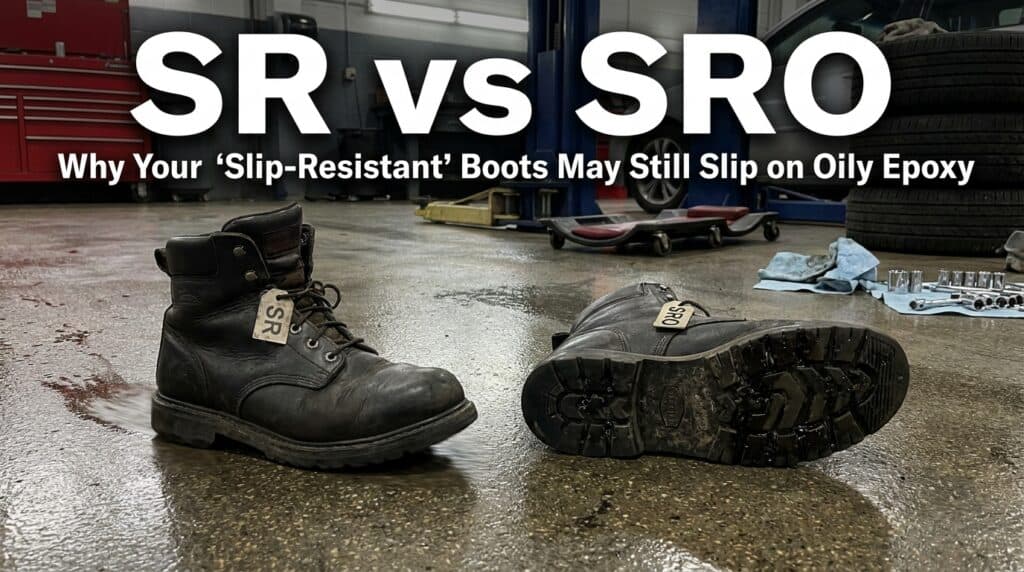
Every mechanic boot article says get oil-resistant slip-resistant outsoles. Almost none of them explains why this recommendation is more technically specific in 2026 than it was in 2022 — or why the boots on your shelf right now with "SR" ratings may have never been tested on the kind of surface you actually work on.
The old SR standard (F2413-18): Slip resistance was tested on a wet ceramic tile surface using a specific soap solution to create the slippery condition. This is an appropriate test for restaurant workers on wet kitchen tile. It is not an appropriate test for auto mechanics on oil-contaminated epoxy floors, which have fundamentally different surface chemistry, different friction coefficients, and different slip dynamics. A boot could earn SR certification under F2413-18 and still slip dangerously on the kind of floor that defines an auto shop.
The new SRO designation (F2413-24): The 2024 update to ASTM F2413 introduced a new designation — SRO, Slip Resistant Oil — specifically tested on lubricated surfaces using a standardised oil contamination protocol. A boot carrying the SRO marking has been tested on the type of surface that actually exists in your shop, not a wet restaurant tile. When you see SRO on a boot label, it means something specific and relevant to automotive work.
🔑 Practical 2026 Buying Guidance
When comparing boots: look for SRO in the certification marking. If a boot only shows SR (and was manufactured before 2024), it was tested on wet tile — not on the oily epoxy floor where you will actually wear it. Boots manufactured in 2025–2026 meeting F2413-24 with SRO have been specifically validated for the oil-slip environment mechanics face daily. This distinction is absent from every competitor article currently ranking for mechanic boot queries.
EH vs SD: The Electrical Protection That Mechanics Most Frequently Get Wrong
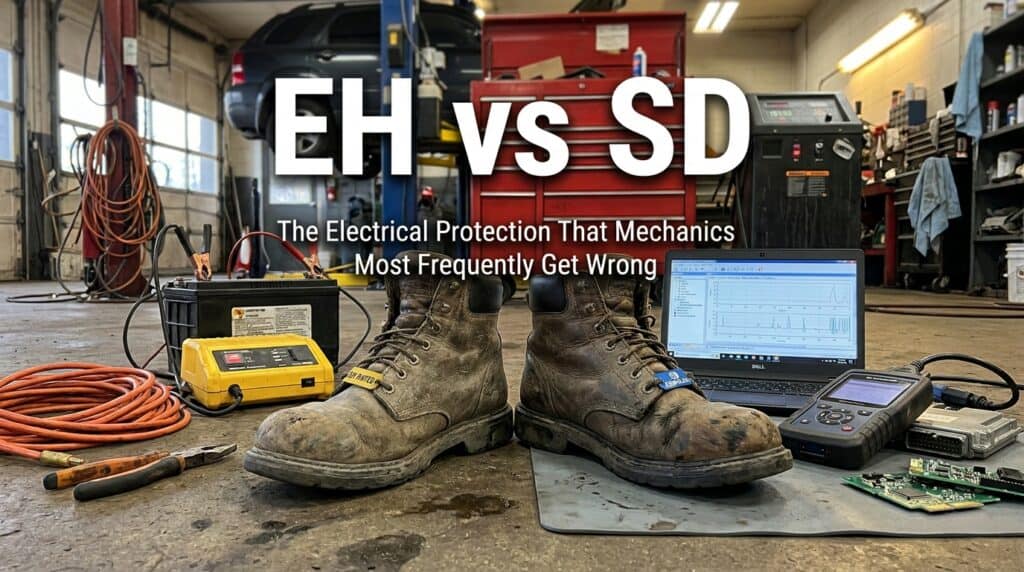
This is the most consequential safety knowledge gap for auto mechanics buying work boots. EH and SD are two different electrical protection mechanisms that are appropriate for two different hazard profiles — and confusing them puts mechanics at genuine risk.
EH (Electrical Hazard) — The Non-Conductive Boot
EH-rated boots have non-conductive soles that prevent current from flowing from the floor or a live circuit through the boot to the wearer's body. The ASTM standard tests at 18,000 volts at 60Hz for one minute, with maximum leakage of 1.0 milliamp. EH protection is correct for: battery work, ignition system servicing, working near live terminals, EV high-voltage system work, and any task near energised circuits.
Critical limitation: EH protection requires dry conditions. A wet EH boot becomes partially conductive. Additionally, EH boots prevent static discharge — static charge BUILDS on the body when wearing EH boots, because there is no path to ground. This is normally harmless. Near fuel vapour, it is a fire risk.
SD (Static-Dissipating / ESD) — The Controlled Conductor
SD or ESD boots have outsoles that allow static charge to drain from the body to the ground at a controlled rate, preventing dangerous static charge buildup. This is appropriate for: fuel system work (a static spark near open fuel tanks or fuel vapour can cause ignition), body shop spray paint environments (solvent vapour ignition risk from static discharge), airbag component handling (accidental static discharge can trigger airbag deployment — a documented automotive technician injury mechanism).
Critical limitation: SD boots conduct charge to ground. They must never be worn near live circuits or battery terminals — the controlled conductivity that drains static also conducts current from a live source through the boot to the wearer.
⚠️ The Wrong Boot for the Wrong Hazard
Using an EH boot while working on fuel systems near vapour: static builds on body → potential spark ignition → fire risk.
Using an SD boot while working on live battery terminals: current can flow through the controlled-conductive SD outsole → electric shock risk.
The practical recommendation for most automotive technicians: EH is the correct specification for general shop work because the consequences of live circuit contact exceed the consequences of static buildup in most shop environments. Body shop workers and mechanics who specifically do fuel system service should use SD-rated footwear for those tasks and implement supplemental grounding protocols (wrist straps) when working near live circuits.
Kneeling, Squatting, and Creeper Comfort: The Boot Geometry Nobody Discusses
An auto technician spends a fundamentally different proportion of their shift on their knees and in squatting positions than a construction worker or warehouse employee. A mechanic doing brake work kneels repeatedly beside each wheel. Under-vehicle work requires lying on a creeper with feet in various positions that no work boot guide has ever designed around. Climbing in and out of engine bays requires ankle flexion and toe-to-ground pressure that rigid welted boots resist.
The kneeling problem with traditional work boots: A stiff Goodyear-welted leather boot with a thick midsole applies concentrated pressure to the metatarsals when the mechanic kneels on a hard floor. The toe cap area presses against the floor surface and the metatarsal joints bear the load of the mechanic's body weight through a rigid platform. A flexible athletic-construction work boot with a thinner, more flexible forefoot allows the foot to flex toward the floor and distributes the kneeling pressure across more contact area. The difference across a 10-hour shift with multiple kneeling sessions is significant cumulative fatigue.
The creeper consideration: When lying on a creeper, boots contact the floor surface in a heel-down flat position for extended periods. A smooth-profile sole — wedge or flat — slides onto and off a creeper platform more easily than aggressive lug soles that catch on the creeper edge. For mechanics who get on and off creepers dozens of times per shift, this is not a minor detail.
The squatting consideration: Deep squats beside wheel wells require ankle flexion beyond what many traditional work boots allow. A lower, more flexible heel counter allows the ankle to flex freely; a stiff traditional boot fights the position and concentrates strain at the ankle throughout the squat.
The practical recommendation: for mechanics who spend significant shift time in kneeling, creeper, and squatting positions, an athletic-construction composite-toe work boot (Skechers Work, Timberland PRO Reaxion, Reebok Sublite) provides meaningfully better positional comfort than a traditional welt-constructed leather boot — even at lower price points.
Chemical Resistance by Fluid Type: What Auto Shop Chemicals Do to Boot Materials
| Chemical | Hazard Level | Effect on Boot Materials | Immediate Action if Contact |
|---|---|---|---|
| Engine oil / motor oil | Medium | Gradual softening of rubber; leather darkens. Manageable with oil-resistant outsole compound. | Wipe off; standard soap and water cleaning |
| DOT 3/4 brake fluid | HIGH | Glycol-based solvent — rapidly softens and degrades standard leather. Destroys most leather boot surfaces if allowed to soak. Degrades some rubber compounds. | Wipe immediately; rinse with water; do not allow to soak — acts within minutes on standard leather |
| Battery acid (H2SO4 30–40%) | VERY HIGH | Highly corrosive to leather, most rubber, and stitching thread. Neoprene and acid-resistant compounds resist; standard nitrile degrades rapidly. | Rinse immediately with water; neutralise with baking soda/water solution; replace boot if repeated exposure occurred |
| Coolant / antifreeze | Medium | Degrades some leather finishes and stitching thread with sustained exposure. Less aggressive than brake fluid. | Wipe and rinse with water; dry thoroughly |
| Brake cleaner / carb cleaner | HIGH | Aggressive ketone/chlorinated solvents — strip leather finishes instantly; swell some rubber compounds with direct contact. Evaporates fast but acts faster. | Rinse with water immediately — do not wipe, spreading solvent worsens penetration |
| Transmission fluid / ATF | Low | Petroleum-based, similar to motor oil. Standard oil-resistant outsole adequate. | Standard wipe and cleaning |
Mechanic Specialty Picker: Different Shops Need Different Boots
| Mechanic Type | Primary Hazard | Electrical Need | Best Pick |
|---|---|---|---|
| Auto technician (light vehicle) | Oily epoxy floor; dropped parts; battery work | EH | Wolverine Overpass CT WP |
| Diesel mechanic / fleet | Heavy falling components; outdoor terrain; fuel/chemical exposure | EH | KEEN Utility Flint II WP ST |
| Body shop worker | Static spark near spray paint vapour; solvent chemical exposure | SD/ESD | KEEN Utility Atlanta Cool 2 ESD |
| Lube tech / quick service | Oil-saturated floor; high pace; overhead oil drops | EH | Timberland PRO Reaxion CT (lightweight, mobile) |
| Heavy equipment mechanic | Heaviest components; outdoor/mixed terrain; high electrical | EH | KEEN Utility Flint II WP ST or Carhartt Rugged Flex CT WP |
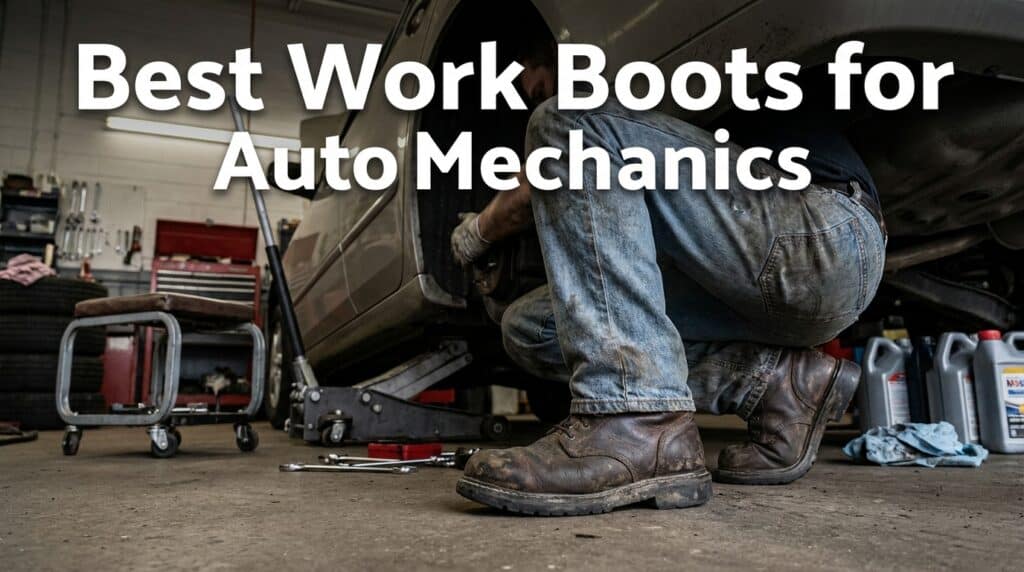
Best Overall / Light Vehicle Tech: Wolverine Overpass 6" Composite Toe Waterproof

TheFootFacts named the Wolverine Overpass their top waterproof mechanic boot pick in their April 2026 tested guide — and the combination of certifications and construction explains why. For the automotive technician who needs the complete spec stack in a single daily boot, the Overpass delivers: composite toe carries ASTM F2413 I/75 C/75 impact and compression certification; EH rating provides non-conductive protection for the battery and ignition work that occupies most auto technicians' days; contour welt construction provides durability and structural integrity beyond athletic cement construction; and the waterproof upper handles the coolant spills, oil contamination, and washdown conditions of an active service bay. The slip-resistant outsole compound targets the oil-contaminated shop floor that is the mechanic's primary daily traction challenge.

The composite toe is the correct specification for most auto technicians for two reasons specific to shop environments. First, composite toes are thermally non-conductive — in a shop where steel components heat up in summer and cool down in winter, a steel toe absorbs ambient temperature and transmits it to the toe box throughout the day. Second, composite is non-metallic — for technicians who work at facilities with metal detector access control (fleet yards, government facilities, some dealerships), a composite toe passes without triggering access delays. Impact protection is identical to steel at the same ASTM I/75 C/75 rating. The Contour Welt construction provides the waterproof sealing and structural durability of a welted boot without the weight penalty of full Goodyear welt construction — a meaningful advantage for a technician who is on their feet and moving across bays for 10 hours.
Anti-fatigue technology addresses the specific fatigue pattern of shop floor work — the Wolverine's midsole system provides energy return and cushioning for the dynamic movement pattern of bay work (not just sustained standing). Break-in is moderate for a leather upper — plan 5–10 hours before full-shift use. Sizing: Wolverine typically runs true to size; if between sizes, size up for toe clearance on long shifts as feet swell through the day.
Shop Specs
Toe: Composite — ASTM F2413 I/75 C/75 (non-metallic, thermally non-conductive) | EH/SD: EH rated
Waterproof: ✅ Yes | Construction: Contour welt | Break-in: 5–10 hours
Specialty: Auto technician (light vehicle), general shop work
✅ Best for: Auto techs needing complete certification stack in one daily boot
Pros: TheFootFacts top waterproof mechanic pick 2026; composite toe (thermally non-conductive, passes detectors); EH rated; waterproof for coolant/oil spills; anti-fatigue midsole for long shop shifts.
Cons: 5–10 hour leather break-in; premium price; not SD-rated — not for body shop paint spray or fuel system primary work.
Best ESD / Body Shop / Fuel Systems: KEEN Utility Atlanta Cool 2 ESD Steel Toe
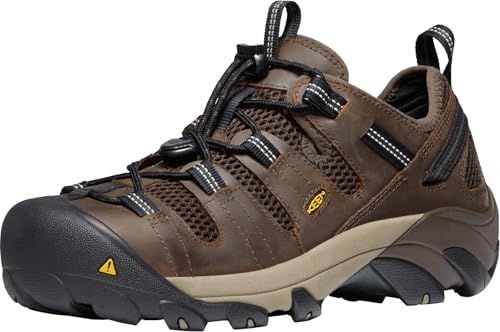
The KEEN Utility Atlanta Cool 2 ESD is the correct pick for the mechanic whose primary electrical hazard is static discharge rather than live current contact — the body shop painter, the fuel system technician, the mechanic who regularly handles airbag components. ESD (Electrostatic Discharge) is KEEN's designation for what ASTM calls SD (Static-Dissipating): the outsole allows static charge to drain from the body to the ground at a controlled rate, preventing the dangerous static accumulation that creates spark ignition risk near fuel vapour and solvent-based spray paint. As explained in the EH vs SD section: this is the opposite protection mechanism from EH, and choosing EH instead of ESD for body shop work creates the exact static buildup that ESD is designed to prevent.

The steel toe provides ASTM F2413 I/75 C/75 impact and compression protection. KEEN's asymmetric wide toe box is the defining fit characteristic of the Atlanta Cool line — the toe box is shaped to accommodate the natural spread of the foot rather than compressing toes toward a conventional narrowed point, which is specifically beneficial for mechanics who stand on hard floors for long shifts as feet swell into the afternoon. The "Cool" designation in the name reflects a specific design choice for indoor shop environments: the non-waterproof upper with breathable mesh allows air circulation that sealed boots prevent — for body shop workers in warm indoor environments, breathability prevents the swamp-foot condition that creates blister risk on long shifts.

The non-waterproof construction is worth addressing explicitly: for body shop environments where water exposure is minimal and breathability matters more than waterproofing, this is the correct trade-off. For mechanics in wet bays or washdown environments, the Carhartt Rugged Flex (Pick 07) with waterproofing is the appropriate alternative. The Atlanta Cool 2's non-slip outsole provides adequate traction on the smooth painted concrete of body shop floors. ESD compliance for electronics environments (shops servicing hybrid and EV systems with sensitive electronic control units) is also addressed by the ESD designation.

Shop Specs
Toe: Steel — ASTM F2413 I/75 C/75 | EH/SD: ESD / SD (static-dissipating — NOT EH)
Waterproof: ❌ Non-WP mesh — maximum breathability for indoor shop heat | Toe box: KEEN asymmetric wide
Specialty: Body shop painters · Fuel system techs · EV electronics work · Airbag component handling
⚠️ Do NOT use near live battery terminals or live circuits — SD conducts current
Pros: ESD/SD rating — correct specification for static discharge risk (body shop, fuel systems); KEEN asymmetric wide toe box for afternoon swelling accommodation; breathable for warm indoor shop environments; steel toe ASTM certified.
Cons: NOT for live circuit work — SD is wrong specification for battery/ignition adjacent tasks; non-waterproof — not for wet bays; steel toe conducts ambient temperature.
Best Lightweight / Lube Tech / Maximum Mobility: Timberland PRO Men's Reaxion Composite Toe

TheFootFacts specifically notes "weight and mobility: lighter builds help during constant in/out of bays and lift steps" as a primary mechanic boot consideration — and the Timberland PRO Reaxion is the product that delivers on this most directly. The athletic cement construction uses zero break-in material from day one: no leather stiffening, no collar hardening, no welt rigidity. A mechanic who picks up the Reaxion at the beginning of their shift is wearing the same comfortable boot at hour ten that they wore at hour one. This is the specific advantage of athletic construction for the lube tech and quick-service mechanic whose work involves constant movement between service bays, vehicles, and service counters — not the sustained heavy-lifting environments where traditional boot construction provides a protective advantage that justifies its break-in cost.

The composite toe is ASTM F2413 certified and EH rated — the correct electrical specification for the battery, charging, and ignition system proximity that even lube tech work involves. The Anti-Fatigue Technology midsole is Timberland PRO's specific energy-return system — a geometric TPR (thermoplastic rubber) compound underfoot that absorbs impact energy and returns a portion of it with each step. For a lube tech covering significant daily mileage between service bays and the service counter, this midsole characteristic reduces end-of-day fatigue measurably compared to flat foam alternatives. The non-waterproof mesh upper is the breathability choice — shop heat accumulation is a fatigue factor that sealed waterproof boots amplify unnecessarily in dry indoor bay environments.

The Reaxion is also the correct boot for mechanics who have found that traditional leather work boots create the kneeling discomfort discussed earlier in this guide. The athletic construction's flexible forefoot and thinner midsole profile distributes kneeling pressure more evenly than a rigid welted construction. For any mechanic who regularly works on creepers or spends significant shift time in kneeling positions, the Reaxion's construction type is specifically appropriate. No break-in. Immediate use. Sizing: true to standard size.

Shop Specs
Toe: Composite — ASTM F2413 (non-metallic, EH rated) | EH/SD: EH rated
Waterproof: ❌ Non-WP mesh — maximum breathability for shop heat | Break-in: Zero — immediate comfort
Midsole: Anti-Fatigue Technology (TPR energy return) | Weight: Lightest in guide
Specialty: Lube tech · Quick service · High-mobility shop roles · Kneeling/creeper work
Pros: Zero break-in — immediate all-day comfort; lightest and most mobile boot in guide; Anti-Fatigue Technology midsole for high-step-count shop roles; composite toe EH rated; flexible forefoot for kneeling/creeper comfort.
Cons: Non-waterproof — not for wet bays or coolant-heavy environments; lighter construction provides less chemical resistance than leather alternatives; athletic build less durable under heavy impact/abrasion.
Best Diesel / Heavy Equipment Mechanic: KEEN Utility Flint II 6" Waterproof Steel Toe
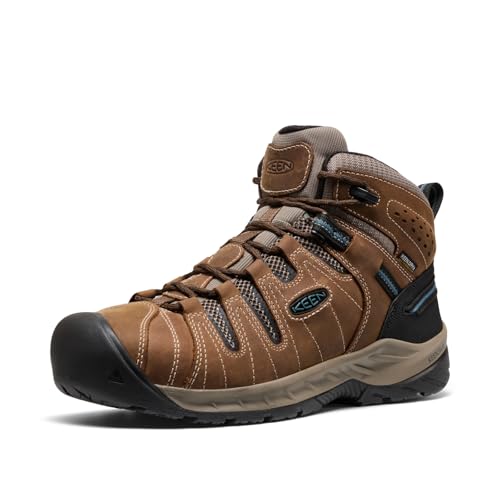
Diesel mechanics and heavy equipment technicians face a measurably different physical hazard profile from light vehicle auto techs: heavier falling components (engine blocks, differential housings, transmission assemblies that dwarf automotive equivalents), more significant outdoor and mixed terrain exposure (fleet yards, construction sites, outdoor equipment parks), greater fuel exposure risk with bulk diesel systems, and higher electrical system voltages on large commercial equipment. The KEEN Utility Flint II 6" WP addresses this hazard profile with a steel toe at the top of the ASTM F2413 I/75 C/75 impact and compression certification — the same protection level as composite but with steel's higher intrinsic impact resistance that experienced heavy equipment mechanics prefer for the largest falling components. EH rated. KEEN.DRY waterproofing for the outdoor mixed-terrain conditions that fleet and equipment work regularly involves.

KEEN's asymmetric toe box geometry — the widest toe box profile in the KEEN Utility work line — accommodates the wide-forefoot male foot that represents a significant portion of the diesel mechanic demographic. The defined rubber heel edge provides stability on equipment steps, ladder rungs, and uneven outdoor surfaces that auto shop mechanics rarely encounter but diesel and fleet mechanics navigate daily. The 6" lace-up construction provides ankle lockdown for terrain work and equipment climbing — a practical advantage over pull-on designs when the mechanic is navigating uneven outdoor service areas and climbing onto large equipment. The outsole provides traction on the mix of wet concrete, gravel, and soil that outdoor fleet servicing involves.

For EV and hybrid vehicle work specifically: diesel mechanics increasingly service fleet vehicles with high-voltage electrical systems. The EH rating on the Flint II is the correct specification for this transition — providing insulation against the higher voltages that fleet hybrid and EV systems carry compared to standard automotive 12V systems. The 6" lace-up also provides better ankle support for working around large commercial vehicles where trip and fall risk from uneven surfaces is higher than in a finished shop floor environment. Break-in: 10–15 hours for full-grain leather and lace-up construction.

Shop Specs
Toe: Steel — ASTM F2413 I/75 C/75 | EH/SD: EH rated
Waterproof: ✅ KEEN.DRY — for outdoor fleet servicing | Toe box: KEEN asymmetric wide
Construction: 6" lace-up — ankle support for outdoor terrain and equipment climbing | Break-in: 10–15 hours
Specialty: Diesel mechanics · Fleet technicians · Heavy equipment · Outdoor service environments
Pros: Steel toe for maximum impact resistance with heavy components; EH rated for high-voltage fleet EV/hybrid systems; KEEN.DRY waterproof for outdoor fleet environments; KEEN wide toe box; lace-up ankle support for terrain work.
Cons: 10–15 hour break-in; steel toe conducts cold in winter outdoor fleet environments; lace-up slower than pull-on for frequent boot removal; heavier than composite alternatives.
Best Kneeling / Creeper Comfort: Skechers Work Arch Fit SR Composite Toe
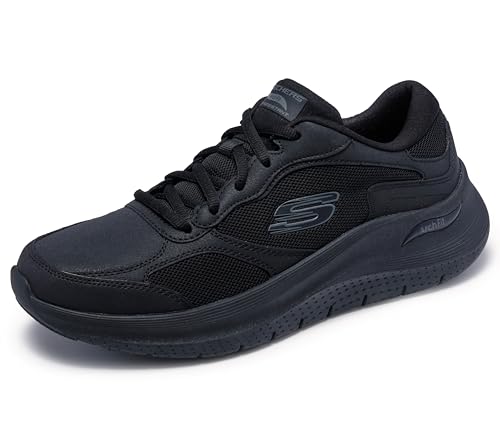
The Skechers Work Arch Fit is the product that most directly solves the kneeling geometry problem identified in this guide's buyer science section. The athletic cement construction's flexible forefoot — specifically absent of the rigid welt or midsole board that traditional work boots use — allows the boot to flex toward the floor when the mechanic kneels, distributing body weight across more contact area rather than concentrating it on the metatarsal heads. For mechanics who do repeated brake jobs, under-vehicle work, and creeper-based service, this positional comfort characteristic reduces the cumulative fatigue that rigid-boot kneeling creates across a long shift. The Arch Fit insole system is Skechers' podiatrist-certified arch support platform — immediate out-of-box comfort with no break-in period required.

The composite toe is ASTM F2413 certified and EH rated — providing the electrical hazard protection that battery and ignition system work requires, in the non-metallic format that is correct for mechanics working near metal detector access points. The slip-resistant outsole targets the oily floor conditions of service bay work. At approximately $95, the Skechers Work Arch Fit is the most accessible EH-rated composite toe option in this guide — appropriate as a primary boot for mechanics who want to test whether athletic construction works for their feet before investing in premium alternatives, or as a dedicated "creeper and kneeling" boot alongside a heavier construction primary boot.

The honest service life note: cement construction athletic work boots typically deliver 10–14 months of daily heavy work use before midsole compression and outsole wear require replacement. For mechanics who wear boots 250+ days per year under the chemical and physical demands of shop work, this is a shorter service life than welted leather alternatives. The Arch Fit's lower upfront cost partially offsets the replacement frequency — but mechanics who want the longest service life per dollar should consider the Wolverine Overpass or Carhartt Rugged Flex for their primary boot and use the Skechers specifically for high-kneeling work days. No break-in required — wear immediately on first use.

Shop Specs
Toe: Composite — ASTM F2413 (EH rated) | EH/SD: EH rated
Construction: Athletic cement — flexible forefoot for kneeling comfort | Break-in: Zero
Insole: Arch Fit (podiatrist-certified) | Price: Most affordable EH composite in guide
Specialty: High-kneeling / creeper work · Brake techs · Under-vehicle specialists
Pros: Best kneeling comfort in guide — flexible forefoot distributes pressure correctly; Arch Fit podiatrist-certified insole; zero break-in; composite EH rated; most affordable safety-certified option in guide.
Cons: 10–14 month service life under heavy daily use (cement construction); not waterproof; less chemical resistance than leather alternatives.
Best Budget / Soft Toe Option: EVER BOOTS Tank Men's Full-Grain Leather Work Boot
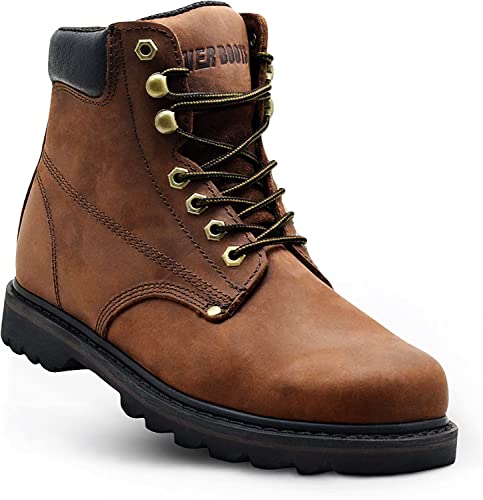
DecentFoot named the EVER BOOTS Tank their top mechanic boot pick — and at under $65, it earns that position for a specific buyer profile: the mechanic who works in an environment where soft toe is permitted by OSHA assessment, wants genuine full-grain leather for durability and chemical resistance, and is operating on a budget that makes $130–$165 for a premium certified boot a prohibitive barrier. The Tank uses full-grain leather construction with an oil-resistant rubber outsole — the two core material specifications that a mechanic's boot needs for basic shop floor durability. The Goodyear welt construction is unusual at this price point and provides better structural integrity and durability than the cement construction that most budget work boots use.

The mandatory disclosure for the EVER BOOTS Tank in a mechanic context: it carries no ASTM F2413 safety toe certification. There is no steel, composite, or alloy toe cap. OSHA 29 CFR 1910.136 requires that employers assess foot hazard risk and provide certified protective footwear where the hazard assessment identifies risks from falling objects. In most automotive service environments, a safety toe is required or strongly recommended. The Tank is the correct choice only for mechanics whose specific work environment has been assessed as not requiring a safety toe — typically mechanics in roles without vehicle-lifting equipment, overhead heavy component handling, or significant falling object risk. If in doubt about your shop's OSHA requirements, choose a certified safety toe boot.

Where the Tank genuinely works: auto shops where management has assessed specific positions as not requiring ASTM toe protection; mechanics who want a backup or second pair for specific tasks; technicians in service advisor or parts counter roles who occasionally enter the shop. The full-grain leather provides reasonable chemical resistance and is conditionable — maintenance extends service life beyond what budget synthetic alternatives offer. The Goodyear welt allows resoling when the outsole wears, which is rare at this price tier but technically possible. Oil-resistant outsole for shop floor grip. Break-in: 10–20 hours for full-grain leather welt construction.

⚠️ Safety Toe Warning
The EVER BOOTS Tank has NO safety toe certification. Before choosing this boot, confirm with your shop's safety officer that your specific role does not require ASTM F2413 safety toe protection under your employer's OSHA hazard assessment. Most automotive service positions require a safety toe — if in any doubt, choose a certified boot from elsewhere in this guide.
Shop Specs
Toe: ❌ Soft toe — no ASTM F2413 certification | EH/SD: None
Construction: Goodyear welt — unusual at this price | Upper: Full-grain leather
Price: ~$65 — lowest in guide | Break-in: 10–20 hours
Specialty: Non-safety-toe permitted roles only — confirm OSHA compliance before choosing
Pros: Lowest price in guide; Goodyear welt construction unusual at budget price; full-grain leather for reasonable chemical resistance; oil-resistant outsole; resoleable in principle.
Cons: No safety toe certification — OSHA non-compliant for most automotive service positions; no EH or SD; 10–20 hour break-in for welt leather.
Best Waterproof / Washdown Bay: Carhartt Men's Rugged Flex 6" Waterproof Composite Toe

For mechanics who regularly work in washdown bays, undercarriage cleaning stations, or shops where pressure washing of vehicles and floors is routine, waterproofing is not optional — and the Carhartt Rugged Flex 6" WP CT is the most complete waterproof package at its price point in this guide. The sealed waterproof construction handles sustained water exposure that would penetrate water-resistant but non-waterproof alternatives within minutes. The Rugged Flex EVA midsole is the specifically appropriate construction for mechanic work: flexible, not rigid — allowing the forefoot to flex naturally during kneeling and squatting without the midsole resistance that a stiffer platform creates. For a shop where waterproofing is the non-negotiable requirement but kneeling comfort also matters, the Rugged Flex provides both.

The composite toe provides ASTM F2413 I/75 C/75 certification in a non-metallic format — thermally non-conductive for shop environments where ambient temperature matters, and EH rated for battery and ignition system work. Carhartt's leather on the Rugged Flex line is specifically treated for chemical resistance beyond standard leather — relevant for the brake fluid, coolant, and oil contamination that washed-down mechanics encounter daily. The Rugged Flex earned its name from the engineered stretch panels in the leather that reduce the break-in period significantly compared to traditional full-grain leather work boots — a meaningful advantage for mechanics who cannot afford several painful days of leather break-in during a demanding service schedule.

The oil-resistant outsole provides shop floor traction on the wet surfaces that washdown bay mechanics encounter — wet epoxy and wet concrete after pressure washing create slip conditions that the Rugged Flex's outsole compound is specifically formulated to handle. 6" height provides adequate coverage for splash and spray without the bulk of taller boot designs that restrict ankle mobility for active shop work. Break-in: 5–8 hours — faster than traditional welt leather due to the Rugged Flex engineered stretch panels. Sizing: Carhartt typically runs true to size; size up 0.5 if you have wide feet.

Shop Specs
Toe: Composite — ASTM F2413 I/75 C/75 (non-metallic) | EH/SD: EH rated
Waterproof: ✅ Full sealed construction — washdown bay rated | Midsole: Rugged Flex EVA (flexible for kneeling)
Break-in: 5–8 hours (faster than traditional leather) | Specialty: Washdown bays · Coolant-heavy shops · Wet floor environments
Pros: Full waterproof construction for washdown bays and wet floor shops; Rugged Flex EVA for flexible kneeling comfort; composite EH rated; chemical-treated leather for oil/coolant resistance; faster break-in than traditional leather via engineered stretch panels.
Cons: 5–8 hour break-in (faster than traditional, still requires planning); heavier than athletic alternatives; not SD-rated for body shop use.
Best Wide Feet / Athletic Shoe Style: New Balance Quikshift Composite Toe
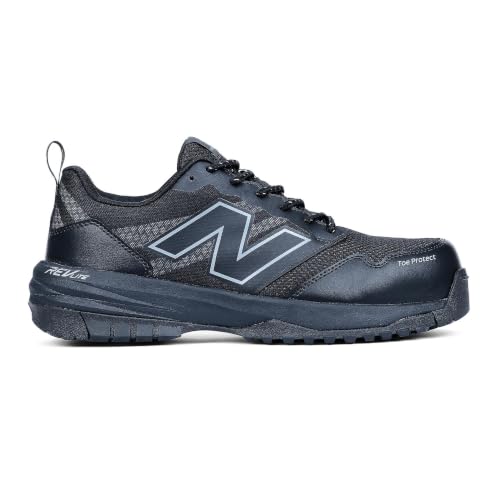
The New Balance 627 v2 is the answer for two specific mechanic profiles: the technician with genuinely wide feet who has failed to find a comfortable certified work boot in standard widths, and the mechanic who specifically does not want a boot silhouette and insists on the athletic shoe format they wear outside of work. The 627 v2 is available in 2E (wide) and 4E (extra wide) sizing — a width range that is genuinely uncommon in the safety toe category and directly addresses the wide-foot afternoon swelling problem that active shop work creates. The ROLLBAR stability post in the midsole provides arch and overpronation support that traditional flat-bottom work boots do not — relevant for mechanics with flat feet or mild overpronation who have found that work boots aggravate their foot mechanics.

The composite toe provides ASTM F2413 impact and compression certification. The slip-resistant outsole is formulated for the mixed surfaces of shop work — the same manufacturing attention to industrial floor traction that New Balance applies to their wider industrial footwear line. The athletic shoe construction means zero break-in — the New Balance 627 v2 fits and feels like an athletic shoe from the first minute of the first shift, which is particularly important for mechanics who experience the painful leather break-in period as a significant barrier to changing footwear.

Honest limitation: the athletic shoe silhouette provides less chemical resistance and less structural upper protection than leather work boots. The mesh and synthetic upper materials are more vulnerable to brake fluid penetration and spray solvent contact than full-grain leather alternatives. For mechanics whose chemical exposure is primarily motor oil and coolant — the most manageable shop chemicals — the New Balance upper handles routine exposure adequately. For mechanics who regularly do brake work or battery service with frequent chemical contact, a leather-upper boot provides better protection. No EH or SD rating on the standard 627 v2 — verify whether your work environment requires electrical hazard rating before purchasing.

Shop Specs
Toe: Steel — ASTM F2413 I/75 C/75 | EH/SD: Verify on specific model — confirm before purchase
Width available: Standard, 2E (wide), 4E (extra wide) | ROLLBAR: Stability post for arch/overpronation support
Break-in: Zero — athletic shoe immediate comfort | Specialty: Wide feet · Athletic shoe preference · Overpronation support need
Pros: Best wide width selection in guide (2E, 4E available); ROLLBAR stability for overpronation; athletic shoe comfort from first use; New Balance brand construction quality; ASTM composite toe certified.
Cons: Athletic mesh/synthetic upper less chemical resistant than leather; verify EH/SD rating before purchasing for electrical hazard environments; composite toe doesn't conduct cold like steel.
Best Women's Mechanic Boot: Reebok Work Women's Sublite Cushion Composite Toe

Women are a growing segment of the automotive service industry — and a segment that most mechanic boot guides address with a footnote or ignore entirely. The Reebok Work Women's Sublite Cushion brings serious safety certification to a boot built on a women's-specific last: not a men's boot in smaller sizes, but a boot with the narrower heel cup, forward arch positioning, and appropriate toe box geometry for women's foot anatomy. The composite toe is ASTM F2413 certified for impact and compression protection. EH rated for the battery, charging, and ignition system work that all auto technicians — regardless of gender — encounter. The Sublite Cushion midsole provides Reebok's lightweight cushioning technology in a platform that maintains comfort across a 10-hour shop shift.

The athletic construction is specifically appropriate for women mechanics for the same reasons outlined in the kneeling/creeper section: flexible forefoot for positional work, immediate comfort without break-in, and a lighter weight than leather work boots that accumulates into measurable fatigue reduction over a long shift. Women mechanics who have worn men's boots in smaller sizes consistently report heel slippage — the wider men's heel cup leaves excess volume that creates friction and blisters across a long shift. The Reebok Sublite's women's-specific last addresses this directly. EH rated. Slip-resistant outsole for shop floor safety.

The January 2025 OSHA update to 29 CFR 1926.95(c) explicitly requires that PPE — including safety footwear — must properly fit each employee. A women's auto technician wearing a men's boot in a smaller size that causes heel slippage may not be meeting the regulatory fit standard even if the boot carries ASTM certifications. The Reebok Women's Sublite provides the fit compliance alongside the safety certification — the correct specification for women mechanics in OSHA-regulated environments. No break-in required. Multiple colour options. Sizing: true to women's shoe sizing.

Shop Specs
Toe: Composite — ASTM F2413 I/75 C/75 (non-metallic) | EH/SD: EH rated
Last: Women's-specific — proper heel lockdown, forward arch position | Break-in: Zero
OSHA 2025: ✅ Women's last meets PPE fit compliance requirement | Specialty: Women auto technicians — all specialties
Pros: Women's-specific last — OSHA 2025 PPE-fit compliant; composite EH rated; Sublite cushion for all-day comfort; athletic flexibility for kneeling/creeper work; zero break-in; genuinely addresses women mechanics rather than recommending "men's in smaller sizes."
Cons: Athletic upper less chemically resistant than leather for high brake-fluid/battery-acid exposure; not waterproof — not for wet washdown environments.
Boot Care for Auto Shop Chemicals: The Maintenance Protocol Mechanics Need
Brake fluid (DOT 3/4) — the most urgent response: If brake fluid contacts your leather work boot, wipe immediately with a clean dry rag and then rinse the area with water. Brake fluid is a glycol-based solvent that penetrates standard leather within minutes and begins softening the surface layer. Leaving brake fluid on leather overnight will measurably degrade the leather surface. For synthetic upper boots, the penetration risk is lower but immediate wiping is still recommended. After cleaning, apply leather conditioner to any brake fluid-contacted area within 24 hours to restore surface integrity.
Battery acid — neutralise before cleaning: Rinse immediately with water, then apply a baking soda/water solution (one tablespoon of baking soda in a cup of water) to neutralise the remaining acid. The baking soda fizzing confirms that acid is present and being neutralised. Rinse again after the fizzing stops. Never use a dry rag to wipe battery acid — the rag will spread the acid further into the upper material. Replace boots that have experienced repeated battery acid contact regardless of apparent condition — the structural degradation to stitching and rubber is often not visible until the boot fails structurally.
Spray solvents (brake cleaner, carb cleaner) — dilute, don't wipe: If spray solvent contacts the boot upper, rinse with water immediately — do not wipe with a dry rag, which spreads the solvent into the leather rather than removing it. The solvents evaporate quickly but act quickly too. The goal is dilution and removal, not spreading and absorption.
General shop maintenance: Wipe boots with a damp cloth at the end of each shift — oil and chemical contamination that is removed fresh does not have time to penetrate and degrade material. Condition leather boots every 3–4 weeks in shop environments (more frequently than the standard 6–8 week recommendation for non-shop use, because chemical exposure accelerates moisture loss from leather). Replace laces every 2–3 months — laces absorb petroleum products and become slippery at the lacing hardware, creating an unexpected slip hazard at the boot's own fastening points.
FAQ — 8 Mechanic Work Boot Questions Answered
What work boots do auto mechanics need?
The core specification for most auto mechanics: ASTM F2413-certified safety toe (composite preferred for thermal non-conductivity and metal detector compatibility), EH rating for battery and ignition system work, slip-resistant outsole ideally with SRO certification for oily epoxy shop floors, and anti-fatigue midsole for long shifts. Waterproofing is important for washdown bays; not required for dry shop environments where breathability may be more valuable. Body shop workers and fuel system techs need SD/ESD rating instead of EH for their primary electrical hazard.
Should mechanics wear steel toe or composite toe boots?
Composite toe is preferred for most auto mechanics for three reasons specific to shop environments: it is thermally non-conductive (does not absorb heat or cold from ambient shop conditions), non-metallic (passes metal detector access control at fleet yards and government facilities), and lighter than steel at the same ASTM I/75 C/75 protection rating. Diesel mechanics and heavy equipment techs handling the heaviest falling components sometimes prefer steel for its higher intrinsic material hardness, but the protection rating is identical at ASTM I/75 C/75.
Do auto mechanics need EH-rated boots?
Yes — for most automotive service roles. Battery work, ignition system servicing, hybrid/EV high-voltage system work, and working near charging equipment all present electrical hazard risk that EH-rated footwear mitigates. Exception: body shop workers and fuel system specialists whose primary electrical hazard is static discharge (fire ignition risk) need SD/ESD-rated footwear instead of EH — the two are different mechanisms appropriate for different hazards.
What is the difference between EH and static-dissipating boots for mechanics?
EH (Electrical Hazard): non-conductive boot prevents current flow from live circuits through the boot. Correct for battery work, ignition systems, live terminal proximity. SD/ESD (Static-Dissipating): controlled-conductive boot allows static charge to drain safely to ground, preventing static buildup. Correct for fuel system work, body shop spray painting, airbag component handling. The two are mutually exclusive for practical purposes — using EH near fuel vapour allows static to build (fire risk); using SD near live circuits allows current flow (shock risk). Know your primary hazard before selecting electrical protection type.
Why do my slip-resistant boots still slip on the shop floor?
Almost certainly because your boots carry the old SR rating tested on wet ceramic tile, not the new SRO rating tested on oily surfaces. The ASTM F2413-24 update introduced SRO (Slip Resistant Oil) specifically tested on lubricated surfaces — the type of surface an auto shop floor presents. SR-rated boots were never tested on oily epoxy and may provide inadequate traction on it despite carrying the slip-resistant certification. When replacing boots, look specifically for SRO in the certification marking, not just SR.
What is ASTM F2413-24 and does it matter for mechanic boots?
ASTM F2413-24 is the 2024 update to the safety footwear standard, replacing the previous F2413-18. For mechanics, the most significant change is the introduction of the SRO (Slip Resistant Oil) designation — specifically tested on oily surfaces rather than just wet tile. Boots certified under F2413-24 with SRO have been validated on the type of floor that actually exists in auto shops. Any article or product listing citing only "F2413-18" is referencing the outdated standard that predates the SRO test.
What boots are most comfortable for kneeling on a creeper?
Athletic-construction work boots with flexible forefronts are specifically more comfortable for kneeling than traditional Goodyear-welted leather work boots. The rigid welt and midsole board in traditional boots concentrates pressure on the metatarsals when kneeling. The flexible forefoot of athletic construction boots allows the boot to conform toward the floor and distribute pressure more evenly. The Skechers Work Arch Fit and Timberland PRO Reaxion are the best picks in this guide specifically for creeper and kneeling comfort.
How do I protect my work boots from brake fluid and battery acid?
Brake fluid: wipe immediately with a dry rag, then rinse with water — brake fluid penetrates leather within minutes if left in contact. Battery acid: rinse immediately with water, then apply a baking soda/water solution to neutralise remaining acid, then rinse again. For both: never dry-wipe without rinsing — wiping spreads the chemical further. Condition leather boots within 24 hours of any chemical contact. Consider synthetic-upper boots (Timberland PRO Reaxion, Skechers Arch Fit) for roles with frequent brake fluid and battery acid exposure — synthetic uppers are more resistant to these specific chemicals than standard leather.
Final Verdict: Best Work Boot by Mechanic Type
Mechanic Type → Best Boot
Auto technician (light vehicle, general shop): Wolverine Overpass 6" CT WP — complete certification stack, composite EH, waterproof, anti-fatigue, TheFootFacts top pick 2026
Body shop worker / fuel system tech (SD/ESD required): KEEN Utility Atlanta Cool 2 ESD — SD/ESD rated (static-dissipating), wide toe box, breathable indoor shop
Lube tech / quick service / high-mobility shop: Timberland PRO Reaxion CT — lightest and most mobile, zero break-in, Anti-Fatigue Technology, EH rated
Diesel mechanic / heavy equipment / fleet: KEEN Utility Flint II 6" WP ST — steel toe for heavy components, KEEN.DRY waterproof, EH, wide toe box, outdoor terrain
High-kneeling / creeper-intensive work: Skechers Work Arch Fit SR CT — flexible forefoot for kneeling comfort, Arch Fit insole, zero break-in, most affordable certified option
Soft-toe permitted / budget (confirm OSHA compliance first): EVER BOOTS Tank — full-grain leather, Goodyear welt, oil-resistant outsole, lowest price in guide
Washdown bay / wet floor shop / coolant-heavy: Carhartt Rugged Flex 6" CT WP — full waterproof, Rugged Flex EVA flexible midsole, composite EH, chemical-treated leather
Wide feet / athletic shoe preference: New Balance 627 v2 Industrial ST — 2E/4E widths available, ROLLBAR stability, athletic shoe comfort, steel toe certified
Women auto technicians (all specialties): Reebok Work Women's Sublite CT — women's-specific last (OSHA 2025 PPE-fit compliant), composite EH, zero break-in, athletic kneeling comfort
The mechanic's boot is a precision tool, not a generic safety box to tick. The EH vs SD distinction matters for specific hazards. The SRO certification matters for specific floors. The construction type matters for specific positions. Get those three right for your specific shop environment and you have selected a boot that actively improves your safety and comfort, not just one that meets a minimum standard.