
Hunting boots make sweaty feet worse for a simple reason: they combine waterproof membranes, thick rubber, neoprene, and insulation with hours of activity, and none of that is built for airflow. The result is a cycle every hunter knows. Your feet sweat during the walk in, your socks go damp, friction starts a hotspot, and then the moment you sit down to glass or wait on a stand, those same wet feet go cold fast.
The fix isn’t a warmer boot or a thicker sock. It’s matching your footwear to the hunt, running a real moisture-management sock system, changing socks at the right moment, and drying your boots completely between hunts. Sweating hard on a steep walk in is normal. If you’re soaking through boots at rest with no exertion at all, that’s a different problem, and this guide covers the practical footwear side, not a diagnosis of hyperhidrosis or a skin condition.
⚡ Quick Answer — The 60-Second Sweaty-Feet Fix
Wear moisture-wicking merino or synthetic socks instead of cotton, drop to uninsulated or lightly insulated boots when you’re moving hard, carry a dry spare pair of socks, change them before you sit, and dry your boots fully overnight with airflow, not direct heat. If sweating is unusually heavy even at rest, a foot-specific antiperspirant applied to dry skin at night may help.
| Problem | Best First Fix | Product Type |
|---|---|---|
| Feet sweat during the walk in | Drop insulation, switch to moisture-wicking socks | Uninsulated boot, merino sock |
| Socks soaked by mid-morning | Carry a spare pair, change mid-hunt | Merino socks, dry bag |
| Rubber boots feel swampy | Thin liner plus a midweight outer sock | Liner sock, merino outer sock |
| Feet get cold after sweating | Change into dry socks before stationary time | Spare dry socks, boot dryer |
| Boots smell after multi-day hunts | Dry liners and insoles fully between days | Low-heat boot dryer |
| Sweating even at rest | Foot antiperspirant, see a clinician if it persists | Antiperspirant lotion |
Table of Contents
- Why Hunting Boots Make Feet Sweat
- Fix #1: Stop Overdressing Your Feet
- Fix #2: Never Wear Cotton Socks
- Fix #3: Carry a Spare Pair and Change at the Right Time
- Fix #4: Use a Liner Sock Correctly
- Fix #5: Foot Antiperspirant for Heavy Sweating
- Fix #6: Foot Powder, Used Right
- Fix #7: Dry Boots and Insoles Fully
- Fix #8: Manage the Insole Separately
- Fix #9: Match the Boot to the Hunt
- Fix #10: Adjust Lacing and Fit
- Fix #11: Sweat, Odor, or Something Medical?
- The Moisture-Management Kit
- FAQ
- Final Verdict
Why Hunting Boots Make Feet Sweat
| Cause | Why It Creates Sweat | Most Common Situation |
|---|---|---|
| Too much insulation | Traps body heat during movement | 400g-1200g boots on an active early-season hunt |
| Rubber or neoprene construction | Fully waterproof but low ventilation | Wet whitetail, swamp, and food-plot hunting |
| Waterproof membrane | Blocks water from outside, but still limits airflow versus a non-waterproof boot | Long, warm hikes in a GORE-TEX-style boot |
| Thick socks in a tight boot | Compresses insulation and restricts circulation, which increases heat and friction | Sizing up poorly, or layering socks without enough boot volume |
| Cotton socks | Holds moisture right against the skin | Everyday cotton athletic socks |
| Long approaches | Activity naturally creates heat and sweat | Elk, public-land deer, turkey, and scouting |
| Damp boots from the day before | Starts the hunt with moisture already retained | Multi-day hunts with no drying routine |
Waterproofing and breathability aren’t opposites, but they’re a trade-off. A waterproof membrane lets moisture vapor escape better than a fully sealed rubber boot, but it can’t keep up with unlimited sweat on a hard uphill push. Breathable waterproof boots are worth it when you’re hiking through rain or wet grass, but even the best membrane still needs the right sock system and insulation level behind it.
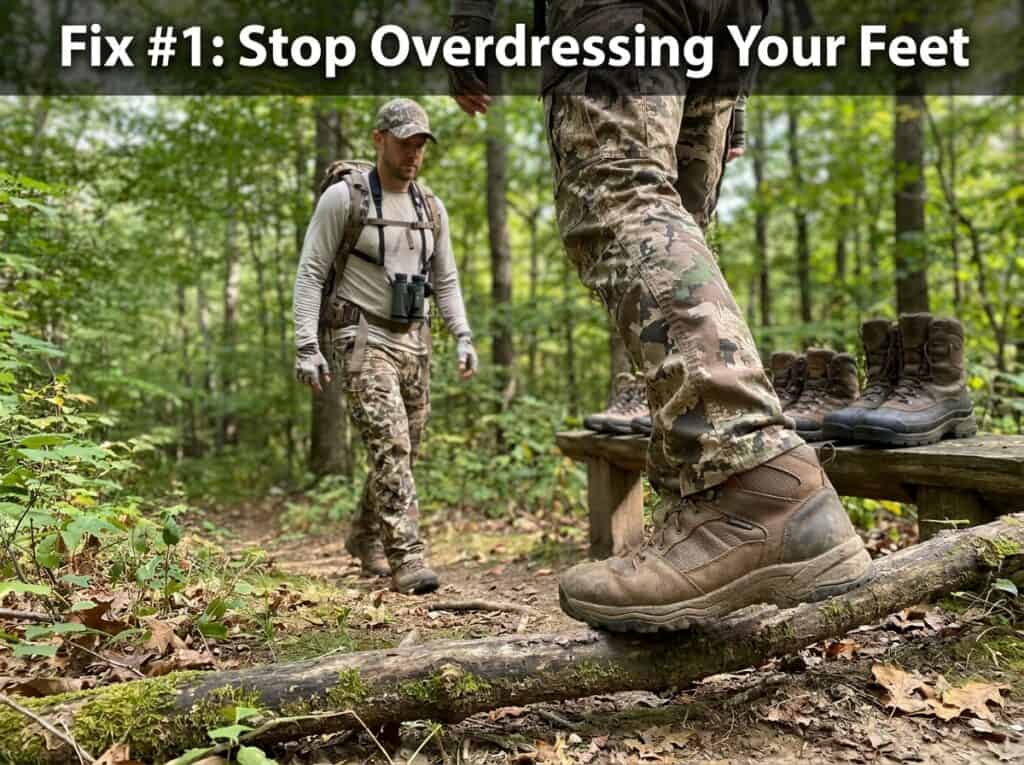
Fix #1: Stop Overdressing Your Feet
hunter walking in forest 20260918160559
Insulation needs to match your movement and stationary time, not the morning forecast on your phone.
| Hunting Situation | Better Boot Direction | Why |
|---|---|---|
| Active September elk, scouting, spot-and-stalk | Uninsulated boot | Maximizes breathability, minimizes sweat |
| Warm or humid whitetail, turkey, upland | Uninsulated waterproof boot | Handles dew and rain without excess heat |
| Cool mornings, frequent movement | 0g-200g | Light warmth without a real sweat penalty |
| Mixed walking and short stand periods | 200g | A practical middle ground |
| Long stationary sit in cold weather | 400g+ | More appropriate once movement drops off |
| Deep cold, long inactive stretches | 800g-1200g+ | Needs a real cold-weather boot system |
For the full early-season breakdown, see Best Early Season Hunting Boots. For cold, low-movement hunts, see Best Insulated Hunting Boots: 400g vs 800g vs 1200g Explained, which walks through exactly how those insulation tiers translate to real hunting conditions.
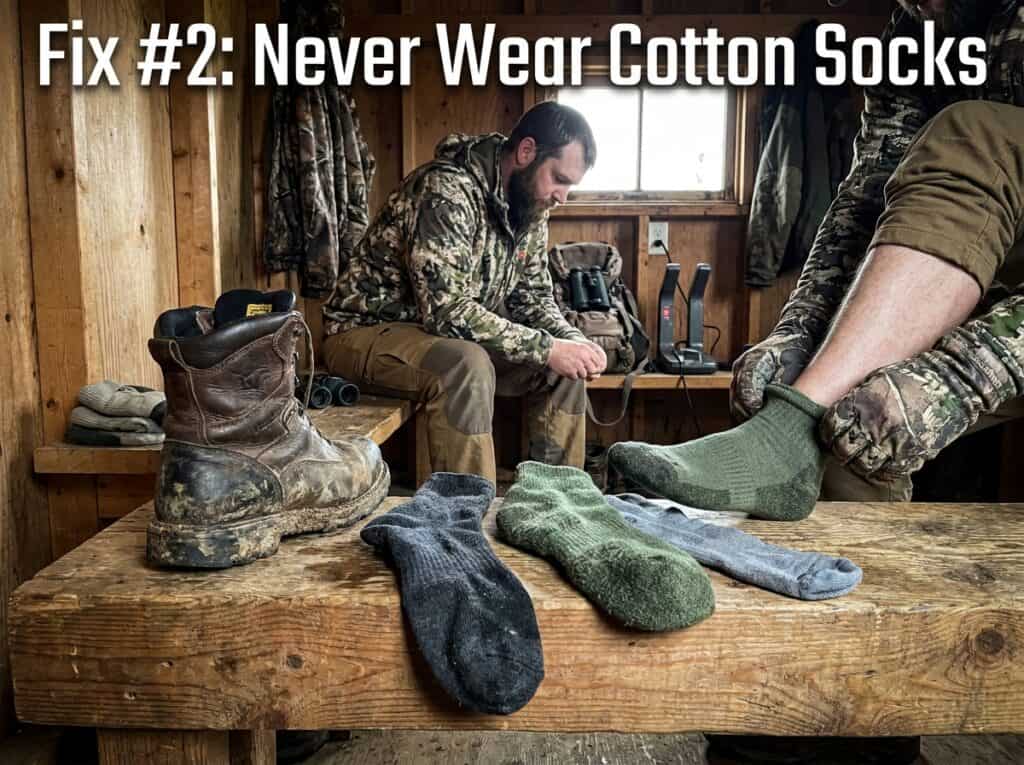
Fix #2: Never Wear Cotton Socks
hunter changing socks in cabin 20260918160624
Cotton is the worst sock fabric you can put in a hunting boot. It absorbs sweat, dries slowly, and holds that moisture right against your skin. Damp cotton increases friction and blister risk on the walk in, and once you stop moving, wet cotton is what makes your feet go cold.
| Hunt Type | Sock System | Why |
|---|---|---|
| Warm weather, active hiking | One lightweight merino or synthetic sock | Minimizes heat while still moving moisture |
| Rubber boots, humid conditions | Thin liner plus a midweight merino outer | Moves sweat off skin and gives you a dryable outer layer |
| Cool active hunts | Midweight merino sock | Balances warmth and moisture control |
| Cold stationary hunts | Liner plus a heavier merino outer, if boot volume allows | Adds warmth without relying on cotton |
| Multi-day hunts | Two to three pairs, rotated and dried | Guarantees a dry replacement when one pair soaks through |
For an everyday active-hunt sock, the Darn Tough Hiker Midweight Micro Crew covers most warm-to-cool hunts without cotton’s downsides. For cold stand hunting where you need real warmth once you stop moving, size up to something like the SmartWool Mountaineer Classic Maximum Cushion Crew, but only if your boot has the volume for it. See The Best Wool Socks for the full sock breakdown.
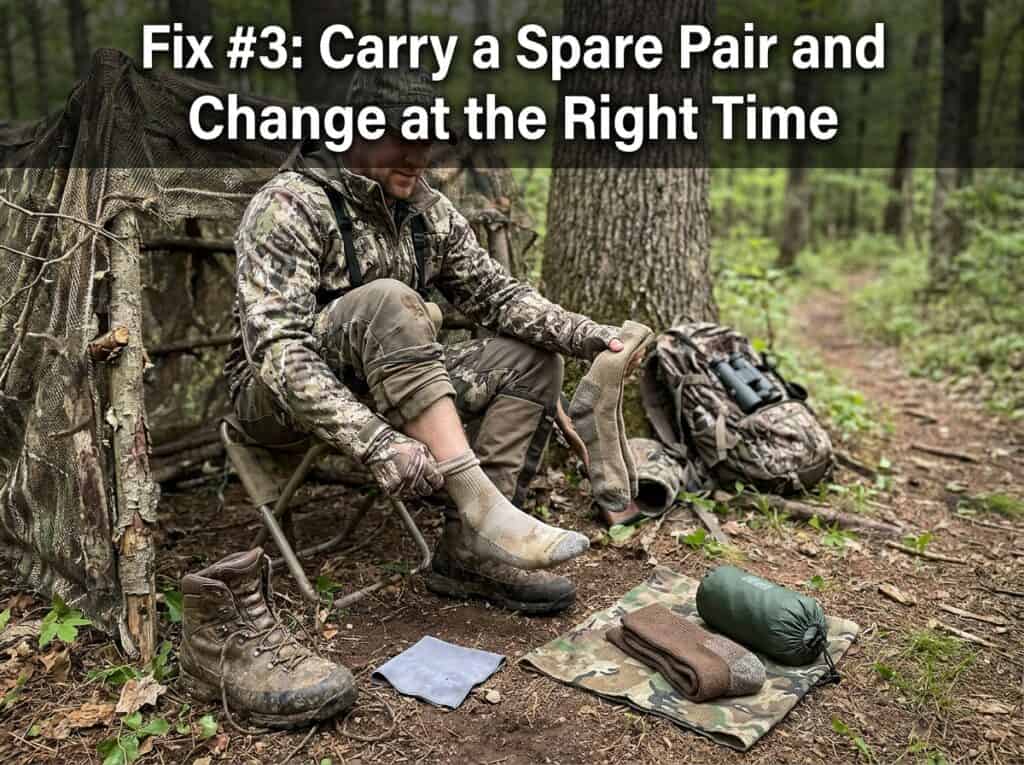
Fix #3: Carry a Spare Pair and Change at the Right Time
hunter changing socks in forest 20260918160736
This is probably the single most actionable fix in this guide, and it costs the price of a second pair of socks.
- Wear a lighter moisture-wicking sock for the hike in to your stand, blind, or glassing point.
- Once you reach your stationary spot, pull your boots off if conditions allow.
- Air your feet out and dry them briefly with a clean cloth if needed.
- Change into a dry pair of socks.
- Put your boots back on without over-tightening.
- Store the damp socks in a sealed bag, away from your dry clothing.
A dry sock change before you sit down is often more effective than another 400g of boot insulation. Keep a spare pair in something like a Sea to Summit Lightweight Dry Bag so a wet pair never touches the dry one.
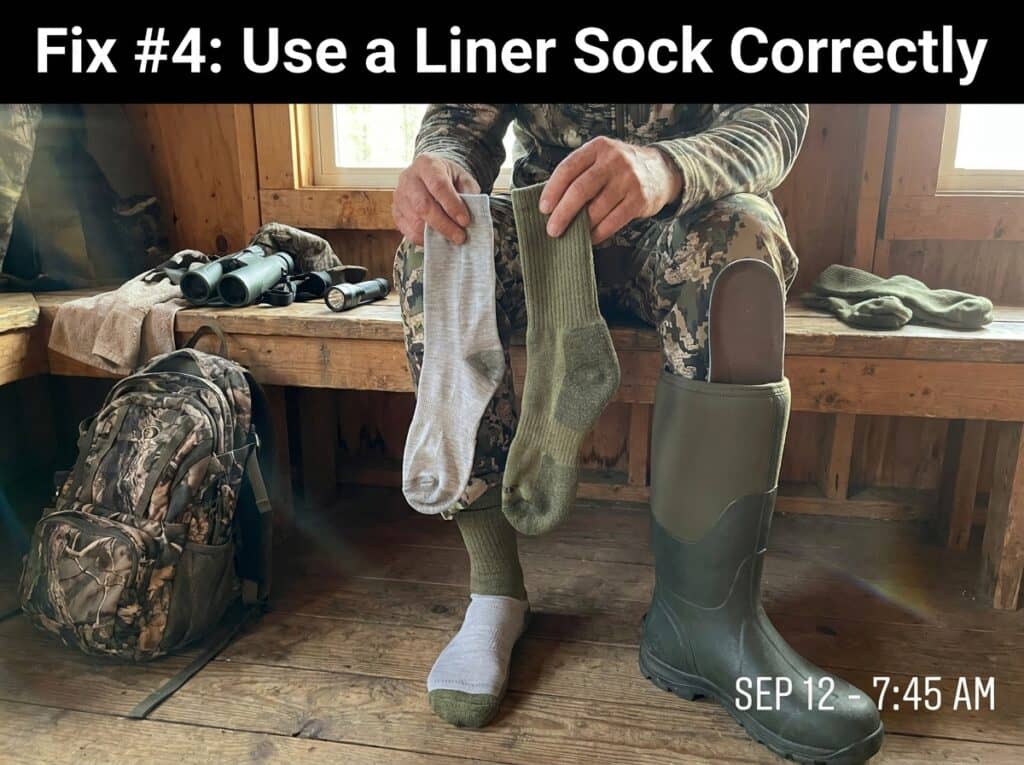
Fix #4: Use a Liner Sock Correctly
hunter preparing socks for boot 20260918160838
A liner sock isn’t mandatory for every hunter. It helps most when you’re in rubber or neoprene boots, your feet sweat heavily, you’re hiking long distances, you get frequent blisters, or you’re hunting humid early-season weather in a tall, low-ventilation boot.
It may not help, and can actually make things worse, when your boot already fits snugly, a second sock creates pressure or numbness, or you’re stacking a thick liner and thick outer sock in a boot that wasn’t sized for it. Don’t run a double-sock system if it makes the boot tight. A tight boot restricts circulation, increases friction, and makes cold feet worse, not better.
A thin liner like the Fox River Wick Dry Military Tactical Boot Sock under a midweight merino outer is a solid starting combination for rubber-boot hunts, as long as your boots have the room for it.
Fix #5: Foot Antiperspirant for Heavy Sweating
hunter applying foot antiperspir… 20260918160902
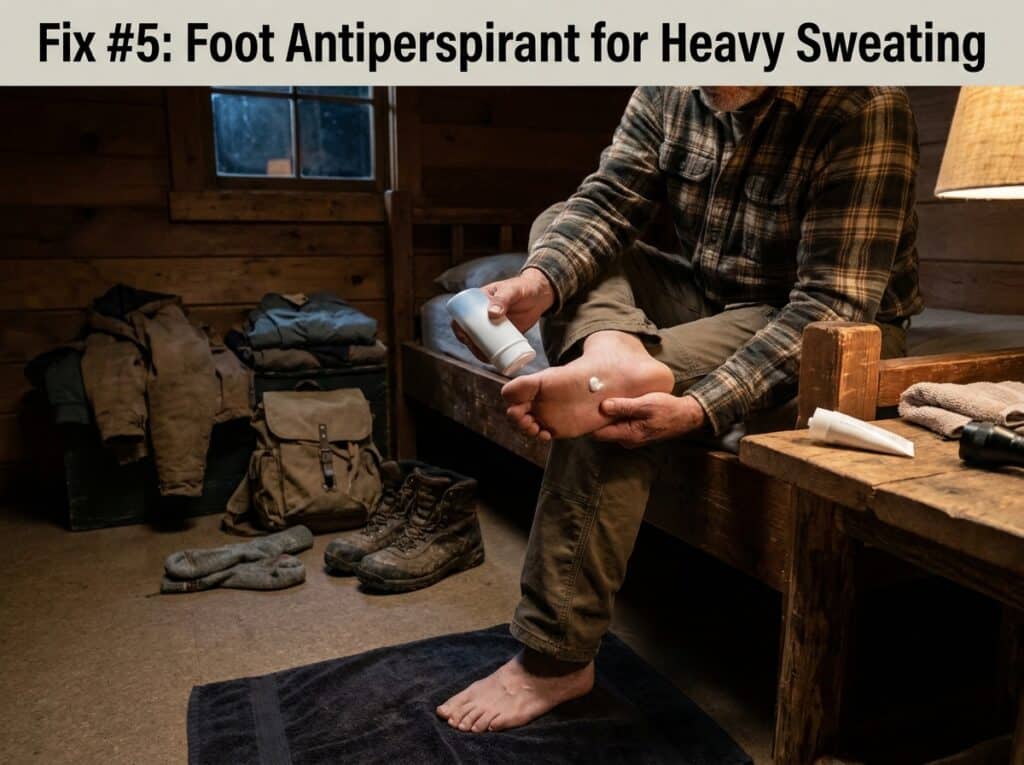
If your feet sweat heavily even in mild conditions, a foot-specific antiperspirant may reduce sweat production. It’s different from deodorant. Deodorant mainly targets odor, while antiperspirant uses active ingredients to reduce how much you actually sweat.
Application protocol:
- Apply at night to completely dry, intact skin.
- Don’t apply over cuts, cracked skin, or freshly shaved areas.
- Let it dry fully before putting on socks or getting into bed.
- Follow the product’s own instructions.
- Stop using it if you notice burning, rash, or irritation.
- See a clinician if sweating is severe, sudden, or doesn’t respond to basic measures.
Carpe Sweat Absorbing Foot Lotion is a widely used over-the-counter option built specifically for this. Apply it the way the product describes, and give it a few nights before judging whether it’s working.
Fix #6: Foot Powder, Used Right
Foot powder can absorb residual moisture and cut down on odor, but it can’t overcome a too-warm boot, wet cotton socks, or boots that never fully dry. Apply it lightly to dry feet or inside dry socks, and don’t dump a heavy layer into a boot that’s still damp. Powder is not a substitute for changing soaked socks, and if you’re dealing with persistent peeling, itching, cracking, or a rash, that’s worth a look from a pharmacist or clinician rather than masking it with more powder.
Gold Bond Medicated Foot Powder is a straightforward, widely available option for the odor and residual-moisture side of this.
Fix #7: Dry Boots and Insoles Fully
Drying routine:
- Remove the insole after every wet or sweaty hunt.
- Open the boot tongue or shaft as wide as it goes.
- Wipe visible mud or water off the outside.
- Use gentle airflow overnight, not direct heat.
- Keep boots away from a heater, wood stove, radiator, or open flame. Direct heat damages leather, adhesives, waterproof membranes, and foam.
- Make sure the interior is fully dry before the next hunt.
- Rotate two pairs of boots on multi-day trips if you have them.
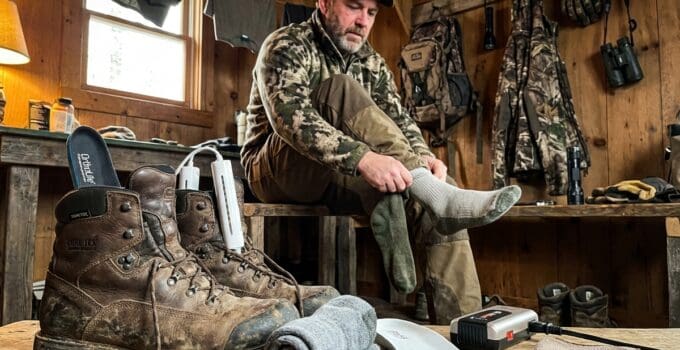
A PEET Original Portable Electric Boot & Shoe Dryer handles this with gentle, sustained airflow instead of blasting your boots with heat, which makes it a better choice than propping boots next to a heater. See Best Boot Dryers for more options.
Fix #8: Manage the Insole Separately
Insoles hold moisture long after the boot upper feels dry to the touch. Pull them out at camp or at home and let them dry on their own. Replace insoles that are permanently saturated or breaking down. A more moisture-managing aftermarket insole can help, but only if it doesn’t change your fit. Don’t add a thicker insole if it makes the boot tighter. That increases both sweating and toe pressure, which is the opposite of what you’re trying to fix.
Fix #9: Match the Boot to the Hunt
| Your Hunt | Better Footwear Direction | Guide |
|---|---|---|
| Early elk, warm spot-and-stalk | Uninsulated lace-up mountain boot | Best Early Season Hunting Boots |
| Wet early whitetail, swamp | Uninsulated rubber boot, liner socks, sock-change routine | Best Waterproof Snake Boots for Swamp Hunting |
| Cold stand hunting | More insulation, plus a dry-sock switch before sitting | Best Insulated Hunting Boots |
| Steep mountain hunting | Breathable, supportive mountain boot, not heavy rubber | Best Mountain Hunting Boots |
| Mild rain, wet grass, general hunting | Waterproof breathable-membrane boot | Best Hunting Boots |
Fix #10: Adjust Lacing and Fit
- Use a heel-lock lacing method for long descents so your foot isn’t sliding and generating extra friction and heat.
- Loosen forefoot pressure slightly if your toes go numb or hot.
- Leave enough toe-box room for normal foot swelling over a long day.
- Don’t layer thick socks in a boot that was sized for one thin sock.
- Test boot fit late in the day, wearing your actual hunting socks.
- Carry a spare lacing option in case your laces get soaked or fail in the field.
Fix #11: Sweat, Odor, or Something Medical?

hunter examining boot in cabin 20260918161026
| Issue | Likely First Response |
|---|---|
| Sweat after a hard hike | Lighter insulation, better socks, a spare sock change |
| Damp boots every morning | Dry boots and insoles completely, rotate pairs |
| Strong odor | Wash and dry socks, dry boots, use a low-scent drying routine |
| Hotspots or blisters | Fix, sock material, a friction barrier, and moisture control |
| Itching, peeling, cracking, or a persistent rash | See a pharmacist or clinician. Don’t self-diagnose. |
| Heavy sweating at rest, without exertion or heat | Consider a clinician’s advice; a foot antiperspirant may be a reasonable first step |
The Moisture-Management Kit
| Need | Product | Price |
|---|---|---|
| Active-hunt sock | Darn Tough Hiker Midweight Micro Crew | ~$26 |
| Rubber-boot liner sock | Fox River Wick Dry Military Tactical Boot Sock | ~$15 |
| Cold stand-hunt outer sock | SmartWool Mountaineer Classic Maximum Cushion Crew | ~$27 |
| Sweat reduction | Carpe Sweat Absorbing Foot Lotion | ~$16 |
| Residual moisture and odor | Gold Bond Medicated Foot Powder | ~$8 |
| Hotspot and blister prevention | Body Glide Foot Glide Anti-Blister Balm | ~$9 |
| Overnight drying | PEET Original Portable Electric Boot & Shoe Dryer | ~$50 |
| Spare dry sock storage | Sea to Summit Lightweight Dry Bag, 1.5L | ~$13 |
FAQ
Why do my feet sweat so much in hunting boots?
Hunting boots commonly combine waterproof membranes, rubber, neoprene, and insulation with limited ventilation. Heavy activity, warm weather, thick socks, a tight fit, and boots still damp from the day before all add to it.
Why do my feet get cold after sweating in hunting boots?
Sweat dampens your socks, and once you stop moving, that moisture pulls heat away from your skin faster than dry air does. Change into dry socks before you sit, and don’t wear more insulation than your activity level actually needs.
Are rubber hunting boots bad for sweaty feet?
Not necessarily, but they trap more heat than a leather or nylon boot with a waterproof membrane, since rubber has essentially no breathability. They’re the right call for swampy ground and wet whitetail access. Use an uninsulated version, moisture-wicking socks, and carry a spare pair.
What socks stop feet from sweating in hunting boots?
No sock fully stops sweating, but lightweight merino or synthetic socks manage moisture far better than cotton. In rubber boots or humid conditions, a thin liner paired with a midweight merino sock helps move that moisture away from your skin.
Should I wear two pairs of socks in hunting boots?
Only if the boot has the volume for it. A thin liner plus a merino outer can cut friction and manage moisture well, but two thick socks in a snug boot restricts circulation and adds heat instead of solving anything.
Is foot powder or antiperspirant better for sweaty feet?
They do different jobs. Antiperspirant reduces how much you sweat. Powder absorbs the moisture that’s already there and helps with odor. For heavy sweating, start with a properly applied antiperspirant, then add a light dusting of powder only if you still need it.
How do I dry sweaty hunting boots overnight?
Pull the insoles, open the boot up as wide as it goes, and use a low-heat or ambient-air boot dryer. Skip the heater, wood stove, or radiator. Direct high heat damages leather, adhesives, and waterproof membranes.
Can sweaty hunting boots cause blisters?
Yes. Damp socks soften skin and increase friction, especially on long approaches or descents. Moisture-wicking socks, a secure heel fit, mid-hunt sock changes, and an anti-friction balm on known hotspots all help.
Should I choose uninsulated boots if my feet sweat a lot?
For active early-season hunting, usually yes, that’s the better starting point. For cold, stationary hunts you’ll likely still need insulation, but pair it with a dry-sock-change routine and don’t size the boot too tight.
Final Verdict
You don’t fix sweaty hunting boots by buying warmer boots or thicker socks. You fix the whole system: the right insulation for how much you’ll actually be moving, boot construction that matches the terrain, moisture-wicking socks instead of cotton, a dry spare pair for the mid-hunt switch, fit that doesn’t fight your feet, and boots that are fully dry before the next hunt starts. Get those five things right and the sweating stops being the problem it used to be.