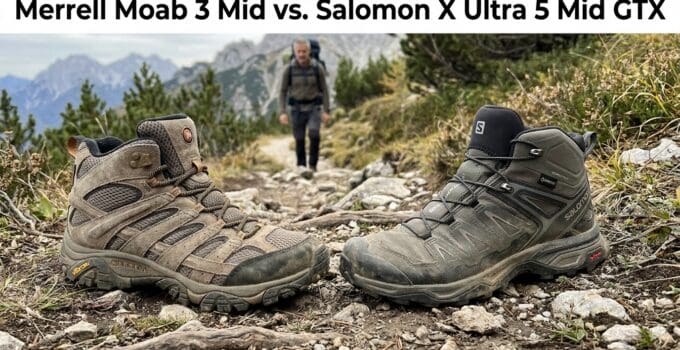

Between them, the Merrell Moab and the Salomon X Ultra line are probably the two best-selling hiking boots on the planet. Every gear site has an opinion on which one to buy, and almost none of them will tell you how much either boot actually weighs. Search for "Moab 3 vs X Ultra 5" and you'll find articles that call one boot "lighter" or "more technical" without ever putting a number next to it, and at least one popular comparison is quietly still reviewing the X Ultra 4, a full generation behind what's currently on shelves.
We pulled the real numbers instead: lab-measured weights, manufacturer spec sheets, and the actual fit mechanics that decide which of these boots works for your foot. If you already want the deep, standalone breakdown of the Moab 3 lineup (low-top vs. mid, wide-width options, non-GTX versions), our Best Merrell Hiking Boots guide covers that in full. This article stays focused on the one question that guide can't answer: Moab 3 Mid GTX or X Ultra 5 Mid GTX, head to head.
At a Glance: Moab 3 Mid GTX vs. X Ultra 5 Mid GTX
| Spec | Merrell Moab 3 Mid GTX | Salomon X Ultra 5 Mid GTX |
|---|---|---|
| Weight (per boot, verified) | 490g / ~17.3 oz | 437g / ~15.4 oz |
| Upper | Pigskin leather + mesh | PU-coated leather/textile + Matryx (Kevlar-reinforced) |
| Midsole | Super Rebound Compound + Air Cushion heel | EnergyCell EVA + advancedCHASSIS |
| Outsole | Vibram TC5+, 5mm lug | All-Terrain Contagrip |
| Waterproofing | GORE-TEX | GORE-TEX |
| Drop | 11.5mm | 11mm (mfr spec) |
| Fit | Roomy, wide-friendly last | Narrower, lower-volume last |
| Price (MSRP) | $195 | $190 |
| Best for | Comfort-first, wide feet, zero break-in | Lighter carry, technical terrain, narrow-to-average feet |
The Real Weight Numbers
Every "X Ultra 5 vs. Moab 3" article we checked says the Salomon is lighter. None of them say by how much. Merrell's own spec sheet lists the Moab 3 Mid GTX at 490 grams per boot, half-pair weight, which comes out to roughly 17.3 oz. RunRepeat's lab scale weighed a men's US9 X Ultra 5 Mid GTX at 437 grams, about 15.4 oz, a figure that lines up with Treeline's independently measured pair weight of 1 lb 15 oz.
That's a verified gap of about 1.9 oz per boot, or roughly 3.8 oz per pair. It's real, but it's not dramatic. Over a full day of hiking, that difference is closer to background noise than a decision-making factor by itself, which is exactly why the fit question below matters more than the scale does.
Fit: Roomy vs. Low-Volume
This is what actually decides it for most people, and it's the part competitor articles gesture at without explaining. The Moab 3 uses a traditionally shaped, generously volumed last. There's real room across the forefoot and through the toe box, which is why Merrell's own wide-width version of the Moab 3 is one of the few actually wide hiking boots on the market rather than a half-size-up substitute. Testers consistently report needing zero break-in time. You can put these on and hike the same day.
The X Ultra 5 is built on Salomon's performance-oriented last: narrower through the midfoot, lower-volume overall, closer in shape to a trail runner than a traditional boot. If you have average-to-narrow feet, this is usually the more locked-in, precise fit on technical ground. If you have wide feet or a high instep, it can feel tight in the same places the Moab feels roomy.
On break-in specifically, sources disagree, and we're not going to paper over that. One reviewer reports needing 10 to 15 miles before the X Ultra 5 feels fully broken in. Treeline's hands-on test found the opposite: boots that were "soft, pliant, and supportive right out of the box," good for a 6-mile hike with no adjustment period. The honest read is that this varies by foot shape and by how close your foot is to Salomon's last in the first place; if you've worn a narrow-fitting boot comfortably before, expect closer to zero break-in, and if you haven't, budget for some.
Merrell Moab 3 Mid GTX: Best for Comfort and Break-In-Free Wear
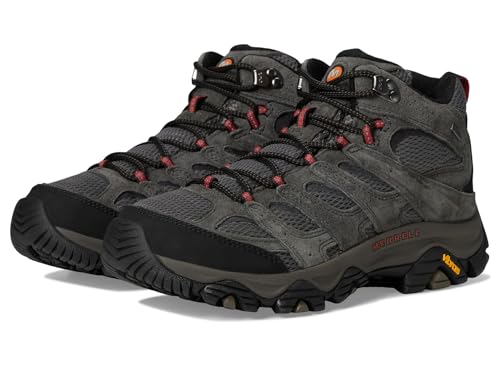
The Moab 3 Mid GTX earns its reputation the boring way: it fits a wide range of feet comfortably straight out of the box, the Vibram TC5+ outsole holds up on everything from maintained trail to loose gravel, and the GORE-TEX membrane keeps water out without the boot feeling like a sauna in mild conditions. This is the boot to reach for if you want to buy once, put it on, and start hiking the same afternoon.

It's not the lightest or the most technical option here, and the pigskin leather upper takes noticeably longer to dry than the X Ultra 5's more synthetic construction if it gets soaked through. For a deeper breakdown of the full Moab 3 lineup, including the low-top, non-GTX, and wide-width versions, see our Best Merrell Hiking Boots guide.
Not the right fit if: you have narrow feet and want a more locked-in, precise fit, or you're chasing every extra ounce for a long thru-hike.
Pros: Genuinely roomy, comfortable last; zero-break-in reputation is well-earned; proven Vibram TC5+ traction; strong value at street prices well under MSRP.
Cons: Heavier than the X Ultra 5 by a verified 1.9 oz per boot; leather upper dries slower than synthetic; less technical on steep, loose terrain than the X Ultra 5's chassis system.
Salomon X Ultra 5 Mid GTX: Best for Lighter, More Technical Terrain

The X Ultra 5 is the update to what was already one of the most popular lightweight hiking boots on the market, and the advancedCHASSIS system is the real change worth knowing about: a molded insert built into the midsole specifically for lateral support on uneven, off-camber ground, the kind of terrain where a lighter boot usually starts to feel unstable. Paired with the Matryx upper's Kevlar reinforcement, it's a boot built to stay light without giving up structure where it counts.

The trade-off is the narrower last. If your foot shape matches it, this disappears as a non-issue and you get a locked-in ride with real technical capability. If it doesn't, no amount of lacing adjustment fully solves a boot that's simply narrower through the midfoot than your foot wants.
Not the right fit if: you have wide feet or a high instep, or you specifically want a zero-break-in boot you can hike in the same day you buy it.
Pros: Verified ~1.9 oz per boot lighter than the Moab 3; advancedCHASSIS adds real lateral support most lightweight boots skip; Matryx upper is more abrasion-resistant than the standard mesh/leather combos in this weight class; dries faster than leather after a soaking.
Cons: Narrower last won't suit wide or high-volume feet; break-in experience is inconsistent depending on foot shape; costs slightly more than the Moab 3 at most retailers.
Durability and Outsole Compared
Both boots land in a similar durability range under normal use. Merrell's Moab 3 lineup is commonly rated for 500 to 800 miles before the outsole lugs round off or the midsole starts to pack out, and independent testing on the X Ultra 5 puts it in the same 500 to 800 mile window before wear shows up around the eyelets and midsole. Neither boot is built for the multi-thousand-mile durability of a full-leather backpacking boot, and neither is priced or marketed as one.
Where they differ is failure mode. The Moab 3's leather upper resists abrasion well but takes longer to dry once saturated, which matters on trips with repeated water crossings. The X Ultra 5's updated Matryx upper adds reinforcement at the side panels specifically to close the gap with heavier boots, though Salomon itself doesn't market it as being as rugged as its own heavier Quest line. On the outsole side, Vibram TC5+ and Contagrip are both proven rubber compounds; neither has a clear durability edge over the other in independent lab wear testing.
Buying Guide
Why "X Ultra 5" and Not "X Ultra 4" Matters
A lot of comparison content still circulating online, including one of the more visible "Moab 3 vs. X Ultra" articles, is actually reviewing the X Ultra 4. The two generations aren't interchangeable in this comparison. The X Ultra 5's headline change is the advancedCHASSIS system, a structural addition aimed directly at the lateral-stability weakness that lightweight boots are usually criticized for. If you're cross-shopping using an older review, you're not seeing the boot's current strongest selling point.
Pack Weight and When the Lighter Boot Stops Winning
A 1.9 oz per boot difference is real but small under a daypack. It stops being small the moment pack weight and mileage climb, and more importantly, the deciding factor at that point isn't the ounce count, it's whether your foot shape matches the narrower X Ultra last well enough to stay comfortable for hours at a stretch. A boot that's slightly heavier but fits correctly will always outperform a lighter boot that doesn't, on any trip longer than a few hours.
Wide Feet vs. Narrow Feet
This is close to the whole decision. Wide or high-volume feet should default to the Moab 3, and specifically consider Merrell's dedicated wide-width version rather than sizing up a standard pair. Narrow-to-average feet who want a more precise, performance-oriented fit should lean X Ultra 5. For a deeper breakdown of width-specific options across brands, see our guides to hiking boots for narrow feet and hiking boots for bunions and wide feet.
Frequently Asked Questions
Is the Salomon X Ultra 5 actually lighter than the Merrell Moab 3?
Yes, by a verified margin. Merrell lists the Moab 3 Mid GTX at 490g per boot; independent lab testing puts the X Ultra 5 Mid GTX at 437g per boot, a difference of about 1.9 oz per boot.
Which one runs true to size?
The Moab 3 runs true to size with a roomy fit throughout. The X Ultra 5 runs true to size in length but noticeably narrower in volume, so if you're between widths or have a wider forefoot, sizing up doesn't fully solve the fit.
Do I need to break in the X Ultra 5?
It depends on your foot shape. Testers whose feet match Salomon's narrower last report little to no break-in needed. Reviewers with wider or higher-volume feet report needing 10 to 15 miles before the boot feels fully comfortable.
Which boot is more durable?
Both land in the same 500 to 800 mile range under normal trail use before the outsole or midsole shows real wear. The Moab 3's leather upper resists abrasion well but dries slowly; the X Ultra 5's reinforced Matryx upper closes most of that gap while drying faster.
Is the Moab 3 or X Ultra 5 better for backpacking?
For loads under about 25-30 lbs, either works. The Moab 3's roomier fit tends to hold up better over consecutive long days if your feet swell, while the X Ultra 5's advancedCHASSIS gives it an edge on technical, off-camber terrain with a pack on.
What actually changed from the X Ultra 4 to the X Ultra 5?
The main structural change is the advancedCHASSIS system, a molded support insert aimed at improving lateral stability on uneven ground. The upper also moved to the Kevlar-reinforced Matryx material for better abrasion resistance. If you're reading a comparison that only mentions the X Ultra 4, it predates these changes.
Bottom Line
If you want a boot that fits comfortably out of the box, especially with wide or high-volume feet, and you're not chasing every ounce, the Merrell Moab 3 Mid GTX remains the safer, more forgiving choice. If your feet suit a narrower last and you want a measurably lighter boot with real lateral support for technical terrain, the Salomon X Ultra 5 Mid GTX is the better-engineered option, and the current generation to buy rather than the older X Ultra 4 still showing up in older comparisons.